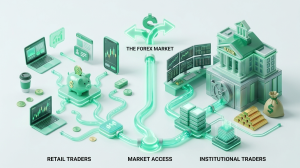


ECN and Market Maker represent the two main forex broker models, differing in how they process trades and generate revenue. ECN brokers provide direct market access and charge a commission, while Market Makers create an internal market and profit from spreads and client losses. Choosing the correct model is foundational to a trader’s success.
Choosing the right forex broker model is one of the most impactful decisions a trader can make, directly influencing trading costs, execution quality, and overall profitability. The two primary models governing the forex industry are ECN (Electronic Communication Network) and Market Maker, also known as a Dealing Desk. This article provides a definitive, in-depth comparison of these models, empowering you to make a confident choice based on your specific needs for 2026 and beyond. We will cover key differences in cost structure, trade execution, transparency, and potential conflicts of interest, topics that have attracted increasing scrutiny from regulatory bodies focused on broker transparency.
What Is an ECN Broker? The Direct Access Model

An ECN broker is a financial intermediary that uses an Electronic Communication Network (ECN) to give traders direct access to other participants in the currency markets. Operating on a Non-Dealing Desk (NDD) basis, these brokers match buy and sell orders between liquidity providers and traders without taking the opposite side of the trade.
An ECN broker provides a transparent trading environment by acting as a conduit to the interbank market. A true ECN broker’s revenue is generated from a fixed commission per trade, not from client losses. The core of this model is the Electronic Communication Network, a sophisticated system that aggregates price quotes from multiple liquidity providers, such as tier-1 banks, hedge funds, and other traders. Because the broker operates on a Non-Dealing Desk (NDD) basis, it does not create its own prices or take the other side of your position; its sole function is to facilitate the transaction. This direct market access (DMA) model means traders interact with real market conditions. Users often ask why ECN spreads are so tight; it’s because the technology finds the best available bid and ask prices from the entire liquidity pool, minimizing the difference.
The following list defines the key characteristics of a true ECN environment:
- Direct access to interbank market prices from multiple liquidity providers.
- Variable, or dynamic, spreads that can become extremely tight, often as low as 0.0 pips.
- Orders are displayed in the market’s order book, known as Depth of Market (DOM).
- Anonymity in trading, as orders are executed on the network without revealing the participant’s identity.
- Broker profits are generated primarily from a fixed, transparent commission per trade.
How ECNs Process Trades: A Step-by-Step Look
An ECN trade is processed through a high-speed, automated system that connects a trader to a pool of liquidity. This process ensures that orders are executed based on live market conditions, using industry standards like the Financial Information eXchange (FIX) protocol for electronic communication.
Here is the sequential flow of a typical ECN trade from placement to confirmation:
- Order Placement: A trader places a buy or sell order on a currency pair through the broker’s trading platform.
- Order Transmission: The order is instantly sent through the broker’s ECN bridge to the liquidity pool, which contains competing bids and offers.
- Matching: The ECN’s automated matching engine finds the best available counter-order from a liquidity provider in the network. This could be a major bank, a hedge fund, or another trader.
- Execution: The trade is executed at the best available market price at that moment. This price can sometimes be better or worse than the requested price, a phenomenon known as slippage.
- Confirmation: The executed trade details are sent back to the trader’s platform for confirmation. The broker then charges a pre-disclosed commission for facilitating this transaction.
The Core Components of the ECN Ecosystem
The ECN model functions through the interaction of several key participants and technologies. At the heart of the system are the Liquidity Providers (LPs), which are the Tier-1 banks like Goldman Sachs and Deutsche Bank, hedge funds, and other major financial institutions. These LPs provide the massive volume of buy and sell orders that create market depth. The technology that gathers all these orders is the ECN Aggregator. This software collects all bid and ask prices from the LPs and organizes them to present the best available prices, creating the tightest possible spread. The Broker serves as the essential bridge, connecting the retail trader to this ECN aggregator. Finally, The Trader is the end-user who accesses this powerful network through the broker’s platform to execute trades. A key selling point for top-tier ECN brokers is the depth and diversity of their liquidity pool, which directly contributes to better pricing and minimizes negative slippage.
What Is a Market Maker Broker? The Dealing Desk Model

A Market Maker is a type of forex broker that operates a Dealing Desk (DD) to “make a market” for its clients. This means they typically take the opposite side of a client’s trade, creating an internal market and profiting from the bid-ask spread and, in many cases, from client losses.
A Market Maker broker, also known as a Dealing Desk (DD) broker, functions as the counterparty to its clients’ trades. Market Maker brokers generate revenue from the bid-ask spread and by internalizing client trades, where a client’s loss becomes the broker’s profit. Instead of connecting traders to the broader market, they create their own internal market with their own bid and ask prices. These prices are derived from the underlying interbank market rates but are typically widened to include the broker’s profit margin. When a client places a trade, the Market Maker takes the opposite position. For example, if you buy EUR/USD, the broker sells it to you. This creates a direct conflict of interest, a topic that has prompted warnings from regulators like the Financial Conduct Authority (FCA) and Cyprus Securities and Exchange Commission (CySEC). To manage their risk, Market Makers may hedge larger positions by passing them on to their own liquidity providers, but smaller retail trades are almost always kept in-house. A common question traders ask is what the difference is between a Market Maker and an ECN broker; the primary distinction is that the Market Maker is your counterparty, while the ECN broker is a neutral intermediary.
The following list outlines the key characteristics of a Market Maker broker:
- Operates a Dealing Desk (DD) to manage order flow and risk.
- Profits from both the spread and from the net losses of its clients.
- Often offers fixed spreads, which provides cost predictability for traders.
- May issue requotes during periods of high market volatility.
- Can offer lower minimum deposit requirements, making them accessible to new traders.
How Market Makers Process Trades: The B-Book vs. A-Book
Market Makers employ two primary risk management strategies, known as the A-Book and B-Book, to process client trades. These internal systems determine whether the broker will take the risk of a trade itself or pass it on to an external liquidity provider. Industry statistics showing that a high percentage of retail traders lose money form the business case for the B-Book model.
B-Book: The B-Book is the default execution model for most Market Makers. When a client’s trade is “B-booked,” the broker internalizes the position by taking the opposite side. In this scenario, the client’s loss directly translates into the broker’s profit, and the client’s profit is the broker’s loss. The majority of trades from smaller retail accounts are processed this way, as it is the most profitable method for the broker.
A-Book: The A-Book model is used for risk management. For larger trades or for clients who are identified as consistently profitable, the broker may choose not to take the counterparty risk. Instead, the broker passes the trade directly to a liquidity provider, a process similar to Straight Through Processing (STP). In this case, the broker profits from a small markup added to the spread from the liquidity provider. Brokers use sophisticated software to automatically analyze a trader’s profile, trade size, and overall profitability to decide whether to A-book or B-book each trade.
The Inherent Conflict of Interest Explained
The fundamental conflict of interest in the B-Book Market Maker model arises from the direct financial opposition between the broker and the client. The “trader loss = broker profit” equation can create incentives for less reputable brokers to engage in practices that disadvantage the trader. These practices might include stop-loss hunting, where price spikes mysteriously trigger stop orders; asymmetric slippage, where only negative price movements are passed to the client; or frequent requotes during fast markets to prevent traders from getting favorable entries. While reputable, well-regulated Market Makers are deterred from such actions by regulatory oversight and reputational risk, the underlying conflict remains. This is in sharp contrast to the ECN model, where the broker is a neutral party that profits from trading volume, aligning its interests with the trader’s activity, not their losses. Regulatory bodies have issued fines for unfair trading practices, underscoring the reality of this risk.
ECN vs. Market Maker: A Head-to-Head Comparison for 2026
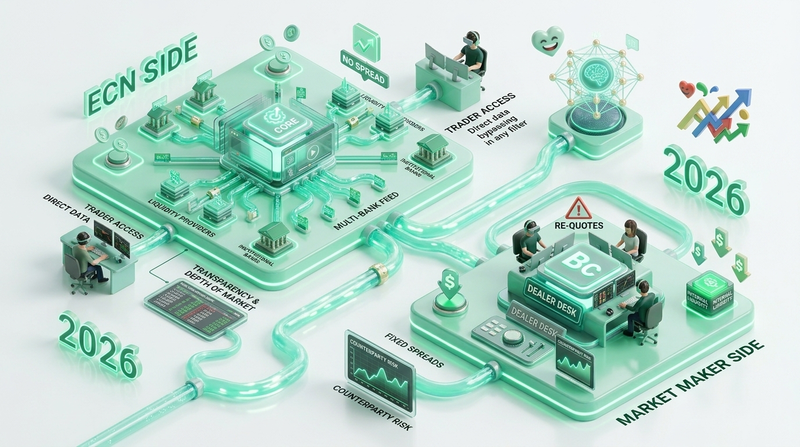
The primary difference between ECN and Market Maker brokers in 2026 lies in their execution model and revenue source. ECN brokers offer direct market access with variable spreads and a commission fee, ensuring no conflict of interest. Market Makers create their own market with fixed spreads, profiting from the spread and client losses.
To help you decide which model fits your trading strategy, it’s useful to compare them directly across several key features. For active traders, the total cost on an ECN model (spread + commission) is often lower than the spread-only cost of a Market Maker. A frequent question is how to calculate the total cost of a trade on each model. For example, trading 1 lot of EUR/USD on an ECN broker might cost a $7 commission plus a 0.1 pip spread ($1), for a total of $8. On a Market Maker with a 1.2 pip fixed spread and zero commission, the total cost is $12. This shows how ECN can be more cost-effective for active traders. Why does this cost difference exist? It’s because the ECN broker’s business is volume, while the Market Maker’s is the spread margin.
| Feature | ECN Broker | Market Maker Broker |
|---|---|---|
| Trading Desk | No Dealing Desk (NDD) | Dealing Desk (DD) |
| Spreads | Variable, very tight (from 0.0 pips) | Often Fixed, wider |
| Pricing Source | Direct Interbank Prices | Broker-Created Prices |
| Profit Model | Commission per trade | Spreads and Client Losses |
| Conflict of Interest | None (Broker is neutral) | Inherent (Broker vs. Client) |
| Execution Speed | Typically faster, market execution | Can be slower, instant or market execution |
| Slippage | Possible (both positive and negative) | Less common, but requotes are possible |
| Scalping/Hedging | Always allowed and encouraged | Sometimes restricted |
| Best For | Scalpers, high-volume traders, automated systems | Beginners, small-volume traders |
| Transparency | High (Depth of Market visible) | Low (Opaque pricing) |
Spreads and Pricing Structure
The spread and pricing structure is a defining difference between ECN and Market Maker brokers. ECN brokers offer variable, or raw spreads, because their pricing is a direct reflection of real-time supply and demand within the liquidity pool. During periods of high liquidity, such as the overlap of the London and New York trading sessions, these interbank spreads can narrow to 0.0 pips on major pairs. In contrast, Market Makers typically offer fixed spreads. They achieve this by quoting a price that is consistently wider than the underlying market rate. This creates a built-in buffer for themselves and guarantees a profit margin on every trade, regardless of the live market conditions.
Commissions and Trading Costs
The total cost of trading is calculated differently between the two models. An ECN broker’s primary revenue comes from a transparent commission, usually charged as a fixed amount per lot traded. For example, a common structure is a $7 round-turn commission per 100,000-unit lot. The all-in cost for an ECN trader is therefore the raw spread plus this commission. Market Makers often advertise “commission-free trading,” but this is a marketing term. The cost is not absent; it is simply built into the wider, fixed spread. The total cost is the spread itself. For an active trader, the combined cost of a tight spread and a small commission on an ECN account can frequently be lower than the cost of a wide, commission-free spread on a Market Maker account.
Trade Execution Speed and Slippage
ECN execution is generally faster due to the direct routing of orders and automated matching within the liquidity network. Latency is a key factor, and top ECN brokers reduce it by co-locating their servers in major financial data centers like Equinix NY4 (New York) and LD5 (London). With ECN, slippage is a natural feature of market execution in a volatile market; it can be positive (your order fills at a better price) or negative (it fills at a worse price). Market Maker execution can be “instant,” but this may come with requotes. A requote occurs when the broker declines to fill an order at the requested price and offers a new one, causing delays and potential missed opportunities. While slippage can also occur with Market Makers, less reputable ones have been known to apply asymmetric slippage, where only price movements that are unfavorable to the client are passed on. Independent studies on execution speeds consistently show ECN and STP models performing in the sub-100 millisecond (ms) range.
Hybrid Models: The Best of Both Worlds?

Hybrid broker models combine Dealing Desk (B-Book) and No Dealing Desk (A-Book/STP/ECN) execution methods. These brokers typically use a Dealing Desk for smaller, novice accounts and route larger or professional client orders directly to liquidity providers, allowing them to cater to a wider range of traders while managing risk.
The hybrid broker model is an increasingly common structure that blends elements of both ECN and Market Maker operations. Many brokers that advertise STP or ECN execution actually operate a hybrid model, as disclosed in their Order Execution Policy documents. A broker using this model will often segment its client base. For smaller retail accounts, they may act as a Market Maker, internalizing trades on their B-Book. For professional clients, high-volume traders, or accounts identified as consistently profitable, they will switch to an A-Book model. In this A-Book model, they use Straight Through Processing (STP) to pass orders directly to their liquidity providers. Why do brokers use a hybrid model? It allows them to maximize profitability from the mass retail market while mitigating the risk posed by skilled traders. A key distinction to understand is between ECN and STP. While all ECN brokers use STP, not all STP brokers offer true ECN access. STP simply means the order is passed on, but it might be to a single liquidity provider without the order book transparency of an ECN. A broker’s regulatory disclosure, such as its Order Execution Policy, can often reveal if it operates a hybrid model.
How to Choose the Right Broker for Your Trading Style

To choose the right broker, match the broker’s model to your trading strategy and priorities. ECN brokers are ideal for active traders, scalpers, and those using automated systems who need tight spreads and fast execution. Market Makers are often more suitable for beginners and long-term traders who value simplicity and fixed costs.
Making the right choice between an ECN and a Market Maker broker is not about which one is universally superior, but which one aligns with your personal trading style, experience level, and financial goals. The “best” broker model is subjective; the optimal choice depends entirely on the trader’s strategy, capital, and risk tolerance. A beginner trader asking how to start with a small account might find a Market Maker more accessible, while an experienced scalper asking how to reduce trading costs would benefit from an ECN model. The following scenarios provide a practical decision-making framework to guide your choice.
When to Choose an ECN Broker
An ECN broker is the superior choice under specific circumstances where speed, cost, and transparency are the highest priorities.
You should choose an ECN broker if you fit one or more of the following profiles:
- You are a scalper or day trader who executes many trades and requires the tightest possible spreads to be profitable.
- You are a high-volume trader where savings from narrow spreads outweigh the fixed commission costs.
- You use Expert Advisors (EAs) or other automated strategies that depend on precise entry/exit points and cannot tolerate requotes.
- Transparency and the complete avoidance of conflicts of interest are your primary concerns.
- You have sufficient starting capital to meet potentially higher minimum deposits and comfortably cover commission fees on each trade.
When a Market Maker Might Be Suitable
A Market Maker can be a suitable option for traders with different needs, particularly those who are new to the markets or who trade less frequently.
A Market Maker broker might be a good fit for you in these situations:
- You are a beginner who values simplicity, the cost predictability of fixed spreads, and lower minimum deposit requirements.
- You are a swing or position trader holding trades for days or weeks, where a slightly wider spread has a minimal impact on your overall profit.
- You trade with very small amounts (micro-lots), where a fixed commission per trade from an ECN broker would be disproportionately high.
- You prioritize a guaranteed fill at a specific price, even if it means experiencing requotes, over the possibility of negative slippage in volatile markets.
The Future of Brokerage Models: Trends to Watch in 2026 and Beyond
The future of brokerage models in 2026 is trending toward increased transparency, technological integration, and a blurring of lines between models. Regulatory pressure is forcing more clarity in execution, while AI is optimizing speed and risk management. Hybrid models are becoming the standard, offering tiered services to different client types.
The forex brokerage industry is continuously shaped by technology and regulation. Looking ahead to 2026, several key trends are set to define the landscape. Regulatory frameworks like MiFID II in Europe are forcing all broker types to provide detailed reports on order execution quality, increasing transparency industry-wide. One of the biggest drivers is the push for Increased Transparency. Regulations such as MiFID II require brokers to be far more open about how and where they execute trades, reducing the opacity of some Market Maker and hybrid models. We are also in a Technological Arms Race, where AI and machine learning are being used to optimize ECN price aggregation for faster execution and to refine risk management algorithms for Market Makers. This leads to the Blurring of Lines, where more brokers will adopt hybrid structures, offering premium ECN-like accounts to attract sophisticated traders while retaining the profitable Market Maker model for entry-level clients. A new influence is the Rise of DeFi, as decentralized exchanges (DEXs) in the crypto space introduce a model of complete on-chain transparency that could inspire future innovations in forex brokerage technology. Both Bloomberg and Reuters have reported extensively on the impact of FinTech and AI on financial markets.
Now that we’ve covered the core mechanics, comparisons, and future outlook of ECN and Market Maker brokers, let’s address some of the most common questions traders have about these models to further clarify your understanding.
Frequently Asked Questions About ECN and Market Maker Brokers
Are ECN Brokers Always Better Than Market Makers?
No, ECN brokers are not always better than Market Makers. The term “better” is subjective and depends entirely on the trader’s individual needs and strategy. An ECN broker is superior for active, experienced traders who prioritize fast execution, low spreads, and transparency. However, a well-regulated Market Maker can be a better choice for beginners due to its simplicity, predictable fixed costs, and lower financial barrier to entry.
What Is Slippage in Forex Trading?
Slippage is the difference between the expected price of a trade and the price at which the trade is actually executed. It is a natural market phenomenon caused by high volatility or a delay between when an order is placed and when it is filled. In a fair ECN environment, slippage can be positive (you get a better price), negative (you get a worse price), or zero. With some unscrupulous brokers, slippage can be asymmetric, meaning only negative slippage is passed on to the client.
What Are the Different Types of Forex Broker Models?
The main forex broker models can be grouped into two primary categories, which are further broken down.
- Dealing Desk (DD): This is the Market Maker model, where the broker creates the market and is the counterparty to trades.
- No Dealing Desk (NDD): This category includes several execution types that pass orders to external liquidity sources.
- STP (Straight Through Processing): Routes client orders directly to one or more liquidity providers.
- ECN (Electronic Communication Network): Routes client orders to an interconnected network where they can interact with orders from all participants.
- Hybrid Model: A combination of DD (B-Book) and NDD (A-Book) execution.
ECN vs. STP: What’s the Main Difference?
The main difference is that a true ECN provides market depth and transparency, while STP does not necessarily. Both are No Dealing Desk (NDD) models that route orders to liquidity providers. However, an ECN broker connects your order to a central network (like the one supported by the FIX Trading Community) where it interacts with all other orders in an order book, allowing you to see the Depth of Market. An STP broker simply passes your order to one of its liquidity providers, but you typically cannot see the underlying order book. In short, all ECN brokers are fundamentally STP, but not all STP brokers offer the full transparency and market integration of a true ECN.