


Forex currency pairs are the fundamental assets traded in the foreign exchange market. They are categorized into three groups: Majors, Minors, and Exotics. Understanding these distinctions is the first step for anyone looking to build a sound trading strategy and manage risk effectively in the global currency market.
The foreign exchange market is the largest financial market in the world, with a daily turnover of 7.5 trillion USD, according to the 2022 Bank for International Settlements (BIS) Triennial Central Bank Survey. At its core are currency pairs, the instruments you trade. This guide provides a definitive explanation of the three primary categories—Major, Minor, and Exotic—and offers a clear framework for navigating them effectively as we look toward the economic conditions of 2026. Grasping these categories is foundational to constructing a successful trading plan.
Understanding the Core Concepts of Forex Currency Pairs

A forex currency pair is the quotation of two different currencies, with the value of one currency being quoted against the other. The first listed currency is the base currency, while the second is the quote currency. This structure forms the basis of every transaction in the forex market, where you are always buying one currency while selling another.
This section establishes the foundational knowledge required before analyzing specific pair categories. Trading a currency pair means you are simultaneously purchasing one currency and selling another. You can think of this like exchanging money for a vacation; you sell your home currency to buy the currency of the country you are visiting. In forex, you speculate on the direction of this exchange rate.
What Is a Base and Quote Currency?
The base currency is the first currency appearing in a forex pair quotation, and the quote currency, or counter currency, is the second. The exchange rate tells you how much of the quote currency is needed to purchase one unit of the base currency. This structure is universal across all forex pairs. The US Dollar is involved in approximately 88% of all global forex transactions, making it the world’s primary reserve currency.
For example, consider the most traded currency pair in the world, the EUR/USD.
In this pair, EUR is the base currency and USD is the quote currency.
If the price is quoted at 1.0800, it means that 1 Euro is worth 1.0800 US dollars.
When you place a ‘buy’ order on EUR/USD, you are buying the base currency (EUR) and selling the quote currency (USD). You do this if you believe the Euro will strengthen against the US Dollar. Conversely, if you place a ‘sell’ order, you are selling the Euro because you anticipate it will weaken against the US Dollar.
How to Read a Forex Quote: Bid, Ask and Spread
A forex quote always includes two prices: the bid and the ask, and the difference between them is the spread. The bid is the price at which your broker will buy the base currency from you, while the ask is the price at which they will sell it to you. The spread is a direct transaction cost.
Understanding these three components is necessary for executing trades and calculating costs. These elements are:
- Bid Price: The price at which you can sell the base currency. It is the first number in the quote.
- Ask Price: The price at which you can buy the base currency. It is the second number in the quote and is always slightly higher than the bid price.
- Spread: The difference between the bid and ask price. This represents the broker’s fee for facilitating the trade.
For example, you might see a quote for EUR/USD as 1.0800/1.0801. Here, the bid price is 1.0800, and the ask price is 1.0801. The spread is 0.0001, or 1 pip. Traders prefer pairs with lower, or tighter, spreads because it reduces their overall transaction costs.
The Major Currency Pairs: The Pillars of the Forex Market

The Major currency pairs are the most traded pairs in the forex market, all of which include the U.S. dollar on one side. Their popularity stems from their extremely high liquidity and low transaction costs (spreads), which are a direct result of their massive trading volume. These pairs represent the world’s largest and most stable economies.
The Majors are considered the pillars of the forex market because they account for the vast majority of all trading activity. All seven Major pairs feature the US Dollar (USD) paired with another powerful currency, reflecting the USD’s status as the globe’s primary reserve currency. The key characteristics that attract traders are their high liquidity, consistently low spreads, and the extensive amount of economic analysis and news coverage available for them. The high trading volume ensures that you can typically enter and exit positions with minimal price slippage.
Defining the Major Pairs and Their Significance in 2026
The major currencies are the official money of large, stable, and influential economies, and their value is managed by globally respected central banks. The eight major currencies are the US Dollar (USD), Euro (EUR), Japanese Yen (JPY), British Pound (GBP), Swiss Franc (CHF), Canadian Dollar (CAD), Australian Dollar (AUD), and New Zealand Dollar (NZD). Looking ahead to 2026, traders must monitor the evolving monetary policies from their respective central banks. For example, the Federal Reserve’s actions on interest rates directly impact the USD, while the European Central Bank’s (ECB) response to Eurozone economic integration and energy security influences the EUR. Likewise, the Bank of Japan’s potential shift from its long-standing low-interest-rate policy and post-Brexit trade dynamics for the UK will introduce distinct volatility, a trend confirmed by forward-looking analyses from sources like the International Monetary Fund (IMF) Economic Outlook.
A Detailed Look at the Seven Major Pairs
The seven major currency pairs each have unique characteristics driven by the economies they represent. The following table provides a breakdown of these pairs, including their common nicknames and primary economic drivers.
| Pair (Nickname) | Currencies | Key Economic Drivers | Typical Volatility |
|---|---|---|---|
| EUR/USD (Fiber) | Euro / US Dollar | ECB & Fed monetary policy, EU/US GDP growth, inflation data (CPI). | Medium |
| USD/JPY (Gopher) | US Dollar / Japanese Yen | Fed & Bank of Japan (BoJ) policy, risk sentiment, US Treasury yields. | Medium |
| GBP/USD (Cable) | British Pound / US Dollar | Bank of England (BoE) & Fed policy, UK economic data, political news. | Medium to High |
| USD/CHF (Swissy) | US Dollar / Swiss Franc | Swiss National Bank (SNB) policy, safe-haven flows, global risk sentiment. | Low to Medium |
| AUD/USD (Aussie) | Australian Dollar / US Dollar | Reserve Bank of Australia (RBA) policy, commodity prices (iron ore, coal), China’s economic data. | Medium |
| USD/CAD (Loonie) | US Dollar / Canadian Dollar | Bank of Canada (BoC) policy, crude oil prices, US-Canada trade relations. | Medium |
| NZD/USD (Kiwi) | New Zealand Dollar / US Dollar | Reserve Bank of New Zealand (RBNZ) policy, dairy prices, global trade sentiment. | Medium |
Exploring the Minor Currency Pairs or Cross-Currency Pairs
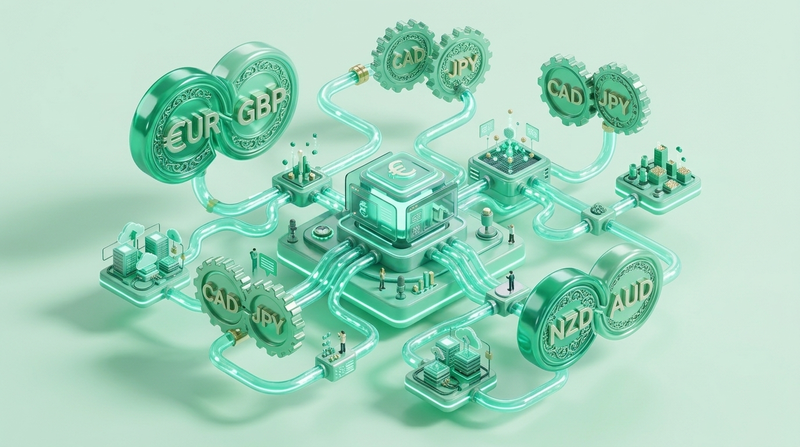
Minor currency pairs, also known as cross-currency pairs, are pairs that feature two major currencies but do not include the US Dollar. These pairs offer good liquidity and present unique trading opportunities independent of USD market movements. Minor pairs, also known as cross-currency pairs, allow traders to speculate on the relative strength of two major economies without direct exposure to the US Dollar.
The term “cross” originates from a time when, to exchange two non-USD currencies, a trader first had to convert the initial currency to US dollars and then convert the USD to the desired second currency. Direct cross-currency pairs eliminate this middle step. While they are generally very liquid, their trading volumes are lower than the majors. This results in slightly wider spreads, which is an important consideration for transaction costs.
Popular Minor Crosses: EUR/JPY, GBP/JPY, and EUR/GBP
Certain minor pairs are highly popular due to their volatility and correlation with global economic sentiment. Here are three of the most traded minor crosses:
- EUR/JPY: This pair is often viewed as a key barometer of global risk sentiment. When investors are optimistic, they may sell the safe-haven Japanese Yen (JPY) to buy the Euro (EUR), causing EUR/JPY to rise. It effectively combines the economic health of the Eurozone with Japan’s status as a funding currency.
- GBP/JPY: Nicknamed “The Dragon” or “Geppy,” this pair is famous for its high volatility. Its large average daily range offers significant profit potential but also comes with elevated risk. The price movements are a product of both UK and Japanese economic factors, often amplified.
- EUR/GBP: This pair directly reflects the economic and political relationship between the Eurozone and the United Kingdom. It is heavily influenced by post-Brexit trade agreements, financial flows between the UK and EU, and the relative monetary policies of the Bank of England and the European Central Bank.
Trading Opportunities and Risks with Minor Pairs
Trading minor pairs offers distinct advantages but also comes with specific risks that require careful management. A primary opportunity is the carry trade, which involves borrowing a low-interest-rate currency to fund the purchase of a high-interest-rate currency. Here are the key opportunities and risks:
- Opportunity: Unique Market Movements. Minor pairs can establish strong, clean trends when their two-component currencies are moving in opposite directions against the US dollar (e.g., one strengthening while the other weakens).
- Opportunity: Carry Trade. Pairs with a significant interest rate differential, such as buying a currency with a high rate and selling one with a low rate like the JPY, can generate profit from the interest paid daily.
- Risk: Lower Liquidity. Spreads on minor pairs are wider than on majors, which increases transaction costs. This is particularly true during off-peak market hours or times of low activity.
- Risk: Higher Volatility. Certain crosses, especially those involving the GBP, can experience rapid and substantial price swings. This requires stricter risk management, including the potential for wider stop-loss orders.
- USD/MXN (US Dollar / Mexican Peso): Highly influenced by US-Mexico trade policies, oil prices, and monetary policy from Mexico’s central bank, Banxico.
- EUR/TRY (Euro / Turkish Lira): Extremely sensitive to Turkey’s unconventional monetary policy decisions, high inflation rates, and regional geopolitical tensions.
- USD/ZAR (US Dollar / South African Rand): Driven by the prices of key commodities like gold and platinum, as well as South Africa’s domestic political and economic stability challenges.
- USD/SGD (US Dollar / Singapore Dollar): This pair reflects Singapore’s position as a global financial hub, its heavy reliance on international trade, and the monetary policy of the Monetary Authority of Singapore (MAS).
- Scalpers: Traders who execute dozens or hundreds of trades per day to profit from very small price movements should focus exclusively on Major pairs. The extremely tight spreads on pairs like EUR/USD and USD/JPY are necessary for this high-frequency strategy to be profitable.
- Day Traders: Those who open and close positions within a single trading day can trade Majors and the most liquid Minor pairs, such as EUR/JPY or EUR/GBP. They require sufficient daily volatility to find profitable opportunities but still need relatively low spreads.
- Swing Traders and Position Traders: Traders who hold positions for several days, weeks, or even months can trade across all three categories. Because their profit targets are much larger, the wider spreads on Minor and Exotic pairs have a smaller proportional impact on their overall return. This style allows them to capitalize on long-term economic trends.
- What Is a Currency Nickname in Forex?
- Currency nicknames are slang terms used by traders for brevity and to foster a sense of community culture within the market. Examples include “Cable” for GBP/USD, “Fiber” for EUR/USD, and “Loonie” for USD/CAD. These names often have historical or cultural origins and make communication faster on a trading floor or in analysis.
- Is It Possible to Only Trade Major Currency Pairs?
- Yes, and it is highly recommended for beginners. Many professional traders build their entire careers by focusing exclusively on a few major pairs. Their high liquidity, low costs, predictability, and abundant available information make them an ideal environment for developing and executing a trading strategy without the added risks of less liquid pairs.
- Which Currency Pairs Are Considered the Most Volatile?
- The most volatile pairs are typically minor crosses involving the British Pound, such as GBP/JPY and GBP/AUD, and almost all exotic pairs, like EUR/TRY or USD/BRL. This volatility is driven by a combination of economic factors, lower liquidity, and, in the case of exotics, heightened political and financial instability.
- What Is the Main Difference Between a Minor Pair and an Exotic Pair?
- The main difference is their composition and liquidity. A minor pair consists of two major currencies (but not the USD) and offers good liquidity. An exotic pair consists of one major currency and one currency from an emerging economy, which results in low liquidity, wide spreads, and high risk.
ol>
Navigating the World of Exotic Currency Pairs

Exotic currency pairs consist of one major currency paired with the currency of an emerging or smaller, yet still robust, economy. These pairs are defined by their low liquidity, very wide spreads, and high volatility, making them suitable only for experienced traders. Exotic pairs carry significant geopolitical and economic risk, making them suitable only for experienced traders with a deep understanding of the specific emerging market involved.
Trading exotic pairs is a high-risk activity. The currencies of emerging economies like Mexico, Turkey, or South Africa are much more susceptible to shifts in political stability and economic policy. This environment creates sharp, unpredictable price movements. Because of the lower trading volume, spreads can be exceptionally wide, making short-term trading strategies impractical. These pairs should only be approached by well-capitalized traders who have conducted extensive research on the specific country’s economic and political landscape.
Examples of Exotic Pairs and Their Associated Economies
Exotic pairs are directly tied to the economic health, political stability, and commodity exports of the emerging nation involved. Here are some prominent examples:
Why Volatility and Spreads Are Higher in Exotic Pairs
The high volatility and wide spreads in exotic pairs are a direct result of market structure and economic fundamentals. Volatility is elevated because emerging economies are more vulnerable to sudden changes in investor sentiment, political instability, and abrupt shifts in economic policy. A single negative news event or unexpected data release can cause dramatic price swings that are far more pronounced than in major currencies.
Spreads are wider due to a lack of market depth and liquidity. With fewer buyers and sellers at any given time, brokers face greater risk when facilitating trades. To compensate for this risk and the difficulty of matching orders, they charge a much wider bid-ask spread. For example, a spread on EUR/USD might be 1-2 pips, whereas the spread on a pair like EUR/TRY could be 50-100 pips or more, significantly increasing the cost of trading.
How to Choose the Right Currency Pair for Your Trading Strategy in 2026
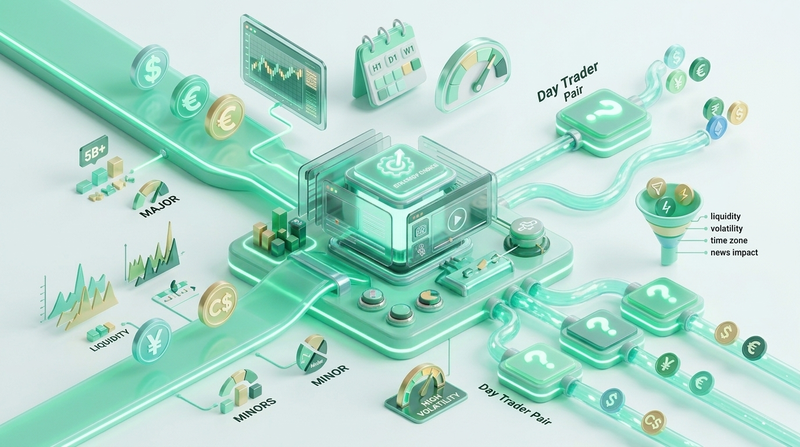
Selecting the right currency pair involves matching the pair’s characteristics, such as its volatility and liquidity, to your personal trading style, risk tolerance, and available time for analysis. The optimal currency pair for a trader is determined by their individual strategy, risk tolerance, and trading timeframe, not by a universal standard. No single pair is best for everyone; the right choice is a personal one.
This section provides a practical framework for applying your knowledge. The ideal pair for you depends on your personality and trading plan. Are you comfortable with high risk for potentially high rewards, or do you prefer stability and predictability? As you make your choice, consider three key factors: your trading style, the pair’s volatility and liquidity profile, and your ability to conduct fundamental analysis. For the 2026 market, it is also important to monitor the impact of evolving global supply chains, persistent inflation trends, and the potential introduction of Central Bank Digital Currencies (CBDCs), which could alter volatility patterns.
Aligning Pairs with Your Trading Style: Scalping, Day Trading, or Swing Trading
Your trading timeframe is a primary determinant of which currency pairs are most suitable for your strategy. Different styles have different requirements for volatility and transaction costs.
Mastering Risk Management Across Major, Minor, and Exotic Pairs
Effective risk management must be adapted to the specific characteristics of the currency pair you are trading. A non-negotiable rule in trading is to never risk more than 1-2% of your account capital on a single trade, regardless of the currency pair. This principle is your primary defense against significant losses.
Risk management is not a one-size-fits-all discipline; it must be tailored. For Majors, the main risk comes from unexpected economic data releases, which can be managed with standard stop-loss orders. For Minors, the higher volatility means you may need to use wider stop-loss orders and reduce your position size to keep your monetary risk consistent. When trading Exotics, you face extreme volatility and the risk of ‘gapping,’ where the market price jumps past your stop-loss. This demands much smaller position sizes and an absolute commitment to using a stop-loss on every trade.
Transitioning from Theory to Practice: Your Questions Answered
Now that we have covered the theory behind major, minor, and exotic pairs and the strategies for trading them, let’s address some of the most common questions traders have. This section provides quick, clear answers to help solidify your understanding and prepare you for practical application.
Frequently Asked Questions (FAQs) About Forex Currency Pairs
Conclusion: Building Your Forex Trading Portfolio with the Right Mix of Pairs for 2026
Understanding the distinct characteristics of Major, Minor, and Exotic currency pairs is fundamental to developing a robust trading strategy and managing risk. The key takeaway is that each category serves a different purpose and is suited to different types of traders. For a successful journey in the forex market in 2026, your choice of pairs must align with your personal risk appetite, trading style, and level of experience.
As a final recommendation, beginners should start their journey with Major pairs to build confidence and learn market dynamics in a stable environment. Intermediate traders can then cautiously explore the opportunities in Minor pairs. Exotic pairs should remain the exclusive domain of experienced, well-capitalized experts. The foundation of long-term success is a well-informed selection of instruments. To put this knowledge into practice, start with a demo account to identify and trade these different pairs without financial risk.