
Forex leverage is borrowed capital provided by a broker that allows traders to control a market position of a much greater value than their own account funds. This financial tool amplifies the potential for both profits and losses. Understanding its mechanics and inherent risks is fundamental for any currency trader.
What Is Forex Leverage: A Powerful Tool for Traders in 2026
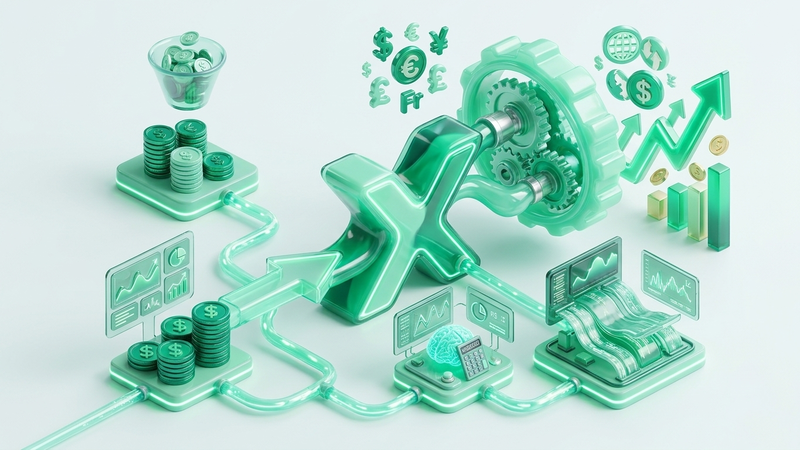
Forex leverage is a financial tool that enables traders to open positions larger than their own capital would otherwise permit by using borrowed funds from a broker. It functions as a double-edged sword, magnifying the size of potential profits from small price movements but also amplifying the scale of potential losses. Think of it like using a physical lever to lift a heavy object; a small amount of force can move a much larger weight. In trading, your capital is the force, and leverage is the lever.
This financial instrument is a standard feature in the foreign exchange market, but its availability is regulated differently across the globe. Forex leverage is expressed as a ratio, such as 50:1, which means a trader can control $50 of a currency for every $1 of their own capital. As we look at the trading environment in 2026, regulatory bodies continue to adjust these ratios to protect retail investors from excessive risk, making a deep understanding of this tool more important than ever.
The Core Mechanics: How Forex Leverage Actually Works

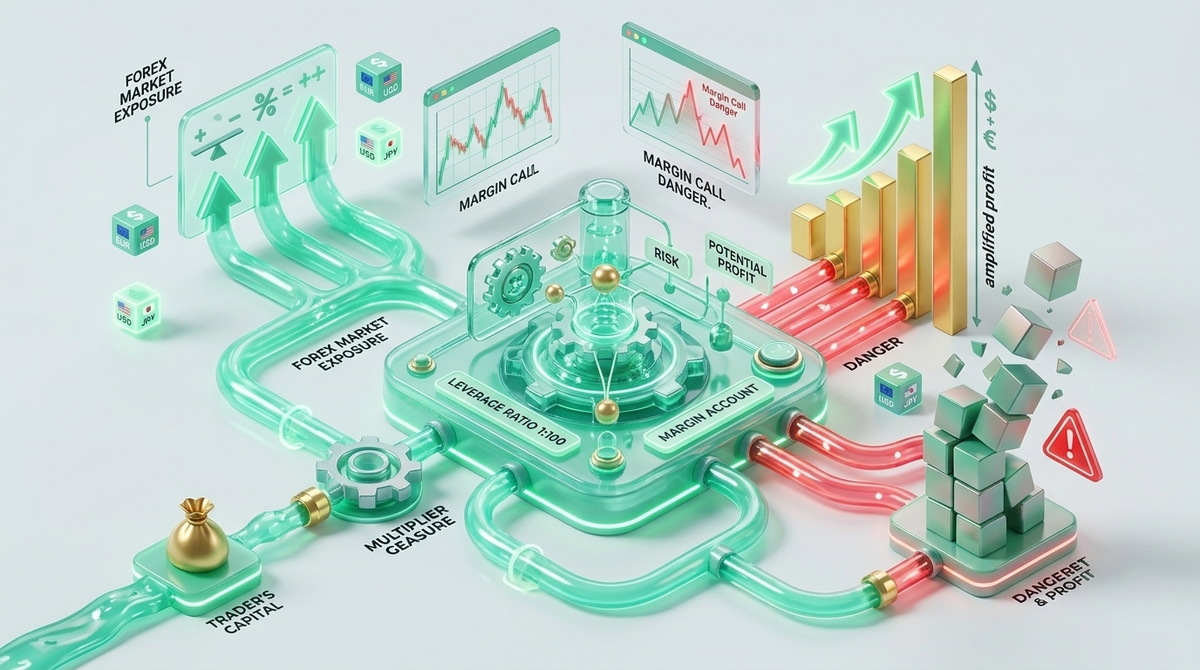
Forex leverage works by using a small deposit of your own money, called margin, as collateral to control a much larger position in the currency market. The broker provides the remaining funds for the trade. For example, with 100:1 leverage, a $1,000 margin from your account allows you to control a $100,000 currency position. This mechanism allows traders to participate in markets that would otherwise require substantial capital. The profit or loss from the trade is calculated on the full $100,000 position, not just the $1,000 margin.
A trader’s ability to use this tool is directly tied to the concepts of margin and the notional value of a trade. The notional value of a trade is the total value of the position controlled, calculated by multiplying the contract size by the current price of the currency pair. The margin is the portion of your account balance set aside to open and maintain that leveraged position. Answering the question of “How is leverage calculated in forex?” involves understanding this relationship: the leverage ratio determines how much margin is required for a given trade size. Both BabyPips.com and Investopedia provide foundational materials on this topic, confirming these core mechanics.
Understanding the Broker’s Role: The Source of Leveraged Funds
The broker provides the loan that constitutes the leveraged portion of your trade. When you open a leveraged position, your own funds—the required margin—act as a good-faith deposit, or collateral, for this short-term loan. The broker is not giving you this money to withdraw; it only exists to allow you to control a larger contract size on their trading platform.
Brokers offer this facility because it encourages higher trading volume from retail investor accounts. A brokerage firm generates revenue primarily through the spread, which is the small difference between the buy and sell price of a currency pair. By enabling traders to open larger positions, brokers increase the total volume traded, which in turn increases their revenue from these spreads.
Calculating Leverage, Margin, and Potential Exposure
The required margin for a trade is calculated by dividing the total value of your position by the leverage ratio. The formula for the notional value is the position size (in units) multiplied by the current price of the asset. The formula for the required margin is the notional value divided by the first number in the leverage ratio.
Consider this calculation example:
- Account Balance: $2,000
- Leverage Ratio: 100:1
- Trade: 1 standard lot (100,000 units) of EUR/USD
- Current EUR/USD Price: 1.0800
First, calculate the notional value of the position: 100,000 units * $1.0800 = $108,000. Next, calculate the required margin: $108,000 / 100 = $1,080. In this scenario, you are using $1,080 of your own capital (the used margin) to control a $108,000 position. The remaining $920 in your account is your free margin, available for other trades or to cover losses.
A Practical Example: How Leverage Amplifies Profits
To see how leverage amplifies profits, we can compare a trade made with and without it. Using the previous example, assume the EUR/USD price moves up by 50 pips, from 1.0800 to 1.0850. A pip is the smallest price move in a currency pair, and for EUR/USD, a 50-pip move on a standard lot is worth $500.
| Metric | Trade Without Leverage (1:1) | Trade With Leverage (100:1) |
|---|---|---|
| Capital Used | $1,080 | $1,080 (as Margin) |
| Position Size | ~1,000 units | 100,000 units |
| Profit from 50-pip gain | $5 | $500 |
| Return on Investment (ROI) | 0.46% | 46.3% |
The table clearly shows the amplification effect. The same capital and the same market movement produce a vastly different return on investment. This amplified gain is the primary attraction for many forex traders.
The Double-Edged Sword: Unpacking the Significant Risks of Leverage

The primary risk of using leverage in forex trading is the magnification of losses, where a small adverse price movement can result in a substantial or total loss of trading capital. While the potential for amplified profits is attractive, the opposite is equally true and far more dangerous. High leverage is a principal reason why many new traders lose money quickly, as it accelerates the impact of poor trades and market volatility.
Regulatory bodies are acutely aware of this risk. According to the European Securities and Markets Authority (ESMA), between 74-89% of retail investor accounts lose money when trading CFDs, a product where high leverage is common. This statistic highlights that without proper risk management, leverage often leads to capital loss and financial ruin rather than profit.
The Flip Side: How Leverage Magnifies Devastating Losses
To understand how leverage magnifies losses, we use the exact same trading scenario as before, but with an adverse price movement. Assume the EUR/USD price moves down by 50 pips, from 1.0800 to 1.0750. This 50-pip loss has a profoundly different impact on a leveraged position compared to an unleveraged one.
| Metric | Trade Without Leverage (1:1) | Trade With Leverage (100:1) |
|---|---|---|
| Capital Used | $1,080 | $1,080 (as Margin) |
| Position Size | ~1,000 units | 100,000 units |
| Loss from 50-pip drop | -$5 | -$500 |
| Impact on Capital | -0.46% of capital lost | -46.3% of margin lost |
In the leveraged scenario, a small, common market fluctuation erases nearly half of the capital put up for the trade. This capital depletion demonstrates the risk of ruin; a few losing trades like this can wipe out an entire trading account.
The Margin Call Explained: Your Broker’s Ultimate Safeguard
A margin call is a demand from your broker to deposit additional funds or close losing positions to restore your account’s margin level to the required minimum. It is not a courtesy call but an automated risk-management protocol to prevent your account from falling into a negative balance. The process is governed by your Margin Level, which is calculated as: (Equity / Used Margin) x 100.
The sequence of events leading to a forced liquidation typically follows these steps:
- A losing trade causes your account Equity (your balance plus or minus floating P&L) to fall.
- As Equity drops, the Margin Level percentage decreases. If it reaches the broker’s “margin call level” (e.g., 100%), you receive an alert.
- If you do not add funds or close positions, and the market continues to move against you, your Margin Level will fall to the “stop-out level” (e.g., 50%).
- At the stop-out level, the broker’s system automatically starts closing your trades, beginning with the most unprofitable one, to free up margin and prevent further losses.
Psychological Risks and Common Trading Errors with Leverage
The use of high leverage introduces significant psychological pressures that often lead to poor trading decisions. Here are some common trading errors associated with it:
- Over-leveraging: This occurs when a trader uses too much of the available leverage relative to their account size or risk tolerance, making their account highly vulnerable to small market moves.
- Revenge Trading: After a significant leveraged loss, traders may attempt to “win back” the money by opening even larger, riskier positions, which almost always compounds the initial loss.
- Lack of a Stop-Loss: Some traders fail to use a stop-loss order, hoping the market will reverse. With leverage, this hope can allow a manageable loss to become a catastrophic one that triggers a margin call.
- Emotional Decision Making: The amplified potential for large gains and losses intensifies the cycle of greed and fear, compromising a trader’s discipline and adherence to their trading plan.
Mastering Leverage: A Professional’s Guide to Risk Management in 2026

Mastering leverage involves implementing a strict risk management framework to control exposure and protect capital rather than focusing solely on profit amplification. This requires choosing an appropriate leverage ratio for your strategy, using stop-losses on every trade, and calculating position size based on a predefined risk percentage. A disciplined approach turns leverage from a source of risk into a professional tool.
To succeed, you must understand the difference between the maximum leverage your broker offers and the effective leverage you actually use on any given trade. Professional traders often use an effective leverage of 10:1 or less, even when their broker offers ratios as high as 500:1. This conservative application is a cornerstone of long-term success in the currency markets.
Choosing the Right Leverage Ratio for Your Strategy
The optimal leverage ratio depends entirely on your trading strategy, risk appetite, and experience level. There is no single “best” leverage; what works for a scalper would be destructive for a position trader. A trader’s choice of leverage should align with their trade holding time and stop-loss distance.
Different trading styles call for different levels of effective leverage:
- Low Leverage (5:1 to 20:1): This range is suitable for position traders who hold trades for weeks or months. Their strategies involve wider stop-losses to absorb market volatility, making low leverage a necessity to protect capital.
- Medium Leverage (20:1 to 50:1): Swing traders and many day traders who hold positions for several hours to a few days often operate in this range. It provides some amplification without exposing the account to excessive risk from intraday price swings.
- High Leverage (100:1+): This is typically reserved for experienced scalpers who enter and exit trades within minutes to capture very small price movements. It is extremely risky and not recommended for beginners, as a single unexpected move can be devastating.
A 30-Point Risk Management Checklist for Leveraged Trading
This checklist provides a framework of risk management rules to follow when engaging in leveraged trading. A disciplined trader internalizes these practices to protect their capital.
- I have a written trading plan.
- I understand the difference between broker leverage and effective leverage.
- I have defined my maximum risk per trade as 1-2% of my account balance.
- I calculate my position size based on my stop-loss distance and risk percentage.
- I always use a hard stop-loss order for every trade.
- I have defined a take-profit level for every trade.
- My minimum risk-to-reward ratio is defined, such as 1:1.5 or 1:2.
- I know my broker’s margin call and stop-out levels.
- I monitor my margin level regularly during active trades.
- I am not using the maximum leverage offered by my broker.
- I have chosen a leverage level appropriate for my trading strategy.
- I understand the typical volatility of the currency pairs I trade.
- I avoid trading highly leveraged positions around major news events.
- I keep a trading journal to review my performance and decisions.
- I review my leveraged trades to identify and correct mistakes.
- I have a maximum daily and weekly loss limit.
- If I hit my loss limit, I stop trading for the defined period.
- I am trading with capital I can afford to lose.
- I am not trading under emotional distress, fatigue, or pressure.
- I have backtested my trading strategy to verify its viability.
- I understand the concept of pip value and how it affects my profit and loss.
- I am aware of overnight swap and rollover costs on leveraged positions.
- I use a demo account to practice any new strategy with leverage before going live.
- I understand the trading hours and liquidity for the pairs I trade.
- I have a clear plan for what to do during a margin call.
- I do not add to a losing leveraged position.
- I have verified my broker offers negative balance protection.
- I regularly withdraw profits to secure gains and manage my account size.
- I stay informed about market conditions that could increase volatility.
- I continuously educate myself on risk management principles.
Understanding Broker Leverage Offerings and Regulations in 2026
The maximum leverage a broker can offer you is not uniform; it is determined by the broker’s regulating body and your legal jurisdiction. In an ongoing effort to protect retail clients, major financial regulators have implemented strict leverage caps. As of 2026, these regulations remain a key feature of the global forex market, creating a significant difference between heavily regulated and offshore brokerage firms.
Both the European Securities and Markets Authority (ESMA) and the Australian Securities and Investments Commission (ASIC) have harmonized rules that limit leverage for retail traders. Brokers in unregulated jurisdictions often offer extremely high leverage as a marketing tool, but this comes with a lack of investor protection, such as segregated funds and negative balance protection.
| Regulator | Jurisdiction | Max Leverage (Major Pairs) | Max Leverage (Non-Major Pairs, Gold, Indices) |
|---|---|---|---|
| ESMA, FCA, ASIC | Europe, UK, Australia | 30:1 | 20:1 |
| CFTC / NFA | United States | 50:1 | 20:1 |
| Offshore (Unregulated) | Various | 500:1, 1000:1, or higher | Varies, often very high |
Frequently Asked Questions About Forex Leverage

This section answers common queries about forex leverage, clarifying the distinction between leverage and margin, whether trading without leverage is possible, the main types of risk involved, and how forex leverage compares to the leverage available in the stock market. These answers provide further clarification on key aspects of this financial tool.
What Is The Difference Between Leverage and Margin?
Leverage is the tool, while margin is the deposit required to use that tool. Leverage is a ratio (e.g., 100:1) representing the loan from the broker that allows you to control a large position. Margin is the specific amount of money from your account (e.g., $1,000) that you must set aside as collateral to open that leveraged position. Using a housing analogy, leverage is what allows you to buy a $200,000 house, and the $20,000 down payment you provide is the margin.
Can You Trade Forex Without Leverage?
Yes, you can trade forex without leverage by using a 1:1 ratio. This means you are not borrowing any funds from the broker, and every dollar in your position is backed by a dollar of cash in your account. However, because forex price movements (pips) represent very small fractions of a currency’s value, you would need a very large amount of capital to generate meaningful profits. This is why some level of leverage is standard for most retail forex trading.
What Are The Main Types of Risk in Leveraged Trading?
The primary risks involved in leveraged trading can be grouped into several categories. A comprehensive risk management plan must address each of these potential threats.
- Market Risk: The fundamental risk that the market price moves against your position, with losses magnified by the leverage used.
- Liquidity Risk: The risk of not being able to exit a trade at your desired price due to a lack of buyers or sellers, which can cause slippage, especially during volatile news events.
- Counterparty Risk: The risk that your broker becomes insolvent and is unable to fulfill its financial obligations to you. This risk is minimized by using brokers regulated by top-tier authorities.
- Psychological Risk: The risk of making irrational decisions driven by the amplified fear and greed that leveraged trading induces.
How Does Forex Leverage Compare to Stock Market Leverage?
Forex leverage is typically much higher than the leverage available in the stock market. In forex, regulated brokers in Europe and Australia offer up to 30:1, while US brokers offer up to 50:1 for retail clients. In contrast, leverage for stock trading is much lower. According to FINRA’s Regulation T in the United States, standard margin accounts offer 2:1 leverage for overnight positions and up to 4:1 for pattern day traders. This difference exists because major currency pairs are generally more liquid and, on a percentage basis, less volatile than individual stocks, allowing brokers to manage the associated risk more effectively.
The Final Verdict: Is Forex Leverage a Friend or Foe?
Forex leverage is neither a friend nor a foe; it is a powerful financial amplifier whose outcome is determined entirely by the trader’s skill, discipline, and risk management. Used correctly with a solid trading plan, it can enhance returns from small market movements and be a valuable component of a trading strategy. Without strict controls, however, it is a primary cause of significant financial loss and the reason many aspiring traders fail.
The “double-edged sword” metaphor is accurate. The same force that can multiply your gains can just as easily multiply your losses. Before you seek to amplify your profits with this tool, you must first master the art of protecting your capital. Treat leverage with respect, and it can be a valuable ally in your trading journey; disrespect it, and it will almost certainly be your downfall.