


Understanding forex lot sizes is the most direct way a trader controls market risk and potential profit on any given trade. A lot size is a standardized quantity of currency units you buy or sell. Choosing the correct lot size relative to your account capital is the foundation of effective risk management and long-term survival in the forex market.
Why Understanding Lot Sizes Is Your First Step to Effective Risk Management

Understanding lot sizes is your first step to effective risk management because the lot size directly determines the monetary value of each price movement, known as a pip. This decision dictates how much capital you expose to risk. Over 70% of retail traders lose money, a statistic often attributed to poor risk management, which begins with selecting an inappropriate trade volume for their account size.
A “lot” is the fundamental unit of position sizing in the foreign exchange market. Think of it as the “gear” you select in a car; choosing a high gear at a low speed can stall the engine, just as choosing a large lot size with a small account can destroy your capital. Mastering this single concept is more fundamental to your long-term survival as a trader than learning any complex trading strategy. It is the primary tool for capital preservation.
The Core Forex Lot Sizes: Standard, Mini, Micro, and Nano

The core forex lot sizes are standardized contract amounts that allow traders of all capital levels to participate in the market. These sizes—Standard, Mini, Micro, and Nano—represent specific quantities of the base currency being traded. Brokers offer this variety to accommodate accounts ranging from a few hundred dollars to millions, ensuring accessible market entry for everyone.
Standard Lot (100,000 Units)
A standard lot is defined by the following characteristics:
- Definition: It represents 100,000 units of the base currency in a currency pair. For example, one standard lot of EUR/USD is a contract for €100,000.
- Pip Value: A one-pip movement for a standard lot typically corresponds to a $10 change in value for pairs where the U.S. dollar is the quote currency.
- Ideal User: This lot size is best suited for institutional traders, hedge funds, and professional retail traders with very large account balances, often greater than $100,000.
- Risk Profile: It carries a high-risk and high-reward profile. A small adverse price movement can cause substantial losses and requires a significant amount of required margin to open and maintain the position.
Mini Lot (10,000 Units)
A mini lot provides a more moderate entry point and is defined by these attributes:
- Definition: It represents 10,000 units of the base currency, which is exactly one-tenth of a standard lot.
- Pip Value: A one-pip movement for a mini lot typically corresponds to a $1 change in value for USD-quoted pairs.
- Ideal User: It is a popular choice for intermediate traders who have graduated from smaller accounts and manage moderate capital, such as balances between $5,000 and $25,000.
- Risk Profile: The risk is moderate, offering greater risk flexibility and more precise position sizing compared to a standard lot, making it a balanced option for many retail traders.
Micro Lot (1,000 Units)
A micro lot is the preferred starting point for many new traders due to its low risk, with the following features:
- Definition: It represents 1,000 units of the base currency, or one-tenth of a mini lot.
- Pip Value: A one-pip movement for a micro lot typically corresponds to a $0.10 (10 cents) change in value for USD-quoted pairs.
- Ideal User: This size is excellent for beginner traders, traders with small accounts under $5,000, and experienced traders who are testing new strategies with real money.
- Risk Profile: The risk is low, which permits highly granular risk management. This allows a trader to use wider stop-losses without risking a large percentage of their trading capital.
Nano Lot (100 Units)
A nano lot offers the lowest financial exposure and is defined as follows:
- Definition: It represents 100 units of the base currency. Not all brokers offer nano lots, but they are available at brokers like OANDA and Forex.com.
- Pip Value: A one-pip movement for a nano lot typically corresponds to a $0.01 (1 cent) change in value for USD-quoted pairs.
- Ideal User: It is designed for absolute beginners who want to move from a demo account to live trading with minimal risk, or for those testing automated trading systems with high precision.
- Risk Profile: The risk is very low, making it an ideal tool for a live trading transition without significant financial exposure. These are often associated with “cent accounts.”
How Lot Size Determines Pip Value and Your Profit or Loss

Lot size directly determines your profit or loss because it sets the monetary value of each pip movement in a trade. The mathematical relationship is direct: a larger lot size means each pip of price movement results in a larger gain or loss to your account balance. This is the core of forex math for calculating potential outcomes.
The universal formula for calculating pip value is: Pip Value = (One Pip in Decimal Form x Lot Size in Units) / Current Market Rate. For a pair like EUR/USD where the USD is the quote currency, the calculation simplifies. At a rate of 1.0800, one pip is 0.0001. For a mini lot (10,000 units), the pip value is (0.0001 * 10,000) / 1.0800 = $0.9259, which is approximately $1. The following table illustrates how lot size impacts profit and loss on a hypothetical $10,000 account.
| Lot Size | Lot Size (Units) | Approx. Pip Value | Profit on 50-Pip Gain | Loss on 30-Pip Loss |
|---|---|---|---|---|
| Micro Lot | 1,000 | $0.10 | $5.00 | -$3.00 |
| Mini Lot | 10,000 | $1.00 | $50.00 | -$30.00 |
| Standard Lot | 100,000 | $10.00 | $500.00 | -$300.00 |
The Critical Link Between Lot Size, Leverage, and Margin

The link between lot size, leverage, and margin is that you use leverage provided by your broker to control a lot size that is larger than your account capital, and margin is the good-faith deposit required to open that leveraged position. These three elements form a triad that governs your trading capacity and risk exposure. A larger lot size always requires a larger amount of margin.
Think of it this way: leverage is a tool from your broker that lets you afford a large position size. Margin is the security deposit you must provide to use that tool. For example, to control a $100,000 standard lot, you do not need $100,000. With 100:1 leverage, you only need 1%, or $1,000, as margin. However, if that trade moves against you, your losses are magnified, and you risk a “margin call,” where the broker closes your position to prevent further losses. Understanding this relationship is fundamental to avoiding catastrophic account blow-ups.
A Step-by-Step Guide to Choosing the Right Lot Size
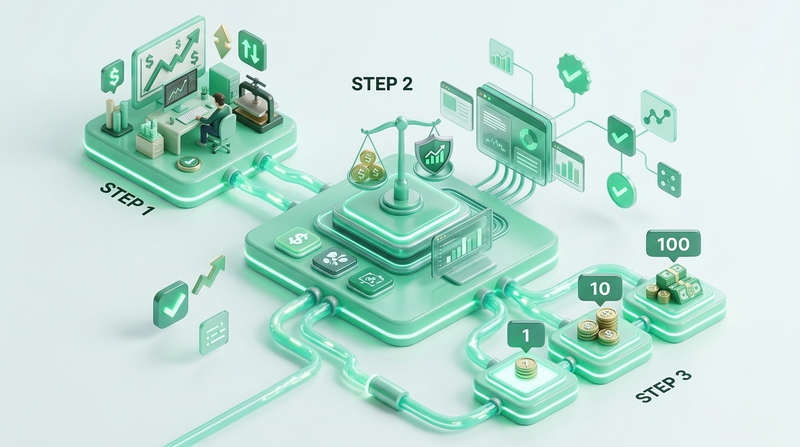
Choosing the right lot size involves a risk-first calculation that prioritizes capital preservation over potential profit. This professional approach ensures you know your maximum potential loss before entering a trade. By following a defined process, you can determine a precise position size for any trade, on any account, with any strategy.
Here is a step-by-step guide for calculating your lot size:
- Determine Your Account Risk Per Trade. First, decide on a fixed percentage of your account you are willing to risk on a single trade. A conservative and widely accepted standard is 1-2%. On a $5,000 account, a 1% risk means you will not lose more than $50 on the trade if your stop-loss is hit.
- Define Your Stop-Loss in Pips. Second, use technical analysis to determine a logical price level to place your stop-loss. This should be based on market structure, such as below a support level or above a resistance level, not an arbitrary number of pips. For this example, let’s say your analysis determines the stop-loss should be 40 pips away from your entry price.
- Calculate the Pip Value You Can Afford. Third, calculate the maximum value per pip your trade can have. You do this by dividing your dollar risk by your stop-loss in pips. Using our example: $50 / 40 pips = $1.25 per pip. This means for every pip the market moves against you, you will lose $1.25.
- Convert Pip Value to Lot Size. Finally, convert this pip value into a lot size. Since a mini lot ($1/pip) is too small and two mini lots ($2/pip) is too large, you need a more precise size. The correct position is 1.25 mini lots, which is equivalent to 12.5 micro lots or 0.125 standard lots. You can use a Forex Position Size Calculator to automate this final step and avoid errors.
Advanced Lot Sizing Strategies for Experienced Traders in 2026
Advanced lot sizing strategies allow experienced traders to dynamically adjust position sizes based on account growth and specific trading environments, like proprietary trading firms. These methods move beyond simple fixed-percentage risk. A key trend anticipated to grow through 2026 is the focus on sizing for prop firm trading challenges, which have unique risk constraints.
Experienced traders employ several advanced methods for position sizing. These methods include:
- Fixed Fractional Sizing: This is the professional standard described in the previous section, where a trader risks a fixed percentage of their account equity (e.g., 1%) on every trade. As the account grows, the dollar amount risked increases, allowing for compounding.
- Fixed Ratio Sizing: This is a more complex method where position size increases as profits accumulate, but the relationship is not linear. It requires a certain amount of profit to be made before increasing the contract size, which can help manage the psychological pressure of trading larger sizes.
- Sizing for Prop Firm Trading (A 2026 Trend): Proprietary trading firms impose strict rules, such as a 5% maximum daily loss limit and a 10% total drawdown limit. Traders must use micro-management of their lot size to ensure no single trade or series of trades can breach these limits. This often involves risking less than 0.5% per trade and requires constant monitoring of the equity curve to pass evaluation challenges.
From Theory to Practice: Key Takeaways on Lot Sizing
The practical application of lot sizing principles is what separates professional risk managers from gamblers. By internalizing these concepts, you gain direct control over your trading outcomes before the market even moves. The key is to shift your focus from “how much can I make?” to “how much can I lose?”.
Here are the key takeaways to put lot sizing theory into practice:
- Your lot size dictates your risk before you even place the trade.
- Always calculate your lot size based on a pre-defined stop-loss and a fixed account risk percentage.
- Start with micro or nano lots if you are a beginner; there is no shame in trading small to preserve capital.
- Understand the direct relationship between lot size, leverage, and your margin requirement to avoid unexpected margin calls.
Frequently Asked Questions About Forex Lot Sizes
This section answers common questions traders have about lot sizes, pips, and how broker types relate to trade sizing. The answers provide clear, definitional, and comparative information to resolve frequent points of confusion for new and intermediate traders.
What Is a Pip in Forex?
A pip, an acronym for “Percentage in Point,” is the smallest standard unit of price change for a currency pair. For most currency pairs like EUR/USD or GBP/USD, a pip is the fourth decimal place (0.0001). For pairs involving the Japanese Yen (JPY), such as USD/JPY, a pip is the second decimal place (0.01). The monetary value of a pip is determined by the lot size you are trading.
Can I Trade With Less Than a Micro Lot?
Yes, you can trade with less than a micro lot. Many brokers offer nano lots, which are 100 units of currency, or one-tenth the size of a micro lot. Additionally, most modern trading platforms allow you to trade in increments of micro lots, such as 0.02 lots (2 micro lots) or 0.05 lots (5 micro lots), giving you very fine control over your position size.
What Are the Main Types of Brokers Based on Lot Size Offerings?
Brokers can be grouped into three main types based on the lot sizes they offer. The three main types are:
- Standard Account Brokers: These brokers often have a minimum trade size of one mini lot (0.10 lots) and are geared towards traders with larger account balances.
- Cent/Micro Account Brokers: These brokers specialize in allowing micro lot (0.01 lots) and nano lot trading, making them ideal for beginners and those with small capital.
- ECN/Pro Brokers: These brokers typically offer flexible sizing starting from 0.01 lots and provide direct market access with raw spreads, catering to experienced traders, scalpers, and automated systems.
Standard Lot vs. Micro Lot: Which Is Better for a $10,000 Account?
For a $10,000 account, using micro lots is far better and safer than using a standard lot. While a $10,000 account might have enough margin to open one standard lot, it is extremely risky. A single adverse move of 100 pips on a standard lot trade would result in a $1,000 loss, which is 10% of the account. In contrast, using micro lots allows for precise risk management, such as risking 1% ($100) on a trade, making them superior for prudent capital preservation.
The Ultimate Risk of Ignoring Proper Lot Size Principles
The ultimate risk of ignoring proper lot size principles is the near-certainty of blowing up your trading account. It is the fastest and most common path to financial ruin in the forex market. Traders who fail to calculate their position size based on a risk-first methodology are effectively gambling, not trading, regardless of how effective their market analysis is.
It is not the market that blows up accounts; it is improper position sizing. A trader can have a winning strategy that is correct 70% of the time but still lose all their money if their losing trades are too large relative to their account. By mastering lot size calculation, you transform from a market gambler into a calculated risk manager. This shift in perspective is the foundation for building a consistent and sustainable trading career.