
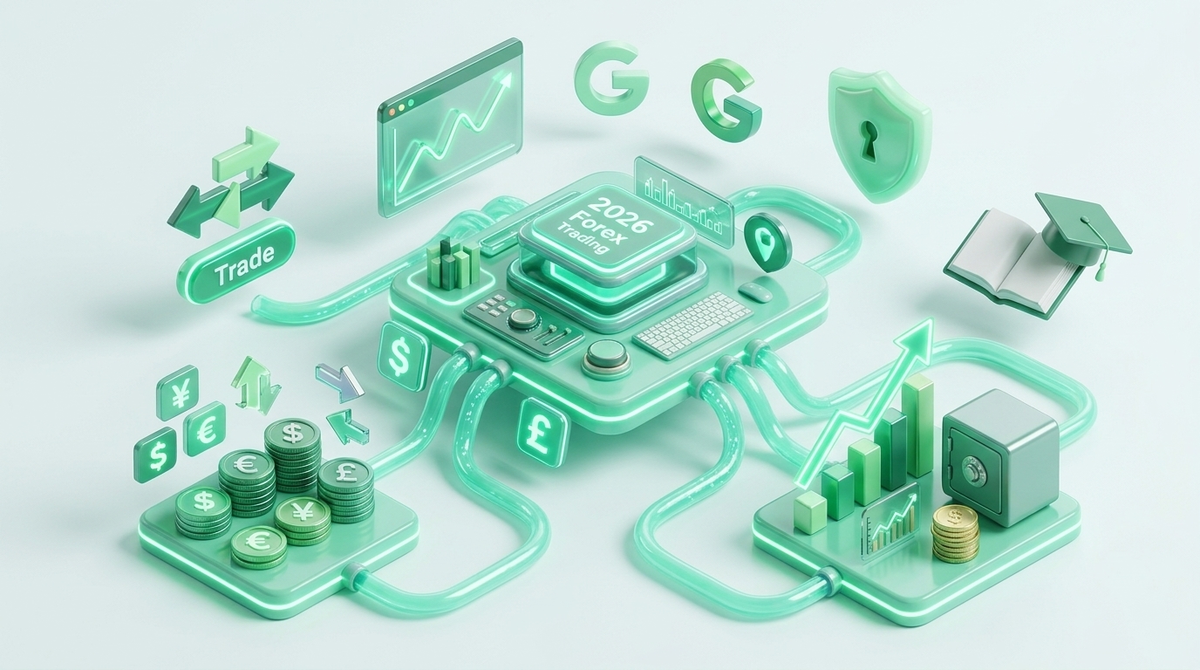
This article provides the definitive beginner’s guide to forex trading in 2026, designed to build your knowledge from the ground up. We will cover core concepts, a step-by-step plan to start, essential strategies, and critical risk management rules. Success in the currency market comes from education, a disciplined strategy, and realistic expectations, not from luck. In 2026, technological advancements and evolving market dynamics present unique opportunities for the informed trader, making a solid educational foundation more important than ever.
Why Consider Forex Trading in 2026?
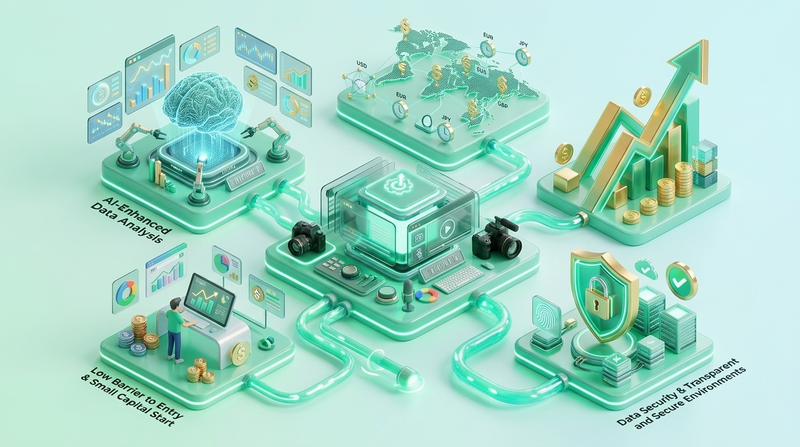
Forex trading in 2026 offers distinct advantages, including unmatched market accessibility, 24-hour operation, low transaction costs, and the ability to trade in any market direction. These characteristics make the foreign exchange market a flexible option for new traders. Its immense scale and liquidity are primary reasons for its popularity among global financial participants.
The foreign exchange market presents several unique characteristics that appeal to new and experienced traders alike. Here are the primary benefits of participating in the forex market:
- Unmatched Market Accessibility and Liquidity
- A 24-Hour, 5-Day-a-Week Market
- Low Transaction Costs and Capital Requirements
- The Ability to Profit in Both Rising and Falling Markets
1. Unmatched Market Accessibility and Liquidity
The forex market’s high liquidity stems from it being the world’s largest financial market, which allows traders to buy and sell currencies with ease. Liquidity is the ability to execute a trade quickly at a stable price. According to the Bank for International Settlements (BIS) Triennial Central Bank Survey, daily forex turnover reached $7.5 trillion, a scale that ensures tight bid-ask spreads and efficient order execution for the most-traded currency pairs.
2. A 24-Hour, 5-Day-a-Week Market
The forex market operates 24 hours a day, five days a week, because it follows the sun through four major financial centers. The market opens on Sunday afternoon in New York (corresponding to Monday morning in Sydney) and closes on Friday afternoon in New York. This continuous nature provides immense flexibility, allowing part-time traders with day jobs to participate during the active London, New York, or Asian trading sessions.
3. Low Transaction Costs and Capital Requirements
Most retail forex brokers generate revenue primarily through the spread, which is the small difference between the buying and selling price of a currency pair. This model often eliminates separate commission fees common in equity trading. Furthermore, the availability of leverage allows traders to open positions with a relatively small amount of initial capital, though it is critical to understand that this also increases risk.
4. The Ability to Profit in Both Rising and Falling Markets
Forex trading allows you to speculate on both the appreciation and depreciation of currency values, a key advantage over some other markets. If you believe the Euro will strengthen against the US Dollar, you “go long” by buying the EUR/USD pair. Conversely, if you predict the Euro will weaken, you “go short” by selling EUR/USD, providing opportunities to profit in both bullish and bearish market conditions.
Understanding the Core Concepts of the Forex Market
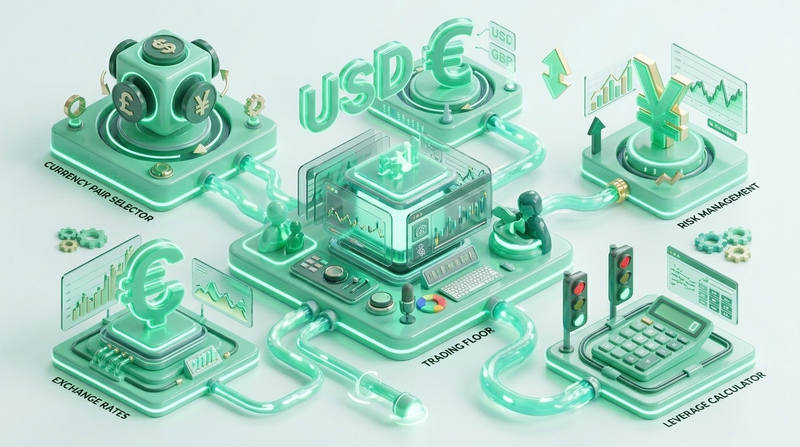
A solid foundation in the market’s fundamental mechanics and terminology is essential before placing a single trade. This section provides the basic rules and definitions required to understand how currency trading works. Mastering these core concepts is the first step toward building a coherent trading strategy and navigating the market with confidence.
Before you can trade, you must first understand the language and structure of the foreign exchange market. This knowledge serves as the rulebook for all your future trading activities. It is the bedrock upon which you will build your strategies and risk management protocols.
What Is the Forex Market?
The Foreign Exchange (Forex or FX) market is a global, decentralized marketplace where the world’s currencies are traded. Its primary purpose is to facilitate international trade and investment by enabling businesses to convert one currency into another. Unlike a stock exchange, it is an over-the-counter (OTC) market where transactions occur directly between two parties, facilitated by a network of banks, corporations, central banks like the U.S. Federal Reserve, and retail brokers.
How Currency Pairs Work: Base and Quote Currency
Currencies are always traded in pairs, where the value of one currency is quoted relative to another. The first currency in a pair is the base currency, and it always represents one unit. The second currency is the quote currency, and its value indicates how much of it is needed to purchase one unit of the base currency. For example, if the EUR/USD exchange rate is 1.0800, it means that 1 Euro costs 1.0800 US Dollars.
Understanding Key Forex Terminology for 2026
Familiarity with essential forex terminology is necessary for understanding market analysis and using a trading platform effectively. The following table defines the core terms every new trader must know.
| Term | Definition |
|---|---|
| Pip | Stands for “Percentage in Point,” the smallest standard unit of price change in a currency quote. For most pairs, it is the fourth decimal place (0.0001). |
| Lot Size | The number of currency units being traded. A standard lot is 100,000 units, a mini lot is 10,000, and a micro lot is 1,000 units. |
| Spread | The difference between the bid (sell) price and the ask (buy) price of a currency pair. This is the primary cost of a trade. |
| Leverage | A tool provided by brokers that allows traders to control a large position with a small amount of capital. It amplifies both potential profits and potential losses. |
| Margin | The amount of capital required in your account to open and maintain a leveraged position. It is not a fee but a portion of your account equity set aside. |
| Bid/Ask Price | The Bid is the price at which you can sell the base currency. The Ask is the price at which you can buy the base currency. |
| Stop-Loss | An order placed with a broker to automatically close a losing trade once it reaches a certain price level, limiting your potential loss. |
| Take-Profit | An order placed with a broker to automatically close a profitable trade once it reaches a certain price level, securing your gains. |
| Broker | A financial services company that provides traders with access to a platform for buying and selling foreign currencies. |
| Volatility | A measure of the frequency and magnitude of price fluctuations in a currency pair. High volatility means prices are changing rapidly. |
Your Step-By-Step Guide to Getting Started with Forex Trading

This section provides a clear, sequential roadmap to guide you from zero knowledge to placing your first informed trade in a risk-free environment. Following these steps in order is the most effective way to build a solid trading foundation. Each step is designed to develop the skills and discipline necessary for navigating the forex market responsibly.
Transitioning from theory to practice requires a structured approach. This guide outlines the exact sequence of actions to take as you begin your trading journey. By methodically progressing through each stage, you build both competence and confidence while minimizing initial risk.
Step 1: Commit to Comprehensive Education
The first and most important step is committing to a thorough and ongoing education, as successful trading is a skill developed through learning, not a form of gambling. Before risking any capital, you must understand market mechanics, analysis techniques, and risk management principles. This foundational knowledge is non-negotiable for long-term survival in the market.
Valuable educational resources include:
- Reputable Websites: The Babypips School of Pipsology is a widely respected free course for absolute beginners.
- Books: Classic texts like “Currency Trading for Dummies” provide structured learning paths.
- Financial News: Following major outlets like Bloomberg Markets and Reuters Financial News helps you understand how global events affect currency values.
Be skeptical of any “gurus” or signals that promise guaranteed profits, as these are hallmarks of forex scams.
Step 2: Create Your Personal Trading Plan (Checklist Included)
A trading plan is a documented set of rules that dictates every decision you make, effectively removing emotion and impulsiveness from your trading. It is your personal business plan for navigating the markets. Trading without a plan is equivalent to gambling, whereas trading with one turns speculation into a structured business.
Your trading plan must be written down and followed without deviation. Here is a checklist of essential components to include in your plan:
- Motivation: Clearly define why you are trading and establish specific, realistic financial goals.
- Time Commitment: Determine how many hours per day or week you can dedicate to market analysis and active trading.
- Risk Capital: Specify the total amount of money you can afford to lose without it negatively impacting your life. This is your trading capital.
- Risk Per Trade: Set a strict percentage of your account to risk on any single trade. A conservative standard is 1%.
- Risk/Reward Ratio: Define the minimum acceptable ratio of potential reward to potential risk for any trade you take, such as 1:2 or higher.
- Markets to Trade: List the specific currency pairs you will focus on. Beginners often start with major pairs due to their high liquidity.
- Trading Strategy: Detail the exact technical or fundamental criteria that must be met for you to consider entering a trade.
- Trade Entry Rules: Write the precise conditions that trigger the opening of a long or short position.
- Trade Exit Rules (Profit): Define how and when you will take profits, whether at a specific risk/reward multiple or a technical level.
- Trade Exit Rules (Loss): State exactly where your stop-loss order will be placed and establish a rule about whether you will ever move it.
- Position Sizing: Outline the formula you will use to calculate your lot size for each trade, based on your risk percentage and stop-loss distance.
- Record Keeping: Describe how you will maintain a trading journal to track every trade’s details, including the entry, exit, profit/loss, and lessons learned.
Step 3: Choose the Right Forex Broker for Your 2026 Needs
A forex broker acts as the intermediary that connects you to the currency market through a trading platform. Selecting a trustworthy and well-regulated broker is one of the most important decisions a new trader makes. Your broker holds your funds and executes your trades, so their reliability is paramount.
For 2026, evaluate potential brokers against the following criteria:
- Regulation: This is non-negotiable. Ensure the broker is regulated by a top-tier authority such as the Financial Conduct Authority (FCA) in the UK, the Cyprus Securities and Exchange Commission (CySEC), or the Australian Securities and Investments Commission (ASIC). Regulation provides a critical layer of investor protection.
- Broker Type: Understand the difference between an ECN (Electronic Communication Network) broker, who passes your orders directly to liquidity providers, and a Market Maker, who takes the other side of your trade.
- Trading Platforms: Check for stable and user-friendly platforms. MetaTrader 5 (MT5) is an industry standard, but many modern brokers in 2026 offer excellent proprietary platforms or integration with TradingView.
- Fees: Compare spreads on the pairs you plan to trade, along with any commissions, swap fees (for holding positions overnight), and deposit/withdrawal fees.
- Customer Support: Test their support team’s responsiveness and knowledge. 24/5 support is standard in the forex industry.
- Educational Resources and Tools: Look for brokers that offer modern tools like AI-powered analytics, market sentiment indicators, and comprehensive educational materials.
Step 4: Open and Fund a Demo Account
A demo account is a trading simulator that uses virtual money but operates on live market data provided by the broker. Its purpose is to provide a risk-free environment where you can practice executing your trading plan, master the trading platform, and build confidence before risking real capital. It is an indispensable tool for every new trader. Treat the virtual money as if it were real to develop proper emotional discipline and risk management habits.
Step 5: Master a Trading Platform (MT5 or Modern Alternatives)
Mastering your chosen trading platform involves learning the practical skills required to execute your strategy efficiently. This goes beyond simply knowing how to open a trade. You must become proficient in placing different order types (market, limit, stop), setting stop-loss and take-profit levels with precision, and using the platform’s analytical tools. While MetaTrader 5 (MT5) remains a popular choice, many traders in 2026 prefer platforms with more intuitive user interfaces and direct TradingView chart integration for advanced analysis.
Step 6: Transition to a Live Account with Small Capital
You should only transition to a live trading account after achieving consistent profitability in your demo account for a period of 1-3 months. When you do go live, start with a small amount of capital that you can afford to lose. Many brokers offer micro or cent accounts, which are ideal for this phase. This step allows you to experience the real psychology of having money at risk without the danger of a catastrophic loss, giving you a chance to see if you can stick to your trading plan under real pressure.
Essential Forex Trading Strategies and Analysis for Beginners
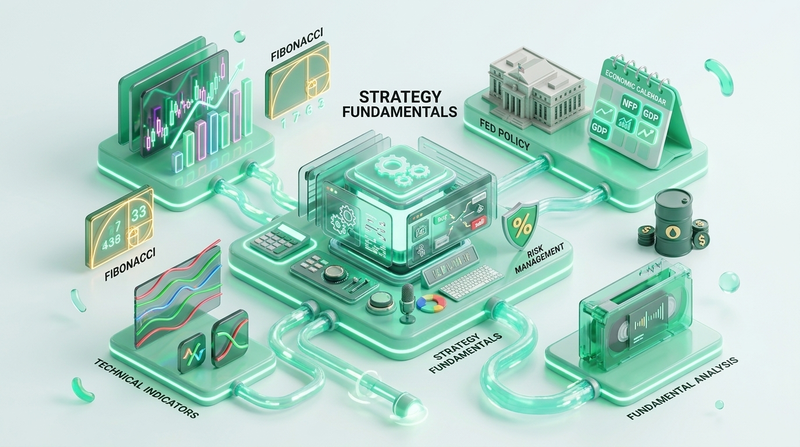
Successful trading relies on a framework for analyzing the market to identify trading opportunities, and there are three primary methods of analysis. Most traders use a combination of these approaches to build a comprehensive view of market dynamics. This section introduces each type of analysis, providing a high-level overview for beginners to explore further.
Understanding how to analyze the market is the next step after learning the basics. Traders typically use three main forms of analysis to forecast price movements.
Technical Analysis: Reading the Charts
Technical analysis (TA) is the study of historical price action on charts to identify patterns and predict future price movements. It operates on the premise that all known information is already reflected in the price. Core concepts of technical analysis are essential for timing trade entries and exits.
Key components of technical analysis include:
- Trends: Identifying the primary market direction, which can be an uptrend (higher highs and higher lows), a downtrend (lower highs and lower lows), or a sideways range.
- Support and Resistance: These are horizontal price levels on a chart where price has previously reversed. Support is a level where buying pressure tends to overcome selling pressure, and resistance is a level where selling pressure tends to overcome buying pressure.
- Indicators: Mathematical calculations based on price and/or volume. Common starting indicators include Moving Averages, which smooth out price data to identify trend direction, and the Relative Strength Index (RSI), which helps identify overbought or oversold conditions.
Fundamental Analysis: Understanding the “Why” Behind Price Moves
Fundamental analysis (FA) involves evaluating a country’s economic, social, and political forces that influence its currency’s value. While technical analysis focuses on the “what” (price), fundamental analysis explores the “why.” A key question fundamental analysts ask is, “What economic data will cause a currency to strengthen or weaken?”
Key drivers of currency value include:
- Interest Rate Decisions: Central banks’ decisions to raise, lower, or hold interest rates are arguably the most significant driver of currency value.
- Economic Data: Key reports such as Gross Domestic Product (GDP), inflation metrics like the Consumer Price Index (CPI), and employment numbers (e.g., the U.S. Non-Farm Payrolls) have a direct impact.
- Geopolitical Events: Elections, political instability, and international relations can cause significant currency volatility.
Traders use an economic calendar to track the release of this data.
Sentimental Analysis: Gauging the Market’s Mood
Sentimental analysis involves assessing the overall mood or feeling of market participants to determine whether they are generally bullish (optimistic) or bearish (pessimistic) on a currency. This form of analysis acts as a contrarian indicator or a confirmation tool. For example, if an extreme majority of retail traders are long on a pair, a contrarian trader might look for opportunities to go short, anticipating a reversal.
Tools for gauging sentiment include the Commitment of Traders (COT) report from the CFTC, which shows the positions of large speculators and commercial players, and sentiment indicators provided by some brokers showing the ratio of long-to-short positions among their clients.
Mastering Risk Management: The Key to Long-Term Success

Effective risk management is the single most important discipline that separates professional traders from gamblers and is the primary determinant of long-term survival in the market. It is not about winning every trade, but ensuring that losses are small and manageable. Industry data consistently shows that 70-80% of retail traders lose money, often due to a failure to implement basic risk management principles.
The goal of risk management is capital preservation. Without capital, you cannot trade. This section covers the non-negotiable rules and tools that protect your account from significant losses, allowing you to stay in the game long enough for your profitable trades to work.
The Non-Negotiable Tools: Stop-Loss and Take-Profit Orders
A Stop-Loss (SL) is an automated order you place with your broker to close a trade at a specific, predetermined price to limit your loss. A Take-Profit (TP) is a similar order that closes a profitable trade at a target price to secure your gains. Every single trade you open must have a stop-loss order attached from the very beginning. This is your primary safety net that protects you from catastrophic losses due to unexpected market moves.
Calculating Your Risk-to-Reward Ratio
The Risk-to-Reward (R/R) ratio compares the potential loss of a trade to its potential profit. It is calculated by dividing the distance from your entry point to your stop-loss (the risk) by the distance from your entry to your take-profit (the reward). For example, if you risk 50 pips to make a potential 150 pips, your R/R ratio is 1:3. Successful traders consistently seek trades with a favorable ratio, such as 1:2 or higher, as it means their winning trades will be larger than their losing ones.
The 1% Rule: Protecting Your Capital
The 1% rule is a simple yet powerful guideline for capital preservation: never risk more than 1% of your total trading account on a single trade. For example, on a $5,000 account, a 1% risk limit means you would not allow a loss of more than $50 on any one position. This rule ensures that you can endure a long string of consecutive losses without depleting your account, giving you the staying power to wait for your strategy’s edge to play out.
Understanding and Respecting Leverage
Leverage is a loan provided by your broker that allows you to control a larger position size than your account capital would normally permit. While it can amplify profits, it also amplifies losses by the same magnitude, making it a double-edged sword. Brokers may offer high leverage, but as a beginner in 2026, you should use very low leverage (e.g., 10:1 or less). High leverage is one of the fastest ways for an inexperienced trader to wipe out their account. Many regulators, like the European Securities and Markets Authority (ESMA), have already placed caps on leverage for this reason.
The Future of Forex Trading: What to Expect in 2026 and Beyond
The forex market is dynamic, and a successful trader in 2026 must be aware of emerging trends in technology and regulation. Staying informed about these shifts is key to adapting your strategy and maintaining an edge. The evolution of financial technology (fintech) and a strengthening global regulatory framework are the two most prominent forces shaping the future of retail trading.
As we look to the future, the environment for retail forex traders continues to evolve. Two key trends are shaping the market: the increasing accessibility of advanced technology and a continuous push for stricter regulatory oversight to protect investors.
The Rise of AI and Algorithmic Trading for Retail
Artificial Intelligence (AI) and algorithmic trading are becoming increasingly accessible to retail traders, moving beyond the exclusive domain of large institutions. By 2026, this trend is evident in AI-powered analytical tools, advanced pattern recognition software, and more sophisticated automated trading strategies, often called Expert Advisors (EAs). The growth of no-code and low-code platforms allows even non-programmers to build and test their own trading bots. However, these tools are not a “magic bullet”; they require a solid underlying strategy and human oversight to be effective.
Evolving Regulatory Landscapes
The global trend toward stricter regulation to protect retail clients is set to continue through 2026 and beyond. Past actions by regulators like ESMA and the FCA, which included leverage caps and marketing restrictions, serve as a blueprint for future changes. We can anticipate enhanced disclosure requirements from brokers and a continued crackdown on unregulated entities. For serious, well-capitalized traders, this is a positive development that promotes a more transparent and secure trading environment.
Frequently Asked Questions About Forex Trading
This section provides direct answers to some of the most common questions that new traders have. These quick resolutions can help clarify lingering doubts as you begin your educational journey.
Is Forex Trading Profitable for Beginners?
Yes, it can be, but it is not easy or guaranteed. Profitability in forex trading depends entirely on a trader’s commitment to education, strict adherence to a trading plan, and disciplined risk management. Statistics from brokers often show that a high percentage of beginners lose money, primarily because they treat trading like a get-rich-quick scheme and skip these essential steps.
What Is a Pip in Forex?
A “Pip,” which stands for Percentage in Point, is the smallest standard unit of price movement in the forex market. For most currency pairs quoted to four decimal places, like EUR/USD, one pip is equal to 0.0001. For pairs involving the Japanese Yen (JPY), a pip is the second decimal place (0.01). For instance, if the GBP/USD price moves from 1.2550 to 1.2551, that is a one-pip move.
What Are the Major, Minor, and Exotic Currency Pairs?
Currency pairs are typically categorized into three groups based on their liquidity and global trading volume. Understanding these groups helps you choose which markets to focus on.
- Majors: These are the seven most traded pairs in the world, all of which include the US Dollar (USD). Examples are EUR/USD, GBP/USD, and USD/JPY. They are characterized by very high liquidity and low spreads.
- Minors (Crosses): These are pairs made up of major currencies that do not include the US Dollar. Examples include EUR/GBP, EUR/JPY, and AUD/NZD.
- Exotics: These pairs consist of one major currency paired with the currency of an emerging economy, such as USD/TRY (US Dollar/Turkish Lira) or EUR/PLN (Euro/Polish Zloty). They typically have lower liquidity, higher volatility, and wider spreads.
What Is the Difference Between a Forex Broker and a Bank?
A forex broker and a bank serve different functions for a retail trader, although both deal with currencies. A bank is a primary participant in the interbank market, which is the core of the global forex system, and typically offers currency exchange for travel or business at wide spreads. In contrast, a forex broker is a specialized intermediary that provides individuals with access to speculate on this market via a trading platform, offering much tighter spreads and leverage specifically for trading purposes.
Your Next Steps: Balancing Opportunity and Risk in Your Forex Journey
The forex market in 2026 presents a world of opportunity, but it is accessible only to those who approach it with discipline and a profound respect for risk. The path to becoming a consistently profitable trader is not a sprint but a marathon built on a simple, powerful sequence: Education, Planning, Practice, and Discipline. Avoid the temptation of shortcuts and focus on building a solid foundation of knowledge. Your next step is not to fund a live account, but to start your education today. Open a demo account, apply the principles in this guide, and begin your journey with the cautious, analytical mindset of a business owner, not a gambler.