
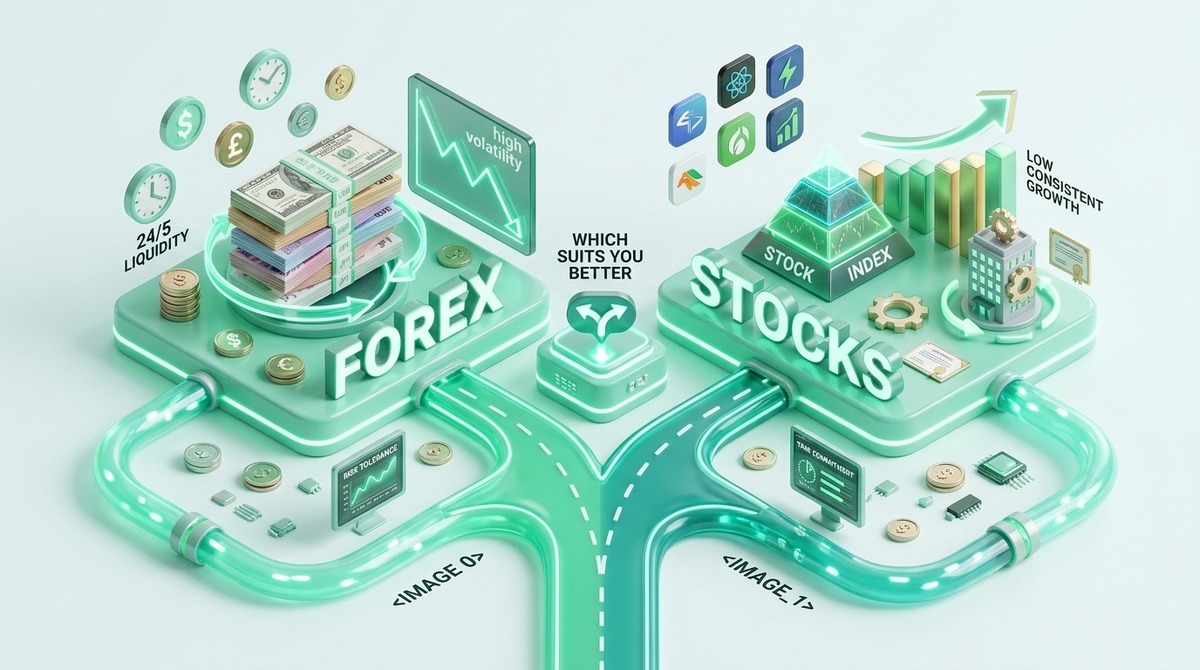
Choosing between Forex and stock trading involves comparing a decentralized, currency-focused market with a centralized market based on corporate ownership. The right choice for your 2026 investing journey depends on your personal financial goals, risk tolerance, and time commitment. This guide provides a direct comparison to help you determine which market is a better fit for your specific trading style.
Navigating the Financial Markets: Your 2026 Guide to Forex and Stocks

This article serves as your definitive 2026 guide to the Forex and stock markets, designed to help you make an informed decision based on your financial situation. The two titans of the trading world, the fast-paced global Forex market and the established world of stock investing, present different opportunities and risks. Our purpose is to demystify both markets, provide a direct comparison, and offer a personalized framework for choosing the right path for your investing journey.
What Is the Forex Market? The World’s Largest Financial Arena

The Forex (Foreign Exchange) market is the decentralized global marketplace where the world’s currencies are traded. Its primary function is to facilitate international trade and tourism, which underpins its massive scale. According to the Bank for International Settlements (BIS), the Forex market’s daily trading volume is approximately $7.5 trillion, making it the largest financial market in the world. For traders, it is an arena for speculating on the fluctuating values of currency pairs.
Trading in this over-the-counter (OTC) market is like placing a bet on the economic health of one country against another. When you buy a currency pair like the EUR/USD, you are buying the euro and selling the U.S. dollar, speculating that the euro will strengthen relative to the dollar. The immense liquidity in Forex means traders can typically enter and exit positions with ease.
Here are the key takeaways about the Forex market:
- It involves trading currencies in pairs, such as EUR/USD, GBP/JPY, or AUD/CAD.
- It is the largest financial market by daily volume, ensuring high liquidity.
- The market operates 24 hours a day, 5 days a week, across different global sessions.
What Are Stocks? Owning a Piece of a Company

Stocks, also known as equities or shares, are a type of security that signifies ownership in a fraction of a corporation. Owning a company’s stock makes you a shareholder, entitling you to a portion of that company’s assets and profits proportional to your ownership. These are traded on centralized exchanges like the New York Stock Exchange (NYSE) and NASDAQ. The value of a stock is tied directly to the company’s performance, profitability, and overall market sentiment.
Buying a stock is like buying a small slice of a business, such as Apple or Ford, and becoming a part-owner. There are two primary ways to profit from stocks: capital appreciation, which occurs when the stock’s price increases, and dividends, which are portions of the company’s profits distributed to shareholders. A company’s total value in the stock market is its market capitalization.
Here are the key takeaways about the stock market:
- Stocks represent a claim on a portion of a publicly traded company’s assets and earnings.
- They are traded on centralized and regulated exchanges, for example the NYSE or NASDAQ.
- A stock’s value is influenced by company performance, industry trends, and economic factors.
The Head-to-Head Comparison: Forex and Stocks Analyzed

This section provides a direct comparison of the key differences between the Forex and stock markets to give you maximum clarity. We will break down the critical trading characteristics point by point, from market size and trading hours to volatility and the factors that influence prices. This side-by-side analysis is designed to highlight the distinct nature of each market.
Market Size and Liquidity: Trillions vs Billions
The Forex market’s liquidity is substantially higher than the stock market’s, with a daily trading volume of approximately $7.5 trillion according to the Bank for International Settlements (BIS) Triennial Central Bank Survey. In contrast, global stock markets, while massive, trade hundreds of billions of dollars per day, per data from the World Federation of Exchanges. For a trader, the high liquidity in Forex translates to significant advantages: you can enter and exit positions almost instantly at stable prices, and transaction costs, reflected in the bid-ask spread, are typically very low for major pairs. This contrasts with stocks, where liquidity can differ dramatically between a blue-chip stock like Microsoft and a lesser-known small-cap stock, which might be harder to sell quickly without affecting the price.
Trading Hours: 24/5 Accessibility vs Standard Market Times
The Forex market offers 24-hour access five days a week, providing unparalleled trading flexibility. It operates continuously as trading sessions overlap around the globe, following the sun from Sydney to the Tokyo session, then to the London session, and finally closing with the New York session. This 24/5 availability is highly appealing for part-time traders who need to fit trading around a standard work schedule. Conversely, stock markets adhere to the business hours of their specific exchange, such as the NYSE’s 9:30 AM to 4:00 PM Eastern Time schedule. While pre-market and after-hours trading exist for stocks, liquidity is much lower and volatility can be higher during these times.
Volatility and Risk Profile: Fast-Paced vs Long-Term Growth Potential
Forex volatility is unique because price movements are measured in pips, which are tiny fractions of a cent, but the use of high leverage can amplify these small movements into substantial gains or losses. This environment creates opportunities for short-term profits, making it attractive for day trading, but it also elevates the risk profile significantly. Stock volatility, on the other hand, can be dramatic for a single company based on an earnings report, industry news, or management changes. However, a diversified portfolio of stocks is generally considered a vehicle for long-term growth and wealth accumulation, often following a “buy and hold” strategy rather than reacting to short-term price swings.
Leverage: The Double-Edged Sword in Trading
Leverage is the ability to control a large financial position with a small amount of capital, and it is a defining difference between Forex and stock trading. Forex brokers often provide high leverage, with rates up to 50:1 in the United States for major pairs as per CFTC regulations, and even higher in other jurisdictions. Stock trading leverage is far more restricted, typically at 2:1 for overnight positions and up to 4:1 for pattern day traders under FINRA rules. For example, with 50:1 leverage on a $1,000 Forex account, you can control a $50,000 position. This magnifies potential profits from small price changes but, more critically, it also magnifies losses. Proper risk management is required because losses can exceed your initial deposit, leading to a margin call.
Influencing Factors: Macroeconomics vs Corporate Performance
Forex market movements are driven primarily by macroeconomic indicators that reflect the health of an entire country’s economy. These factors include central bank policy, interest rates, inflation data, gross domestic product (GDP), and major geopolitical events like the Non-Farm Payroll (NFP) report in the US. In contrast, stock prices are most directly influenced by microeconomic factors related to the specific company. These include corporate earnings, revenue growth, profit margins, new product launches, management changes, and the competitive landscape of their industry. While broad market sentiment affects stocks, the core analysis is on company fundamentals.
Transaction Costs: Spreads, Commissions, and Fees Explained
The primary transaction cost in Forex trading is the bid-ask spread, which is the small difference between the buying and selling price of a currency pair. Many market maker brokers offer “commission-free” trading, building their fee into this spread. ECN brokers may offer tighter spreads but charge a separate, fixed commission per trade. Stock trading costs traditionally involved a commission per trade or per share. While many online brokers now advertise commission-free trading, they often generate revenue through other means, such as payment for order flow or wider spreads on their platform. Stock investors might also encounter other fees, like custody or inactivity fees, depending on the broker.
| Feature | Forex Trading | Stock Trading |
|---|---|---|
| Primary Cost | The bid-ask spread | Commission per trade (or spread on “commission-free” platforms) |
| Other Potential Costs | Commissions (on ECN accounts), overnight funding fees | Platform fees, custody fees, data fees |
Weighing the Opportunities: Pros and Cons of Each Market

This section provides a balanced view of the advantages and disadvantages of participating in the Forex and stock markets. By understanding the distinct opportunities and risks inherent in each, you can better align your choice with your personal trading style, financial goals, and risk tolerance. We will examine the pros and cons of each market separately.
The Advantages and Disadvantages of Forex Trading
Forex trading offers a unique set of benefits and drawbacks rooted in its structure, liquidity, and use of leverage. These points define the experience of a Forex trader.
The primary advantages of Forex trading include:
- High Liquidity: The market’s massive size allows for the smooth entry and exit of trades at nearly any time.
- 24/5 Market Access: Its continuous operation during the week offers exceptional flexibility to trade around other commitments.
- High Leverage: It provides the potential for significant returns from a small capital base, though this comes with high risk.
- Lower Transaction Costs: Most brokers charge only the spread, avoiding separate commission fees.
- Simplicity of Choice: Traders can focus on a few major currency pairs rather than analyzing thousands of stocks.
The main disadvantages of Forex trading are:
- Extreme Risk with Leverage: High leverage is the top reason traders lose money, as it can cause rapid and substantial losses.
- High Volatility: The market can experience sudden and sharp movements, especially during major news releases.
- Complex Influences: Success requires a good understanding of global macroeconomics, interest rates, and geopolitics.
- Less Regulatory Oversight: The over-the-counter (OTC) nature can mean less investor protection depending on the broker’s jurisdiction.
The Advantages and Disadvantages of Stock Investing
Stock investing allows you to own a piece of a business, which comes with its own set of opportunities and challenges compared to currency trading. These points highlight the core experience of a stock investor.
The primary advantages of stock investing include:
- Ownership and Growth: You own an asset in a real business with the potential for long-term value appreciation.
- Stronger Regulation: Markets in the US are heavily regulated by the Securities and Exchange Commission (SEC), offering greater investor protection.
- Vast Information Availability: Public companies are required to disclose their financial statements, making research more accessible.
- Potential for Dividends: Many companies pay dividends, providing a source of passive income.
- Wide Choice: You can choose from thousands of companies across every imaginable sector to build a diversified portfolio.
The main disadvantages of stock investing are:
- Limited Trading Hours: Trading is restricted to the exchange’s specific operating hours.
- Lower Liquidity (for some stocks): Small-cap or penny stocks can be illiquid and difficult to sell quickly.
- Higher Barriers to Entry (Historically): Traditionally required more capital, although fractional shares have made it more accessible.
- Company-Specific Risk: A single poor earnings report, scandal, or management issue can severely damage a stock’s value.
Which Market Is Right for You? A Personalized Assessment for 2026
Determining whether Forex or stocks are right for you requires a self-assessment of your investment style, risk appetite, and time commitment. There is no single “best” market; there is only the market that best fits your personality and goals. To help you decide, we have created three common trader profiles and a checklist of questions to guide your decision-making process for 2026.
Profile 1: The Active Day Trader Seeking High Liquidity
This individual is looking to dedicate several hours a day to active trading, possesses a high tolerance for risk, and is disciplined enough to follow a strict trading plan. They enjoy the challenge of fast-paced technical analysis and want to capitalize on short-term price movements. For this person, the Forex market’s 24/5 access, deep liquidity, and high volatility, when combined with leverage, may be a better fit for their active trading style.
Profile 2: The Long-Term Investor Focused on Value Growth
This person has a “set it and build” mindset, is more risk-averse, and aims to build wealth over several years or decades for goals like retirement. They enjoy researching the fundamentals of a business, including its products, management, and financial health, to identify companies with long-term growth potential. For this investor, the stock market is the clear choice, as it is structured for long-term ownership, value appreciation, and the potential for dividend income.
Profile 3: The Part-Time Trader Balancing a Career
This individual has a full-time job but wants to be more active in the markets than a passive long-term investor. They can dedicate a few hours in the morning or evening to analysis and trading. This profile presents a mixed case. Forex offers superior flexibility due to its 24-hour market, allowing trading outside of typical work hours. Alternatively, swing trading stocks—holding positions for several days or weeks—is also an excellent option that does not require constant monitoring. The choice here depends on their interest in macroeconomics versus individual company analysis.
A Decision-Making Checklist: 10 Questions to Ask Yourself
Answering these questions honestly will help clarify which market aligns better with your personal circumstances and trading psychology.
- What is my primary goal: rapid, short-term profits (trading) or long-term wealth accumulation (investing)?
- How much time can I dedicate each day or week to trading?
- What is my true risk tolerance on a scale of 1-10? Can I stomach losing my entire investment?
- Am I more interested in the big picture of global economics or the specific performance of individual companies?
- Do I want to be an active trader or a passive investor?
- How much capital can I realistically start with and afford to lose?
- Do I understand the risks of leverage and am I prepared to manage them strictly?
- Am I more comfortable with a highly regulated market (stocks) or a decentralized one (Forex)?
- Do I prefer a huge range of choices (thousands of stocks) or a focused set of options (major currency pairs)?
- Am I disciplined enough to follow a strict trading plan and manage my emotions?
Your First Steps: How to Start Trading Forex or Stocks
Getting started in either Forex or stocks requires a foundational commitment to education and responsible practices. Before risking real capital, it is vital to understand the market you choose, practice your strategy, and select a reputable broker. This section provides clear, actionable steps for beginners looking to enter either market, emphasizing a cautious and informed approach.
Essential Steps for Starting in Forex
Follow these steps to begin your Forex trading journey responsibly.
- Educate yourself: Take time to learn essential Forex terminology, how currency pairs work, and basic trading strategies.
- Open a demo account: Practice trading with virtual money on a live platform from a reputable broker to test your strategy risk-free.
- Develop a trading plan: Create clear rules for when to enter and exit trades, how much to risk per trade, and which pairs to trade.
- Choose a well-regulated broker: Select a broker regulated by a top-tier authority, such as the CFTC and NFA in the US or the FCA in the UK.
- Start small: When you go live, begin with a small amount of capital you can afford to lose and focus on trading the major, most liquid pairs.
Essential Steps for Starting in Stock Investing
Follow these steps to begin your stock investing journey with a solid foundation.
- Educate yourself: Learn the basics of fundamental analysis, portfolio diversification, and different types of stock orders.
- Define your investment goals: Clarify what you are saving for, such as retirement or a down payment, and your time horizon.
- Choose a reputable stock broker: Select a broker that offers the tools, research, and fee structure that aligns with your needs.
- Build a core portfolio: Start by investing in broad-market Exchange-Traded Funds (ETFs) or established blue-chip stocks to create a diversified base.
- Use paper trading: If you plan to trade stocks actively rather than invest long-term, use a paper trading account to practice your strategies first.
Understanding and Managing Risk: The Non-Negotiable Element of Trading
Risk management is the single most important element for survival and success in any financial market, whether Forex or stocks. No strategy can be profitable long-term without a robust plan to preserve capital. Success is impossible without a disciplined risk management strategy. Key techniques include always using a stop-loss order to define your maximum acceptable loss on a trade, employing proper position sizing to control your exposure, and adhering to rules like the “1% rule,” where you risk no more than 1% of your trading capital on any single trade. This focus on capital preservation is a hallmark of professional trading psychology.
Frequently Asked Questions About Forex and Stocks
This section answers some of the most common questions traders and investors have when comparing the Forex and stock markets.
Is Forex Trading More Profitable Than Stock Trading?
No, not necessarily. Forex offers the potential for faster profits because of high leverage, which magnifies gains from small price movements. However, this same leverage equally magnifies losses, making Forex exceptionally risky. Profitability in any market depends entirely on the individual’s skill, discipline, strategy, and risk management. Many people build substantial and more sustainable wealth through long-term stock investing. One market is not inherently more profitable than the other; they just offer different risk and reward profiles.
What Is a “Pip” in Forex and How Does It Compare to a Stock Price Movement?
A “pip,” which stands for “percentage in point,” is the smallest standard unit of price movement in the Forex market. For most currency pairs, a pip is equal to 0.0001, or the fourth decimal place (e.g., a move from 1.1051 to 1.1052 is one pip). This compares to a stock price movement, which is measured in dollars and cents (e.g., a move from $150.51 to $150.52 is one cent). While the concept is similar—the smallest unit of measure—the terminology and scale are different.
What Are the Major Currency Pairs and Blue-Chip Stocks?
These terms refer to the most popular and stable assets in their respective markets. “Major Pairs” in Forex are the most traded currency pairs; they all involve the US Dollar (USD) and offer the highest liquidity. “Blue-Chip Stocks” are shares of large, financially sound, and well-established companies with a history of reliable performance.
The seven major currency pairs are:
- EUR/USD (Euro/US Dollar)
- USD/JPY (US Dollar/Japanese Yen)
- GBP/USD (British Pound/US Dollar)
- USD/CHF (US Dollar/Swiss Franc)
- AUD/USD (Australian Dollar/US Dollar)
- USD/CAD (US Dollar/Canadian Dollar)
Examples of blue-chip stocks include:
- Apple (AAPL)
- Microsoft (MSFT)
- Johnson & Johnson (JNJ)
- Coca-Cola (KO)
- Procter & Gamble (PG)
How Does Regulation Differ Between US Forex Brokers and Stock Brokers?
Regulation differs significantly, with the US stock market framework generally considered more comprehensive. US Forex brokers are regulated by the Commodity Futures Trading Commission (CFTC) and the National Futures Association (NFA). These bodies enforce strict rules, including leverage caps of 50:1 for major pairs and anti-hedging regulations. US stock brokers are regulated by the Securities and Exchange Commission (SEC) and the Financial Industry Regulatory Authority (FINRA). A key difference is that eligible client assets at stock brokers are protected up to $500,000 by the Securities Investor Protection Corporation (SIPC) in case of broker failure, a protection that does not exist for Forex accounts.
Final Verdict for 2026: Aligning Your Trading Strategy With Your Personal Goals
The final verdict for 2026 is that there is no universally “better” market, only the market that is a “better fit” for your individual goals, personality, and resources. The decision between Forex and stocks is a choice between two different philosophies. Your success will not be determined by the market you choose, but by the discipline, education, and risk management you bring to it.
To summarize, the Forex market is often better suited for active, short-term traders who are comfortable with high leverage, understand macroeconomic trends, and require the flexibility of a 24-hour market. The stock market is generally the preferred choice for long-term investors who are focused on fundamental company growth, value accumulation, and building wealth over time in a more regulated environment.
Before you invest a single dollar, invest your time in education. Open a demo account, create a trading or investment plan, and start with a small amount of capital. Your success in 2026 and beyond will depend not on which market you choose, but on the disciplined approach you take.