
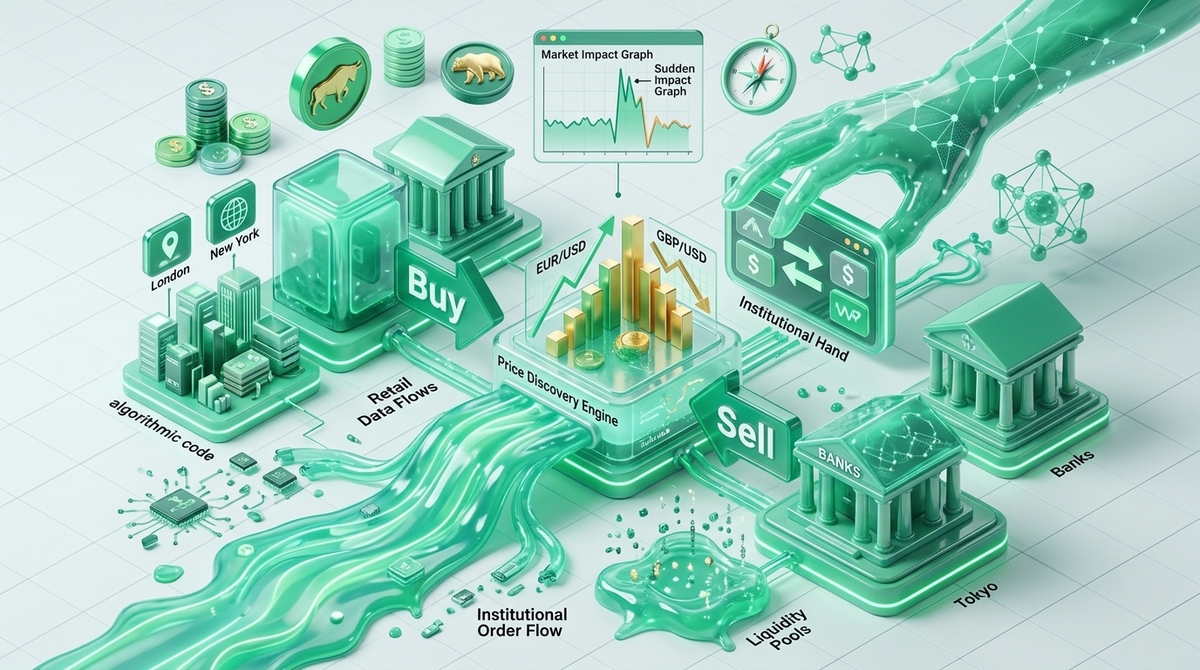
Institutional traders move the forex market by executing enormous transaction volumes that absorb available market liquidity and influence price discovery. Their actions, driven by macroeconomic analysis, corporate hedging needs, and advanced algorithmic strategies, create the significant price movements that define market trends. Understanding their mechanics is fundamental to analyzing forex market dynamics.
Sudden, powerful price swings in the forex market often leave retail traders feeling caught on the wrong side of an invisible force. These movements are rarely random. They are the footprints of institutional traders: the colossal banks, hedge funds, and asset managers whose actions dictate the flow of global capital. According to the 2022 Bank for International Settlements (BIS) Triennial Central Bank Survey, the forex market’s daily turnover reached $7.5 trillion, with the vast majority of this volume handled by these large players. This article explains who these institutions are, the specific tactics they employ to execute trades, their motivations, and how you can detect their activity in the 2026 market environment, which is increasingly shaped by artificial intelligence and high-speed computing.
Understanding the Titans: Who Are the Institutional Players?

The institutional players in forex are large organizations that trade currencies in massive volumes for reasons ranging from commercial facilitation to pure speculation. The primary categories include Tier-1 banks, which form the interbank market, speculative hedge funds, policy-driven central banks, and long-term asset managers. Their collective activity generates the market’s liquidity and primary directional moves.
To comprehend the forex market’s structure, you must first identify the main categories of institutional participants. These entities collectively dictate the flow and direction of the great majority of foreign exchange transactions, creating the ecosystem in which all other traders operate. The interbank market, dominated by Tier-1 banks, accounts for over 50% of all forex volume, establishing it as the core of the global currency markets.
Tier-1 Banks and the Interbank Market
Tier-1 banks, such as JPMorgan, UBS, and Citi, function as the primary market makers in the forex ecosystem. They operate within the interbank market, a global network where they trade currencies directly with one another. This market is the top level of the foreign exchange hierarchy, setting the baseline exchange rates that trickle down to all other market participants. These banks have a dual role: they facilitate massive orders for their corporate clients who need to hedge currency risk, and they also engage in proprietary trading, where they speculate on currency movements for their own profit. The Euromoney FX Survey consistently ranks these banks based on their market share, highlighting their dominance.
The key functions of Tier-1 banks in the forex market are:
- Providing the foundational liquidity for the entire market, ensuring buy and sell orders can be matched.
- Setting the core bid-ask spread, from which all other brokers derive their own pricing.
- Processing immense volumes of commercial and corporate transactions, such as currency conversions for international trade.
Hedge Funds and Speculative Giants
Hedge funds are aggressive, profit-driven institutional players that use sophisticated strategies to speculate on forex market movements. Unlike banks that also service clients, a hedge fund’s primary objective is to generate high returns for its investors. They achieve this by employing significant leverage, which allows them to control large currency positions with a relatively small amount of capital, amplifying both potential gains and losses. Common strategies include global macro trading, which involves making bets based on broad economic trends, and carry trades, where they profit from interest rate differentials between two currencies.
The potential market impact of these funds is substantial. A historical example is the action of George Soros and his Quantum Fund in 1992, who famously shorted the British pound, betting that the Bank of England could not maintain its fixed exchange rate. Their massive speculative pressure contributed to the pound’s withdrawal from the European Exchange Rate Mechanism, an event that demonstrated how a large, determined fund can challenge even a central bank. Data from firms like Hedge Fund Research (HFR) tracks the performance and asset flows of these speculative giants.
Central Banks and Sovereign Wealth Funds
Central Banks, such as the U.S. Federal Reserve (Fed), the European Central Bank (ECB), and the Bank of Japan (BoJ), participate in the forex market for policy reasons, not for profit. Their primary mandate is to manage their nation’s currency, control inflation, and maintain stable economic growth. They influence exchange rates through two main methods: direct market intervention, where they buy or sell their currency to influence its value, and verbal intervention, where official statements and speeches signal future monetary policy intentions. A central bank’s actions can cause some of the most powerful and sustained trends in the market.
Sovereign Wealth Funds (SWFs), which are state-owned investment funds, also represent a major institutional force. According to the Sovereign Wealth Fund Institute, these funds manage trillions of dollars in assets. While their investment horizon is very long-term, their portfolio rebalancing decisions—selling one currency to buy another to adjust asset allocation—can create significant, slow-moving waves of demand or supply in the market.
Asset Management and Pension Funds
Asset managers and pension funds, including giants like BlackRock and Vanguard, are institutional players whose primary forex activity supports their main investment goals. These entities trade foreign currency principally to facilitate international investments, such as buying foreign stocks or bonds, and to hedge the currency risk associated with their existing foreign assets. For example, if a U.S.-based pension fund holds billions of euros worth of German stocks, it may sell euros against the dollar to protect the portfolio’s value from a potential decline in the EUR/USD exchange rate.
Their actions are often slower and more predictable than those of hedge funds. Many of these currency flows are tied to portfolio rebalancing schedules, leading to noticeable market effects around month-end or quarter-end periods. While their motive is not speculation, the sheer size of their transactions creates substantial, one-sided flows that other market participants must account for.
The Mechanics of Market Impact: How Large Orders Reshape Prices

Large institutional orders reshape prices by consuming all available liquidity at current price levels, forcing the market to move to new prices to find counter-parties. This process is not as simple as placing one large order; institutions use sophisticated execution mechanics, algorithms, and an understanding of order flow to minimize their own costs and strategically influence price action.
The transition from understanding “who” the players are to “how” they move the market requires a look at their trading operations. The sheer scale of their orders prevents them from trading like a retail participant. Executing a billion-dollar position requires a deliberate and methodical approach to navigate the market’s liquidity landscape without causing excessive slippage that would harm their own entry price.
The Concept of Order Flow and Liquidity Pools
Order flow is the real-time stream of buy and sell orders being executed in the market, representing the raw dynamic of supply and demand. Institutions must execute their massive positions where there is sufficient liquidity—a large number of opposing orders—to absorb their trade without causing a dramatic price shift against them, an effect known as slippage. These areas of high order concentration are called liquidity pools. Why do institutions target these pools? Because they provide the necessary volume to fill a large position efficiently.
Liquidity pools typically form at predictable price levels where many traders place their pending orders. These include areas just above recent highs, where buy-stop orders from short-sellers and breakout-buy orders from bulls congregate, and areas just below recent lows, where sell-stop orders from long-traders and breakout-sell orders gather. Institutions, knowing this, can drive price toward these pools to trigger a cascade of orders, providing the liquidity they need to enter or exit their own positions.
Execution Strategies: From TWAP to Algorithmic Trading
An institution cannot simply place a single multi-billion dollar market order for a currency pair. Doing so would instantly exhaust all available liquidity at the current price and subsequent price levels, resulting in a terrible average entry price. To avoid this, they use specialized execution algorithms designed to break up a large order into smaller, more manageable pieces that can be fed into the market over time. These algorithms are a cornerstone of modern institutional trading.
Three classic execution algorithms they employ are:
- TWAP (Time-Weighted Average Price): This algorithm slices a large order into smaller pieces and executes them at regular intervals over a specified period, aiming to achieve an average price close to the period’s time-weighted average.
- VWAP (Volume-Weighted Average Price): This strategy executes order pieces in proportion to the market’s trading volume, becoming more active during high-volume periods and less active during lulls to minimize market impact.
- Iceberg Orders: This method hides the true size of a large order by showing only a small, visible portion (the “tip of the iceberg”) to the market at any time. Once the visible part is filled, another portion is revealed until the entire order is complete.
Stop Hunting and Liquidity Grabs Explained
Stop hunting, also called a stop run, is the practice of deliberately driving price to a level where a high concentration of stop-loss orders is known to exist. This action serves a dual purpose for institutional traders. First, triggering a cascade of stop-loss orders creates a surge of market orders, which provides the immense liquidity they require to fill their large positions. Second, it clears out traders who held positions opposing the institution’s intended direction, removing potential resistance.
A typical stop hunt unfolds in a clear sequence. The price might consolidate in a range, building up stop-loss orders above the range high and below the range low. An institution wanting to go short might first push the price sharply upward to trigger the buy-stops above the high. As breakout traders also jump in, the institution sells into this buying frenzy, filling its large short position at a favorable price. The price then reverses sharply, trapping the breakout buyers and leaving the institution in a strong position as the market moves in its intended direction.
The Ripple Effect of Large-Scale Hedging
Not all major market moves are speculative; many are the result of large-scale corporate hedging. Imagine a U.S.-based multinational corporation like Apple, which earns revenue in multiple currencies around the world. At the end of a quarter, it may need to convert billions of euros, yen, and pounds back into U.S. dollars for its financial reporting. This creates a massive, one-directional demand for USD that is largely insensitive to the current price. The corporation’s bank, tasked with executing this conversion, must buy USD systematically over a period of time.
This type of corporate flow can create a sustained, grinding trend in a currency pair. A similar effect occurs around major options expiry dates. As a currency pair approaches a major strike price where a large volume of options is set to expire, the banks that sold these options may need to hedge their exposure by buying or selling the underlying currency. This hedging activity can “pin” the price to the strike price or cause a rapid move away from it as the expiry time nears.
Key Drivers Behind Institutional Trading Decisions

Institutional trading decisions are primarily driven by three factors: in-depth fundamental analysis of macroeconomic data, shifts in global risk sentiment, and the fulfillment of large-scale corporate needs such as cross-border mergers. These drivers determine the long-term theses and short-term positioning of the market’s largest players, moving beyond simple technical chart patterns.
Moving from the “how” to the “why,” we examine the fundamental factors that prompt institutions to deploy billions of dollars. Their decisions are not made on a whim but are the result of rigorous analysis and a deep understanding of global economic and financial currents. These core drivers are what create the powerful, long-lasting trends in the forex market.
Macroeconomic Data and Fundamental Analysis
Institutions build their long-term directional biases based on the relative economic health of nations. They meticulously analyze macroeconomic data to forecast future central bank policy and currency strength. While retail traders often react to the headline number, institutions trade the deviation from the consensus expectation, as the expected outcome is already priced in. How do I know which data is most important? The market pays closest attention to releases that directly influence interest rate policy.
Key data points that institutions monitor include:
- Interest Rate Decisions: The single most important driver, along with the central bank’s forward guidance on future policy.
- Inflation Reports: Data like the Consumer Price Index (CPI) and Producer Price Index (PPI) are critical indicators of inflation, which heavily influences central bank actions.
- Employment Data: Reports such as the U.S. Non-Farm Payrolls (NFP) and the unemployment rate signal the health of the labor market.
- GDP Growth: Gross Domestic Product measures the overall economic output and health of a country.
Global Capital Flows and Risk-On or Risk-Off Sentiment
Global risk sentiment dictates the flow of capital between asset classes and currencies. This sentiment is typically categorized as either “Risk-On” or “Risk-Off.” In a Risk-On environment, investors are optimistic and seek higher returns by buying riskier assets, which includes the currencies of commodity-producing countries like the Australian Dollar (AUD) and New Zealand Dollar (NZD), along with equities. In a Risk-Off environment, fear dominates, and investors flee to safety. This prompts massive capital flows into safe-haven currencies like the Japanese Yen (JPY), the Swiss Franc (CHF), and the U.S. Dollar (USD).
Major geopolitical events, financial crises, or global health emergencies are common triggers for these sentiment shifts. In response, institutions will rapidly reposition their entire global portfolios, selling risk assets and buying safe havens. This large-scale repositioning is what causes the strong, correlated moves across different currency pairs that are characteristic of a risk-off market. The VIX Index, a measure of stock market volatility, is often used as a proxy for overall market fear.
Mergers, Acquisitions, and Corporate Needs
Large-scale corporate finance activities, especially cross-border Mergers and Acquisitions (M&A), create enormous and predictable demand for a specific currency. For a concrete example, if a U.S.-based company announces it is acquiring a German company for €10 billion, that U.S. company must purchase €10 billion by selling U.S. dollars. This transaction is far too large to be executed at once.
The deal is typically handled by a Tier-1 bank, which will execute the massive currency conversion over days or even weeks to minimize market disruption. This creates a sustained, one-sided buying pressure on the EUR/USD pair that is entirely disconnected from day-to-day economic data or speculative sentiment. Financial news outlets like Reuters and Bloomberg often report on these deals, giving traders a heads-up about potential large-scale flows.
Detecting the Institutional Footprint: Tools and Indicators for 2026
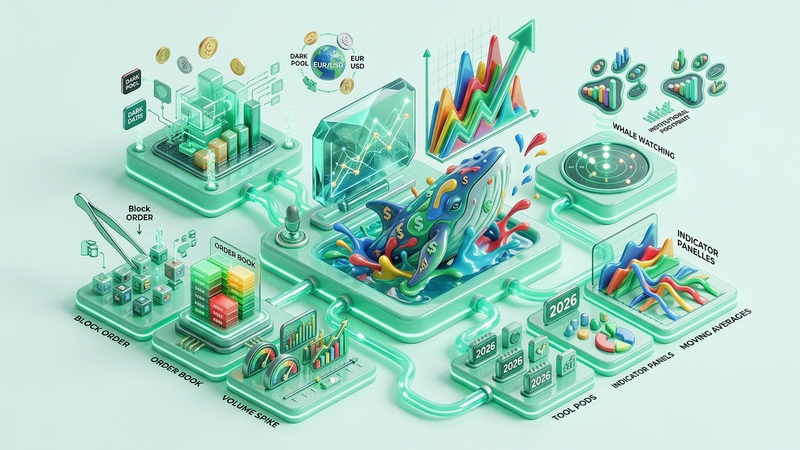
Retail traders can detect the institutional footprint by using specialized tools that analyze volume distribution, trader positioning, and order book depth. Key methods for 2026 include Volume Profile analysis to see where institutions traded, the Commitment of Traders (COT) report to gauge their sentiment, and order book data to spot large pending orders.
This information becomes practical when you can identify evidence of institutional activity on your own charts. While you may not have access to their proprietary systems, several publicly available tools and reports can provide strong clues about where and how the “smart money” is operating. The Commitment of Traders report, published weekly by the CFTC, provides a transparent breakdown of positioning among different market participants.
Volume Profile Analysis and Price Distribution
Volume Profile is an advanced charting tool that displays trading volume horizontally at different price levels, in contrast to traditional volume indicators that show volume over time. This tool reveals the price levels where the most and least amount of trading occurred. High-Volume Nodes (HVNs) appear as peaks in the profile and represent areas of price agreement and consolidation, where institutions have likely been accumulating or distributing large positions. These levels often act as strong support or resistance in the future.
Conversely, Low-Volume Nodes (LVNs) are valleys in the profile, indicating price levels that were quickly rejected by the market. Price tends to move rapidly through LVNs as there is little perceived value or interest at those levels. By analyzing the Volume Profile, traders can identify the “fair value” areas where institutions are active and distinguish them from inefficient price zones, helping to frame trade ideas around institutional levels.
Interpreting the Commitment of Traders (COT) Report
The Commitment of Traders (COT) report, issued weekly by the U.S. Commodity Futures Trading Commission (CFTC), provides a detailed breakdown of the net long and short positions held by different types of traders in the futures market. For forex traders, the most important categories are “Commercials” (hedgers, often considered the “smart money”) and “Non-Commercials” or “Large Speculators” (hedge funds and other large traders). The report shows the collective positioning of these institutional groups.
By tracking the net positioning of Large Speculators, you can gauge the dominant speculative sentiment in a currency. More importantly, when their positioning reaches an extreme net long or net short level, it can often signal that a trend is overextended and a reversal is imminent. What is the difference between Commercial and Non-Commercial positioning? Commercials typically take positions opposite the prevailing trend to hedge their business exposure, while Non-Commercials follow the trend for speculative profit.
| Trader Category | Primary Motivation | Typical Market Role |
|---|---|---|
| Commercials | Hedging commercial risk | Takes positions against the primary trend (sells into rallies, buys into dips). |
| Large Speculators | Speculative profit | Follows the primary trend (buys into rallies, sells into dips). |
| Non-reportable (Retail) | Speculative profit | Often positioned against the institutional trend at turning points. |
Order Book Analysis and Market Depth
An order book, also known as Depth of Market (DOM), displays a real-time list of outstanding buy and sell limit orders at different price levels. While the decentralized forex spot market lacks a single central order book, data from major forex futures exchanges like the CME Group provides a valuable proxy for institutional interest. Analyzing the order book allows traders to see where large pools of limit orders are clustered, which often act as near-term support and resistance.
Traders can watch for large limit orders appearing on the DOM, which can indicate an institution’s intention to defend a certain price level. However, it is also important to be aware of “spoofing,” an illegal manipulative practice where a trader places a large order with no intention of letting it get filled. The goal of spoofing is to trick other participants into trading in a certain direction before the large order is quickly canceled.
The Evolution of Institutional Trading: AI, HFT, and Future Trends

Institutional trading in 2026 is evolving rapidly due to advancements in artificial intelligence (AI), high-frequency trading (HFT), and changing regulations. AI-powered models are enabling predictive analysis of vast alternative datasets, while HFT firms dominate short-term liquidity provision. These technological shifts are creating a more complex and faster market environment.
The methods used by institutional players are not static. Technology is constantly reshaping their strategies and impact on the market. Looking toward 2026, several key trends are defining the future of institutional forex trading. In 2023, a report by the Cambridge Centre for Alternative Finance noted that AI/ML adoption in the financial sector was growing at an accelerated pace, a trend expected to define market structure by 2026.
The Rise of AI-Powered Predictive Models
The next frontier of institutional trading moves beyond simple execution algorithms to sophisticated Artificial Intelligence (AI) and Machine Learning (ML) models. These systems are capable of analyzing immense volumes of unstructured data to find a predictive edge. For example, an AI model can scan millions of news articles, social media posts, and central bank speeches in milliseconds to gauge market sentiment in real-time. Some advanced quantitative funds even use alternative data like satellite imagery of oil tankers or shipping routes to forecast economic activity.
These AI-powered models can identify complex, non-linear correlations between thousands of variables that are invisible to human analysts. By processing this information faster and more comprehensively than any human team, institutions that successfully deploy these models gain a significant information advantage, allowing them to anticipate market moves before they happen.
High-Frequency Trading’s Role in Short-Term Volatility
High-Frequency Trading (HFT) is a type of algorithmic trading characterized by extremely high speeds, with trades executed in microseconds. HFT firms use powerful computers and co-location (placing their servers in the same data center as an exchange’s server) to gain a speed advantage. Their primary strategies are not based on long-term economic views but on exploiting tiny, fleeting price discrepancies. These strategies include market-making, where they simultaneously post buy and sell orders to profit from the bid-ask spread, and latency arbitrage, where they exploit price differences for the same asset across different exchanges.
HFT has a dual impact on the market. On one hand, it provides a massive amount of liquidity, which can tighten spreads and make trading more efficient. On the other hand, it is also a major contributor to short-term volatility and has been implicated in “flash crashes,” where prices plummet and rebound in a matter of seconds due to cascading and interacting algorithms.
The Impact of Evolving Global Regulations
The regulatory environment continuously shapes institutional behavior. Following the 2008 financial crisis, regulations like the Dodd-Frank Act in the U.S. and MiFID II in Europe were introduced to increase transparency and reduce systemic risk. These rules curtailed certain activities, such as proprietary trading by commercial banks, shifting some speculative activity from banks to hedge funds. Looking ahead to 2026, new regulatory frameworks are expected to address emerging technologies and asset classes.
Potential future regulations could focus on the use of AI in trading to prevent market manipulation, the integration of digital assets and central bank digital currencies (CBDCs) into the financial system, and enhanced data privacy rules. Each new piece of regulation forces institutions to adapt their systems, strategies, and compliance frameworks, which can in turn alter market dynamics and liquidity conditions.
Navigating the Institutional Wake: Strategies for Retail Traders
Retail traders can navigate the institutional wake by aligning their trades with institutional order flow, practicing disciplined risk management during high-impact events, and understanding the critical differences that make direct mimicry of institutions a flawed approach. The goal is to trade alongside them, not against them or exactly like them.
Given the immense power of institutional players, how can a retail trader survive and potentially thrive? The key is not to fight them but to understand their behavior and use it to your advantage. This means shifting your perspective from trying to predict the market to reacting to the clear evidence of institutional activity. A core principle of risk management is that you cannot control the market, only your exposure to it.
Aligning Trades with Institutional Order Flow
The most effective strategy is to “swim with the current, not against it.” This means identifying the likely direction of institutional flow and positioning your trades accordingly. Instead of trying to pick tops and bottoms, you wait for institutions to show their hand and then look for a low-risk entry in the direction of their momentum. Why does this work? Because once an institution commits to a large position, it will often defend that position, creating a more reliable trend.
You can apply this with a few actionable steps:
- Identify key institutional levels on your chart using tools like Volume Profile, as well as significant prior highs and lows where liquidity pools are likely to form.
- Wait for a clear liquidity grab or stop hunt to occur at one of these levels. Do not trade into the initial spike.
- Enter a trade after the stop hunt is complete and the price begins to move decisively in the opposite direction, confirming the institution’s true intent.
- Place your stop-loss on the other side of the institutional manipulation, giving your trade a logical and protected position.
Managing Risk During High-Impact Events
Major scheduled news events, such as NFP reports or FOMC interest rate decisions, are institutional battlegrounds. During these releases, liquidity vanishes, spreads widen dramatically, and volatility becomes extreme. For most retail traders, attempting to trade through the initial seconds or minutes of a news release is a form of gambling, not trading.
A more prudent approach is to remain flat (out of the market) immediately before and during the release. Wait for the initial chaotic price swings to subside and for the market to digest the new information. Once the dust has settled and a clear directional bias emerges, you can then look for a technical entry in line with the post-news trend, which is often driven by institutional repositioning.
Why Mimicking Institutions Directly Is a Flawed Strategy
It is critical for retail traders to understand that they cannot and should not try to trade exactly like an institution. There is a fundamental asymmetry of information, capital, and infrastructure that makes direct mimicry impossible and dangerous. For example, an institution can execute a large position and withstand a significant drawdown (a temporary loss) while waiting for their long-term thesis to play out; a retail trader with a leveraged account cannot afford to do so.
Furthermore, institutions trade for different reasons. A corporate treasurer hedging a multi-billion dollar exposure is not operating on the same logic as a retail trader looking for a 50-pip scalp. Their time horizons are vastly different. The goal is not to be an institution, but to understand their likely behavior to make better-informed decisions on a retail scale and avoid being positioned as liquidity for their larger objectives.
While we’ve covered the core mechanics of how institutions operate, many traders have specific questions about some of the more nuanced or controversial aspects of their market influence. Let’s address some of the most common queries.
Frequently Asked Questions About Institutional Forex Trading
Do Institutional Traders Intentionally Manipulate the Forex Market?
The answer is nuanced; while tactical execution can appear manipulative, it is different from illegal collusion. Most market movement caused by institutions is a natural byproduct of their executing legitimate, large-scale business and investment strategies. Tactics like stop hunting are employed to acquire necessary liquidity, which is a strategic part of order execution. This differs from illegal manipulation, such as the proven cases of banks colluding to fix FX benchmark rates (the LIBOR and FX fixing scandals), which involves explicit and illegal cooperation to defraud clients.
What Is a “Dark Pool” in Forex Trading?
A dark pool is a private, anonymous exchange where institutions can trade large blocks of financial instruments, including forex, without revealing their intentions to the public market. Their purpose is to allow the execution of massive orders without causing immediate, adverse price movements (market impact) that would occur if the order were placed on a public exchange. By trading in a dark pool, an institution can buy or sell a large position without tipping off other market participants.
What Are the Main Types of Institutional Trading Algorithms?
Institutional trading algorithms can be grouped into three main categories based on their objective:
- Execution Algorithms: These are designed to minimize the market impact of executing a large order. Examples include TWAP (Time-Weighted Average Price) and VWAP (Volume-Weighted Average Price).
- High-Frequency Trading (HFT) Algorithms: These are built for speed and aim to profit from small, short-lived market inefficiencies. Examples include arbitrage and market-making algorithms.
- AI/Machine Learning Algorithms: These use advanced data analysis to predict the future direction of the market based on a wide range of inputs, including news, sentiment, and economic data.
How Does Institutional Trading in Forex Differ from Stock Trading?
Institutional trading in forex differs from stock trading primarily in market structure, primary drivers, and liquidity. The forex market is a decentralized, over-the-counter (OTC) market dominated by macroeconomics and interest rates, while the stock market consists of centralized exchanges driven by company-specific factors like earnings. Major forex pairs also offer significantly deeper liquidity than most individual stocks.
The Inherent Risks of Ignoring Institutional Market Movers
Ignoring the behavior of institutional market movers is one of the greatest risks a retail forex trader can take. When you are unaware of their methods, you are susceptible to being caught in liquidity grabs and stop hunts, repeatedly finding yourself on the wrong side of powerful, unexpected moves. Trading against a strong institutional trend, driven by massive capital flows, is a low-probability strategy that often leads to consistent losses. Understanding institutional behavior is not just an academic exercise; it is a fundamental pillar of robust risk management and a prerequisite for achieving long-term sustainability in the forex market.