
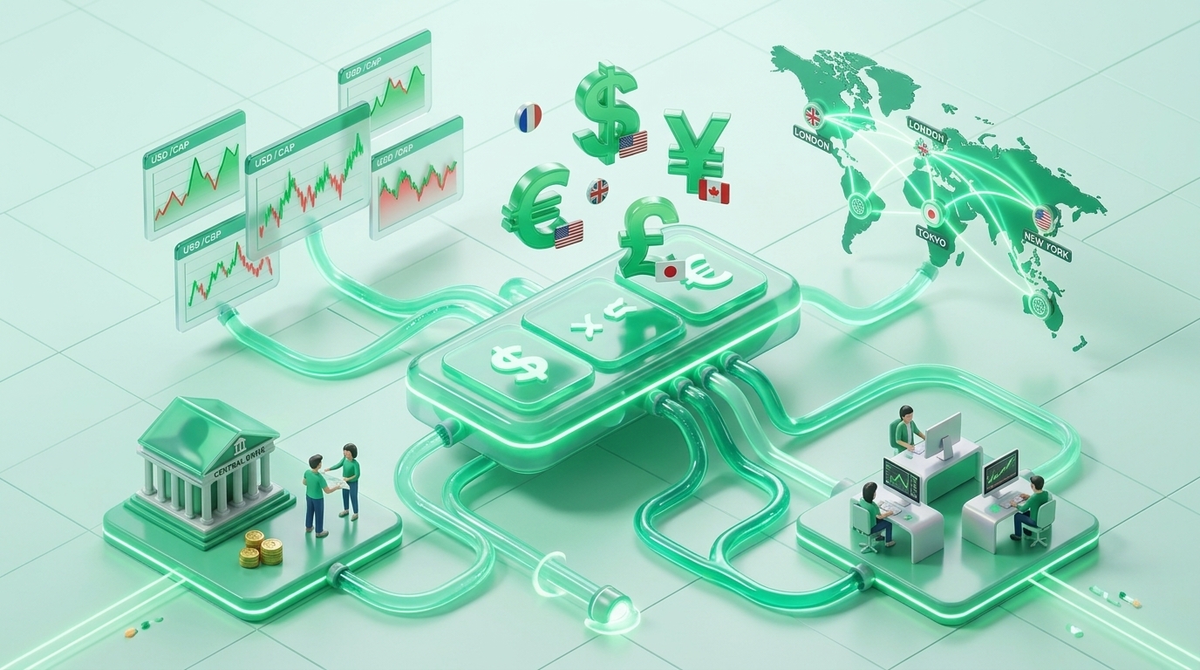
The Forex market is a global, decentralized marketplace for exchanging national currencies, operating 24 hours a day, five days a week. It facilitates international trade and investment by allowing businesses and individuals to convert one currency into another. Its massive scale and high liquidity also attract traders who speculate on exchange rate fluctuations.
If you have ever exchanged your home currency for another before a vacation, you have already participated in the foreign exchange market. On a much larger scale, this is the same mechanism that powers global finance. As the world’s largest financial market, its daily trading volume exceeds $7.5 trillion, according to the Bank for International Settlements (BIS) Triennial Survey. This plain-English guide will provide you with a solid foundation for understanding currency trading and its role in the global economy in 2026.
What Is the Forex Market and Why Does It Matter?

The Forex market is a decentralized, over-the-counter (OTC) global network where currencies are traded. It matters because it underpins the global economy, enabling everything from international corporate transactions and government operations to tourism. Without a mechanism for currency conversion, cross-border trade and investment at their current scale would be impossible.
The foreign exchange market is not a physical location but a vast electronic network connecting banks, corporations, and individuals. Its primary function is to facilitate currency conversion for international trade and investment, a flow driven by data from organizations like the World Trade Organization (WTO). For example, when a German car manufacturer buys steel from the United States, it must convert Euros (EUR) to US Dollars (USD) to complete the purchase. Similarly, when a Japanese investor wants to buy UK government bonds, they must exchange Japanese Yen (JPY) for British Pounds (GBP). Even a tourist visiting Egypt needs to exchange their home currency for Egyptian Pounds (EGP) to pay for goods and services. These activities form the bedrock of the market’s purpose.
Understanding Currency Pairs: The Foundation of Forex Trading
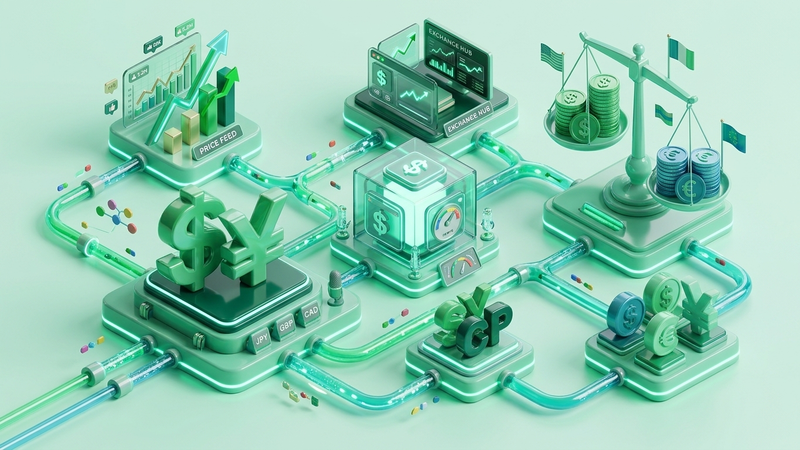
Currency pairs are the central trading instrument in the Forex market, representing the value of one currency relative to another. Every transaction involves simultaneously buying one currency while selling the other. This structure allows traders to speculate on the fluctuating exchange rate between the two currencies, aiming to profit from the change.
In the Forex market, you never trade a currency in isolation; you always trade it as part of a pair. This is the core concept of currency trading. The value of a currency is always expressed in terms of another. When you execute a trade, you are making a judgment on the future strength of one currency against the other. If you believe the first currency in the pair will strengthen, you buy the pair. If you believe it will weaken, you sell the pair. This speculation on exchange rate fluctuation is the source of both potential profit and loss.
How to Read a Currency Pair: Base vs. Quote Currency
Reading a currency pair involves understanding the roles of the base currency and the quote currency. The base currency is the first currency listed in the pair (e.g., EUR in EUR/USD) and always has a value of one. The quote currency is the second one listed, and its value indicates how much of it is needed to purchase one unit of the base currency.
Consider the currency pair EUR/USD = 1.0850.
- Base Currency: EUR. This is the currency you are conceptually buying or selling.
- Quote Currency: USD. This is the currency used to price the base currency.
This quote means it costs 1.0850 US dollars to buy exactly 1 Euro. If you buy the pair, known as “going long,” you are buying Euros and selling US Dollars, expecting the Euro to strengthen against the Dollar. Conversely, if you sell the pair, or “go short,” you are selling Euros and buying US Dollars, expecting the Euro to weaken.
Major, Minor, and Exotic Pairs Explained
Currency pairs are categorized into three main groups based on their global trading volume and liquidity: majors, minors, and exotics. This classification helps traders understand a pair’s typical volatility and associated trading costs, such as the bid-ask spread. The major pairs are the most liquid and widely traded currency pairs in the forex market.
| Pair Type | Description | Examples |
|---|---|---|
| Major Pairs | Pairs that include the US Dollar (USD) and another major world currency. They account for the vast majority of all forex trading. | EUR/USD, USD/JPY, GBP/USD, USD/CHF, AUD/USD, USD/CAD |
| Minor Pairs (Cross-Currency) | Pairs of major currencies that do not include the US Dollar. They are also highly liquid but less so than the majors. | EUR/GBP, EUR/JPY, GBP/JPY, AUD/NZD |
| Exotic Pairs | A major currency paired with the currency of a smaller or emerging economy. These pairs have lower liquidity, higher volatility, and wider bid-ask spreads. | USD/ZAR (South African Rand), EUR/TRY (Turkish Lira), GBP/MXN (Mexican Peso) |
Who Are the Key Participants in the Forex Market?
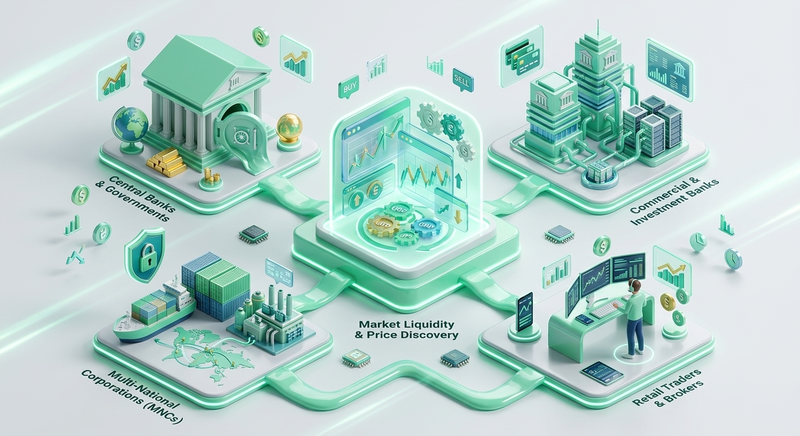
The key participants in the Forex market form a hierarchy, ranging from massive financial institutions at the top to individual retail traders at the bottom. This structure determines how prices are set and how liquidity flows through the system. At the core is the interbank market, where the largest banks trade currencies directly with one another.
This tiered structure means that different participants access the market with varying levels of pricing and volume. The largest players deal in volumes that grant them the tightest pricing, while smaller participants access the market through intermediaries. Understanding this market hierarchy helps explain why a large corporation gets a better exchange rate than a tourist at an airport kiosk.
The Big Players: Central Banks and Commercial Banks
The largest participants shaping the Forex market are central banks and major commercial banks. Central banks, such as the United States Federal Reserve (The Fed) or the European Central Bank (ECB), intervene in the market to manage their country’s monetary policy, control inflation, and stabilize their currency. They do not trade for profit but to achieve economic goals, often by using their substantial foreign exchange reserves.
Major commercial banks like Citi, JPMorgan, and UBS form the interbank market, which is the top level of the Forex hierarchy. These banks act as dealers, providing liquidity to the market by quoting buy and sell prices for currencies. They execute trades for their clients—including corporations and investment funds—and also trade for their own proprietary accounts, accounting for the bulk of the market’s daily trading volume.
Corporations, Investment Funds, and Retail Traders
Beyond the major banks, several other groups participate in the Forex market for different reasons. The following list identifies these key participants:
- Multinational Corporations: These companies engage in the market for operational purposes. For example, a corporation may need to pay suppliers in a foreign country, hedge against currency risk on international sales, or repatriate profits earned abroad.
- Investment and Hedge Funds: These firms trade currencies for speculative purposes, managing large portfolios for their clients. They often use complex strategies to profit from anticipated currency movements, sometimes placing very large bets on economic outcomes.
- Retail Traders: This group consists of individuals who trade their own money to speculate on currency fluctuations. The growth of online brokers and accessible trading platforms has made the Forex market available to a much wider audience of retail forex traders than ever before.
How and When Does Forex Trading Happen?

Forex trading happens continuously across a global network of computers, 24 hours a day, five days a week. Because the market is decentralized and over-the-counter (OTC), it has no central physical exchange. Instead, electronic trading allows participants from all over the world to buy and sell currencies at any time during the trading week.
This 24-hour cycle is possible because different financial centers around the world operate during their respective business hours. As one major market closes, another one opens, creating a seamless and continuous trading environment. The trading week begins on Monday morning in Sydney, Australia, and ends on Friday afternoon in New York, USA. This constant activity is a defining feature of the Forex market, and a user might ask, “When is the best time to trade forex?” The answer often relates to when multiple market sessions overlap, as this increases trading activity.
The 24-Hour Market: Trading Across Global Sessions
The 24-hour Forex market is structured around four major trading sessions, named after the primary financial centers active during those times: Sydney, Tokyo, London, and New York. The market’s activity level, measured by liquidity and volatility, changes as these sessions open and close. The London session is the largest and most important, accounting for a significant portion of daily turnover.
The highest trading volumes typically occur when two sessions overlap. The most significant of these is the London and New York session overlap, as it combines the two largest financial centers in the world. This period sees heightened market volatility and provides the most trading opportunities. The following table shows the approximate times for each session.
| Session | Opening Time (UTC) | Closing Time (UTC) |
|---|---|---|
| Sydney | 22:00 | 07:00 |
| Tokyo | 00:00 | 09:00 |
| London | 08:00 | 17:00 |
| New York | 13:00 | 22:00 |
What Factors Influence Currency Exchange Rates in 2026?

Currency exchange rates in 2026 are influenced by a combination of economic data, central bank policies, geopolitical events, and market sentiment. The value of a currency reflects the perceived economic health and stability of its home country. Traders use both fundamental analysis of economic factors and technical analysis of price charts to forecast these movements.
A central question for any trader is, “What makes currency prices move?” The answer lies in supply and demand. If demand for a currency is high, its value increases, and vice versa. This demand is driven by factors that suggest a country’s economy is strong and its future is stable. Looking ahead to 2026, emerging influences like the speed of Central Bank Digital Currency (CBDC) adoption and the accuracy of AI-driven economic forecasting are becoming more prominent in shaping market expectations and price movement.
Economic Indicators: Interest Rates, Inflation, and GDP
A country’s economic data provides the most direct insight into its currency’s potential strength or weakness. The following economic indicators are among the most closely watched by Forex traders:
- Interest Rates: Set by a country’s central bank, interest rates are the most powerful driver of currency valuation. Higher interest rates offer better returns on currency-denominated assets, attracting foreign investment and increasing demand for the currency. This relationship is known as interest rate differentials.
- Inflation: A high inflation rate erodes a currency’s purchasing power and is generally negative for its value. Reports like the Consumer Price Index (CPI) are monitored to gauge inflation trends.
- Gross Domestic Product (GDP): GDP measures the total value of all goods and services produced by a country, serving as a comprehensive scorecard of its economic health. A strong GDP report indicates economic growth and is positive for the currency.
- Employment Data: Reports such as the U.S. Non-Farm Payrolls (NFP) provide a snapshot of the labor market’s health. Strong employment figures signal a robust economy, which supports a stronger currency.
Geopolitical Events and Market Sentiment
Geopolitical risk and market sentiment are powerful forces that can cause rapid and significant price movements. Political stability is a key factor; events like major elections, trade disputes, or international conflicts create uncertainty and can cause investors to move their capital away from the affected currency. For example, the uncertainty surrounding the Brexit vote caused a sharp decline in the value of the British Pound (GBP).
Market sentiment describes the collective mood of traders, which can shift between “risk-on” and “risk-off.” During risk-on periods, traders have a higher risk appetite and may invest in currencies with higher yields. In risk-off periods, driven by fear or uncertainty, they flee to so-called safe-haven currencies. These currencies, such as the US Dollar (USD), Japanese Yen (JPY), and Swiss Franc (CHF), are associated with stable economies and are expected to retain their value during turbulent times.
A Beginner’s Guide to Making a Forex Trade
Making a Forex trade involves choosing a broker, learning a trading platform, and placing an order based on your market analysis. This conceptual walkthrough is designed to illustrate the practical steps an individual takes to participate in the market. It is an educational overview, not financial advice, to show how you can translate a market opinion into a live trade.
The process of placing a trade has become highly accessible to individuals through online forex brokers. These firms provide the necessary software and access to the market, acting as the gateway for retail traders. The core journey involves setting up an account, funding it, and then using the broker’s platform to manage your trades. Understanding this workflow is the first step toward practical participation.
Step 1: Choosing a Reputable Forex Broker
Choosing a reputable forex broker is the most important decision a new trader will make, as the broker acts as the intermediary for all trades. A trustworthy broker ensures the safety of your funds and provides fair execution of your orders. Key criteria for selecting a broker include regulation, trading costs, and customer support.
Regulation is the top priority. Your broker should be authorized and regulated by a top-tier financial authority. These agencies enforce strict rules to protect clients. Examples of such bodies include the Financial Conduct Authority (FCA) in the UK, the Australian Securities and Investments Commission (ASIC) in Australia, and the Commodity Futures Trading Commission (CFTC) in the US. You should also evaluate trading fees (spreads), the quality of the trading platforms offered, and the responsiveness of their support team.
Step 2: Understanding Your Trading Platform (MT4/MT5 and Proprietary)
A trading platform is the software you use to analyze the market, view charts, and place your trades. The industry standard for many years has been MetaTrader 4 (MT4) and its successor, MetaTrader 5 (MT5). These platforms are known for their powerful charting tools, a wide range of technical indicators, and support for automated trading strategies.
Many brokers also offer their own proprietary web-based or mobile platforms. These are often designed with a focus on user-friendliness and may be easier for beginners to use. A critical feature offered by most brokers is a demo account. This allows you to practice trading with virtual money in a real market environment, providing a risk-free way to familiarize yourself with the platform and test your strategies.
Step 3: Placing Your First Order: Market, Limit, and Stop-Loss
Placing an order requires understanding the basic order types that tell your broker how to execute your trade. These instructions are fundamental to managing your market entry, exit, and risk. The three primary order types are market, limit, and stop-loss orders.
- Market Order: This instructs your broker to buy or sell immediately at the best available current price. It guarantees execution but not the price.
- Limit Order: This sets a specific price at which you are willing to enter the market. A buy limit order is placed below the current price, and a sell limit order is placed above it. It guarantees the price but not the execution.
- Stop-Loss Order: This is an essential risk management tool. It is an order placed to automatically close a losing trade once it reaches a certain price level, thereby limiting your potential loss on that specific trade. A take-profit order works similarly to lock in profits.
A Simple Forex Trade Example: Buying EUR/USD
A hypothetical trade example can clarify how buying and selling a currency pair works in practice. This scenario illustrates how a trader acts on a market belief and the potential outcomes of profit and loss. It also introduces the concept of a “pip,” the standard unit of measurement for currency price changes.
Let’s imagine you believe the Euro is going to strengthen against the US Dollar based on positive economic news from the Eurozone.
- Premise: You forecast that EUR/USD will rise.
- Action: You decide to “go long” or buy the EUR/USD pair. The current price is 1.0800. You place a buy order.
- Outcome 1 (Profit): The market moves in your favor, and the EUR/USD price rises to 1.0850. You decide to close your trade. The difference is 50 pips (1.0850 – 1.0800 = 0.0050). Depending on your trade size (lot size), this results in a profit.
- Outcome 2 (Loss): The market moves against you, and the price falls to 1.0770. You close the trade to prevent further losses (or your pre-set stop-loss order is triggered). The difference is a 30-pip loss (1.0800 – 1.0770 = 0.0030).
In this example, a pip (Percentage in Point) is the change in the fourth decimal place (0.0001). Understanding pip value is fundamental to calculating profit and loss.
The Inherent Risks of Forex Trading You Must Understand
The inherent risks of Forex trading, primarily stemming from leverage and market volatility, mean that a significant majority of retail traders lose money. You must understand these dangers before committing any risk capital. Regulatory bodies like the CFTC issue warnings that Forex trading involves substantial risk of loss and is not suitable for all investors.
While the market offers opportunities, it is not a path to easy money. The potential for high returns is directly linked to high risk. Both the Commodity Futures Trading Commission (CFTC) and the Financial Conduct Authority (FCA) confirm that most retail client accounts lose money when trading these products. The primary risks you must be aware of are listed below.
- Leverage Risk: Leverage allows you to control a large position with a small amount of capital. While this magnifies potential profits, it also creates magnified losses. It is a double-edged sword that can wipe out your account balance quickly.
- Market Volatility: Exchange rates can change rapidly and unpredictably due to economic or geopolitical events. This volatility can lead to significant losses if the market moves against your position.
- Interest Rate Risk: Unexpected changes in a central bank’s interest rate policy can cause violent swings in currency values.
- Counterparty Risk: This is the risk that your broker could become insolvent and unable to return your funds. This risk is greatly mitigated by choosing a broker regulated by a top-tier authority.
The preceding sections have broken down how the Forex market works, from its core components to the risks involved. Now, looking ahead, it’s important to understand how this massive market is evolving. The forces shaping finance today will define the trading landscape of tomorrow.
The Evolving Landscape: Forex Market Trends for 2026 and Beyond
The Forex market landscape for 2026 is being reshaped by technological advancements like artificial intelligence and the potential introduction of government-backed digital currencies. These trends are changing how trades are analyzed and executed, and could alter the fundamental structure of the market. Staying informed about these shifts is necessary for any market participant.
According to a 2026 analysis of FinTech innovations, AI-driven algorithmic trading now accounts for a growing percentage of daily trading volume. These systems can process vast amounts of economic data and news in milliseconds to execute trades faster than any human. Another major trend is the development of Central Bank Digital Currencies (CBDCs). Research from institutions like the Bank for International Settlements (BIS) on CBDC development indicates that dozens of central banks are exploring these. The introduction of a digital dollar or digital euro could have a profound impact on cross-border payments and the role of traditional intermediaries. Finally, while cryptocurrencies like Bitcoin are not part of the traditional Forex market, their price volatility often influences broader risk sentiment, causing capital to flow into or out of safe-haven currencies.
Is Forex Trading Right for You? Weighing the Opportunities and Dangers
Deciding if Forex trading is right for you requires a realistic assessment of your financial goals, risk tolerance, and commitment to continuous learning. The market offers high liquidity and accessibility, but it is a high-risk activity that is unsuitable for individuals who cannot afford to lose their trading capital. It is not a get-rich-quick scheme.
The information in this guide shows that Forex is a legitimate and vital component of the global economy. However, successfully trading it demands discipline, education, and a robust risk management strategy. Before committing real funds, you should spend considerable time on a demo account to practice your strategies and learn the emotional pressures of trading. Your decision should be based on a clear understanding of both the potential rewards and the significant dangers involved.
Frequently Asked Questions About the Forex Market
What Is a “Pip” in Forex?
A “pip” stands for “Percentage in Point” and is the smallest standard price move that a currency pair can make. For most currency pairs quoted to four decimal places, like the EUR/USD, one pip is equal to 0.0001. For pairs involving the Japanese Yen (JPY), a pip is the second decimal place (0.01).
Is the Forex Market Regulated?
The answer is both yes and no. The market itself is decentralized and not controlled by a single entity, but the brokers and dealers who provide access to the market are regulated by national authorities. It is absolutely necessary to choose a broker that is licensed and overseen by a top-tier regulator, such as the FCA in the UK or ASIC in Australia, to protect your funds.
What Are the Main Types of Forex Analysis?
The three main types of analysis used to forecast market movements are technical, fundamental, and sentiment analysis. Most traders use a combination of these approaches. The primary types are:
- Technical Analysis: Studying historical price charts and patterns to predict future price action.
- Fundamental Analysis: Analyzing a country’s economic data, government policy, and geopolitical events to determine a currency’s intrinsic value.
- Sentiment Analysis: Gauging the overall mood or bias of market participants to determine if they are generally bullish (risk-on) or bearish (risk-off).
What Is the Difference Between a Forex Broker and a Market Maker?
A forex broker can operate under different models, and a market maker is one specific type. A broker can be an intermediary (an ECN or STP broker) that passes your trade directly to a liquidity provider, whereas a market maker is a type of broker that takes the other side of your trade. By creating a “market” for you, a market maker profits from the bid-ask spread but also creates a potential conflict of interest, as your loss is their gain.