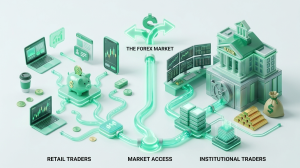


The choice between a Market Maker and an ECN broker is one of the most critical decisions a forex trader will make, directly impacting costs, execution quality, and potential profitability. The right selection depends entirely on your trading style, account size, and tolerance for different fee structures. This guide provides a definitive comparison to help you choose the correct model for your trading success in the 2026 landscape.
Choosing between a Market Maker and an Electronic Communication Network (ECN) broker is a foundational decision that shapes your trading experience. Market Makers offer simplicity and fixed costs, making them suitable for beginners, while ECN brokers provide direct market access and tighter spreads for experienced, high-volume traders. Understanding their core differences in trade execution and business models is the first step toward aligning a broker with your long-term profitability goals.
Understanding the Core Difference: Execution Model and Conflict of Interest

The core difference between broker types is the execution model, which dictates how a trader’s order is processed and whether the broker has a potential conflict of interest. A broker’s execution model determines whether it acts as a counterparty to a client’s trade or as an intermediary. This distinction separates brokers into two primary categories: Dealing Desk (DD) and No Dealing Desk (NDD).
The fundamental distinction between a Market Maker and an ECN broker lies in how they handle your trades and where their profits originate. A Market Maker operates a “dealing desk” and may act as the counterparty to your trade, creating a potential conflict of interest. An ECN broker, in contrast, acts as a pure intermediary, routing your orders to a network of liquidity providers and profiting from commissions, which aligns their interests with yours. Grasping this core tension is fundamental to making an informed choice.
What Is a Market Maker (Dealing Desk) Broker?
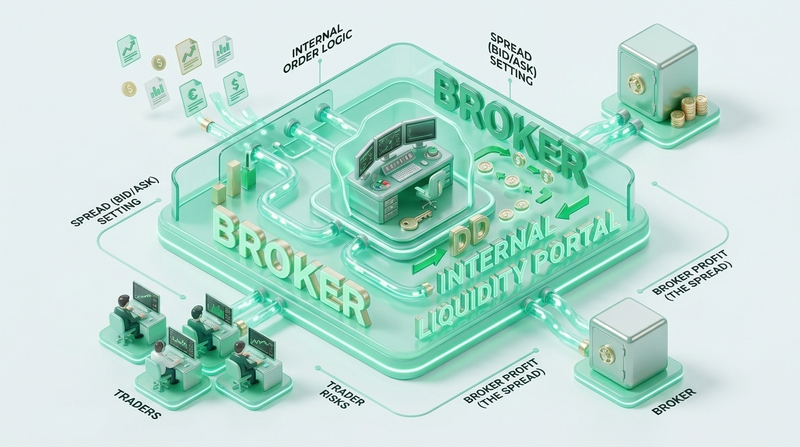
A Market Maker (MM), also known as a Dealing Desk (DD) broker, is a financial firm that creates its own internal market for clients by setting its own bid and ask prices. Market Maker brokers create their own internal market and act as the direct counterparty to their clients’ trades. This means when a client buys, the Market Maker sells, and vice versa, creating liquidity from its own resources.
A Market Maker is a brokerage that “makes a market” by providing liquidity and being the direct counterparty to its clients’ transactions. Instead of sending your order to the wider interbank market, the broker fills it internally. Their primary revenue comes from the bid-ask spread, which is the difference between the price they are willing to buy a currency pair and the price they are willing to sell it. This model is common among brokers catering to retail traders.
How Market Makers Execute Trades and Manage Risk (The B-Book)
Market Makers execute trades and manage risk primarily through a “B-Book” model, where the broker internalizes the client’s trade by taking the opposite position. When a trader opens a position, the broker takes the other side, effectively betting that the client will lose. The broker’s risk management involves aggregating and netting out opposing positions from its entire client base. For example, if Client A buys 1 lot of EUR/USD and Client B sells 1 lot of EUR/USD, the broker’s net exposure is zero. If the broker’s risk on a particular position becomes too large, it may choose to hedge that exposure in the real market, a process which involves passing the trade to an “A-Book.” This B-Book system can sometimes lead to requotes during high volatility as the broker adjusts its pricing to manage rapidly changing risk.
Key Characteristics of a Market Maker Broker
The defining traits of a Market Maker broker stem from its role as a counterparty and its internal risk management process. These characteristics are:
- Fixed Spreads: They often provide fixed spreads that do not change with market liquidity or volatility. This offers predictable trading costs, which appeals to many traders.
- No Commissions: Trading costs are built entirely into the bid-ask spread. You will not see a separate commission fee charged on your trades.
- Potential for Requotes: During fast-moving markets, your order might be rejected at the requested price and re-offered at a new, less favorable price. This happens because the broker cannot fill your order at the original price while managing its risk.
- User-Friendly Platforms: These brokers frequently target new traders with simpler trading platforms, extensive educational resources, and lower minimum deposit requirements.
- Inherent Conflict of Interest: Because the broker profits when a client loses, a direct conflict of interest exists. A client’s loss is a direct gain for the broker’s B-Book.
What Is an Electronic Communication Network (ECN) Broker?

An Electronic Communication Network (ECN) broker is a No Dealing Desk (NDD) financial intermediary that connects traders directly to a network of liquidity providers. An Electronic Communication Network (ECN) broker provides clients with direct market access to a pool of liquidity providers. These providers include banks, hedge funds, investment firms, and other traders, all competing to offer the best bid and ask prices.
An ECN broker functions as a bridge, not a counterparty. It uses a sophisticated network to match buy and sell orders from different market participants. Instead of creating its own market, it provides a gateway to the real interbank market. The broker’s profit comes from charging a small, fixed commission on each trade, meaning its revenue is tied to trading volume, not the outcome of a client’s trade. This business model removes the primary conflict of interest seen with Market Makers.
How ECN Brokers Route Orders to Liquidity Providers (The A-Book)
ECN brokers route orders using an “A-Book” model, where every client order is passed directly to their network of liquidity providers without any dealing desk intervention. When you place a trade, the ECN system automatically scans its liquidity pool to find the best available bid price (for a sell order) or ask price (for a buy order). Your trade is then executed against that liquidity provider. The broker earns its revenue by charging a transparent, fixed commission per trade. This A-Book process aligns the broker’s interests with the trader’s, as the broker profits from increased trading volume, regardless of whether individual trades win or lose.
Key Characteristics of an ECN Broker
An ECN broker’s features are a direct result of its role as a neutral intermediary providing direct market access. The main characteristics of an ECN broker are:
- Variable Spreads: They offer extremely tight, “raw” spreads sourced directly from liquidity providers. These spreads are not fixed and will fluctuate constantly based on market supply, demand, and volatility.
- Commission-Based Fees: The primary trading cost is a fixed commission charged per trade. This fee is transparent and separate from the spread.
- No Requotes: Since orders are executed at the best available market price, there are no requotes. However, in volatile markets, this can result in slippage, where the execution price differs from the requested price.
- Deeper Market Depth: Traders often have access to Depth of Market (DOM) data, which shows the order book of buy and sell orders from liquidity providers. This provides a high degree of transparency.
- No Conflict of Interest: The broker profits from trading volume via commissions. They have no financial interest in whether a client’s trade is profitable or not, creating an aligned interest.
Direct Comparison: Market Maker vs ECN at a Glance

The choice between a Market Maker and an ECN broker comes down to a trade-off between cost structure, execution type, and transparency. Each model offers distinct advantages for different types of traders. ECN brokers are defined by their commission-based fees and direct market access, while Market Makers are characterized by wider, fixed spreads and internal order execution.
The following table provides a direct comparison of the key features that distinguish Market Maker brokers from ECN brokers.
| Feature | Market Maker (Dealing Desk) | ECN (No Dealing Desk) |
|---|---|---|
| Execution Model | Acts as counterparty (B-Book) | Acts as intermediary (A-Book) |
| Conflict of Interest | Potential (Client loss = broker gain) | None (Broker profits on volume) |
| Spreads | Generally fixed and wider | Variable, raw, and very tight |
| Trading Costs | Built into the spread | Raw spread + a fixed commission |
| Requotes | Possible, especially in volatile markets | None, but slippage can occur |
| Execution Speed | Can be instant, but subject to delays | Generally faster, direct market access |
| Transparency | Lower (prices set by broker) | Higher (access to market depth) |
| Best For | Beginners, small accounts, news traders | Scalpers, high-volume traders, professionals |
Beyond the Binary: Understanding STP and Hybrid Broker Models

Beyond the simple Market Maker and ECN distinction, traders will encounter Straight-Through Processing (STP) and Hybrid broker models. A Hybrid broker model combines A-Book and B-Book execution to manage risk by segmenting clients based on profitability and trading style. This sophisticated risk management approach is now a standard industry practice for many large brokerages.
The forex broker landscape is not strictly binary. Many brokers use models that fall between the pure MM and ECN categories. Straight-Through Processing (STP) is another No Dealing Desk (NDD) model, similar to ECN. However, instead of connecting to a large network, an STP broker routes orders to a smaller group of liquidity providers. Their revenue may come from a small markup added to the raw spread rather than a separate commission. More common is the Hybrid Model, where a broker operates both a dealing desk (B-Book) for most retail clients and an A-Book/STP execution path for consistently profitable or high-volume traders. This allows the broker to manage risk effectively across its entire client base.
How to Choose: A Decision Framework for Your Trading Style
Your choice of broker model should be a direct reflection of your trading strategy, experience level, and capital size. The optimal broker for a scalper is fundamentally different from the optimal broker for a new trader with a small account. A trader’s strategy dictates their sensitivity to spreads, commissions, and execution speed, making the broker choice a strategic one.
To select the right broker, you must first analyze your own trading profile. Are you a beginner who values simplicity and predictable costs, or an experienced scalper who needs the tightest possible spreads? Do you trade frequently with large volume, or occasionally with a small account? Answering these questions will clarify whether a Market Maker’s fixed-cost environment or an ECN’s direct-access model is better suited to your needs.
When to Choose a Market Maker Broker
A Market Maker broker is often the superior choice for traders with specific profiles and priorities. You should consider a Market Maker broker under the following circumstances:
- If you are a beginner: The simple fee structure with zero commission and costs built into the spread is easier to understand and manage when you are starting out.
- If you trade with a small account: Market Makers are generally more accommodating to small capital, offering lower minimum deposits and the ability to trade with micro lots.
- If you prefer predictable costs: Fixed spreads allow you to calculate your transaction costs precisely before entering a trade, which is beneficial for certain money management strategies.
- If you are a fundamental or news trader: During major news events, ECN spreads can widen dramatically. A Market Maker’s fixed spread can protect you from this extreme volatility, though you still face the risk of requotes.
When to Choose an ECN Broker
An ECN broker is the preferred choice for traders who require a professional-grade trading environment. You should select an ECN broker if your needs align with these scenarios:
- If you are a scalper or high-frequency trader: Your strategies depend on the tightest possible spreads and fastest execution speeds. The commission-based model of an ECN is designed for this style of trading.
- If you trade large volumes: For large position sizes, paying a small, fixed commission per trade is typically more cost-effective than paying a wider spread on every pip of movement.
- If you demand maximum transparency: You want to eliminate any potential conflict of interest and see the true market prices and liquidity via Depth of Market (DOM) data.
- If you are an experienced or professional trader: You understand the dynamics of variable spreads and slippage and can use the direct market access environment to execute sophisticated strategies effectively.
The Future of Broker Models: Trends to Watch for in 2026 and Beyond
The future of forex brokerage in 2026 and beyond points toward greater technological integration and increased regulatory demands for transparency. A 2026 forecast from the Financial Technology Association projects that AI-driven order routing will reduce execution latency by an additional 15% for retail ECN brokers. This trend signals a move towards faster and more efficient execution for all trader types.
The lines between broker models are becoming increasingly blurred as technology advances and regulations evolve. Key trends shaping the industry include:
- Increased Transparency Regulations: Global regulators, including the FCA and ASIC, are enforcing stricter rules on execution policies, compelling all brokers, including Market Makers, to be more transparent about how they handle client orders.
- AI-Powered Routing: ECN and Hybrid brokers are increasingly using artificial intelligence and machine learning algorithms to optimize order routing, seeking out the best possible pricing and lowest latency from their liquidity pools.
- Growth of Multi-Asset Platforms: The focus is shifting from a single execution model to offering a comprehensive trading experience. Brokers are competing on the quality of their technology, platform stability, and the range of assets offered, such as stocks, crypto, and commodities.
- Retail Access to Deeper Liquidity: Technological advancements are making ECN-like trading conditions more accessible and affordable for the average retail trader, lowering the barrier to entry for professional-grade trading environments.
Making Your Final Choice: A Practical Checklist for Vetting a Broker
A practical checklist for vetting a broker ensures you evaluate all critical factors beyond just the execution model. Regulatory status, confirmed by agencies like the FCA or ASIC, is the primary factor in vetting any forex broker. This non-negotiable step protects you from fraud and ensures the broker adheres to strict operational standards.
Once you have a general idea of the broker model that suits you, use this practical checklist to perform due diligence on any specific broker you are considering.
- Check Regulation: Is the broker regulated by a top-tier authority in a major financial jurisdiction? Examples include the FCA (UK), ASIC (Australia), or CySEC (Cyprus). This is the most important check.
- Read the Client Agreement: Scrutinize the legal documents for specific clauses related to trade execution, slippage policies, and requotes. The fine print reveals the broker’s true operating procedures.
- Test the Demo Account: Use the demo account to test the platform’s stability and features. Be aware that execution on a demo account is often perfect and may not reflect live trading conditions.
- Evaluate Trading Costs: Calculate the total cost for your typical trade, including both the spread and any commissions. Compare this “all-in” cost between different brokers.
- Assess Customer Support: Contact their support team with specific questions about their execution model. Their responsiveness, knowledge, and transparency are good indicators of their overall quality.
- Look for Independent Reviews: Consult reputable industry sources like Finance Magnates or trusted educational sites like BabyPips. Be critical of user reviews on forums, which can be manipulated.
- Verify Withdrawal Policies: Investigate the process, speed, and cost of withdrawing your funds. Delays or high fees in withdrawals are a significant red flag.
Now that you have a clear framework for choosing between a Market Maker and an ECN broker, let’s address some of the most specific and pressing questions traders have about these models.
Frequently Asked Questions About Broker Models
These frequently asked questions address common points of confusion regarding broker business models, helping you clarify the key differences. Answering these queries provides a deeper understanding of how brokers operate and how their structure impacts your trading. The main types of forex broker models fall into two groups: Dealing Desk (Market Makers) and No Dealing Desk (ECN and STP).
[Definitional] What Is the Difference Between an A-Book and B-Book Broker?
The primary difference is how a client’s trade is handled. An A-Book broker passes the client’s trade directly to a liquidity provider, acting as an intermediary and earning a commission or spread markup. A B-Book broker internalizes the trade, taking the opposite side and acting as the counterparty. ECN and STP brokers are primarily A-Book, while Market Makers are primarily B-Book.
[Boolean] Can a Broker Be Both a Market Maker and an ECN?
No, a broker cannot be a pure Market Maker and a pure ECN simultaneously, as their core execution models are fundamentally opposite. However, many large brokers operate a “Hybrid Model.” In this setup, they may B-Book smaller or consistently losing accounts (acting as a Market Maker) while passing larger or profitable accounts to an A-Book execution path (acting like an STP/ECN).
[Grouping] What Are the Main Types of Forex Broker Models?
The main types of forex broker models are grouped into two primary categories.
- Dealing Desk (DD): This category consists of Market Makers, who create their own market and act as the counterparty to client trades.
- No Dealing Desk (NDD): This category includes both Electronic Communication Network (ECN) and Straight-Through Processing (STP) brokers. They both pass client orders to liquidity providers, with the main difference being that ECNs provide direct access to a network, while STPs route to one or more specific providers.
[Comparative] How Do Spreads on ECNs Compare to Market Makers During High Volatility?
During high volatility, ECN spreads widen dramatically while Market Maker spreads may remain fixed, but ECNs offer execution certainty while Market Makers risk requotes. When a major news event occurs, liquidity providers on an ECN network pull their orders, causing spreads to expand significantly. However, a trade will still execute, albeit with potential slippage. A Market Maker may keep its spread fixed, but it might be unable to hedge its risk, leading to frequent requotes or a temporary freeze on trading for that instrument.
The Ultimate Impact: How Your Broker Choice Affects Long-Term Profitability
Your choice of a broker model directly affects long-term profitability by defining your trading costs and execution quality. The “best” broker model is the one that aligns with your specific trading strategy, minimizing friction and allowing your edge to perform efficiently. An unsuitable model will increase costs and create execution barriers, eroding profits over time.
The decision between a Market Maker and an ECN broker is not about which model is universally superior, but which is superior for you. An improper choice leads to higher costs and execution friction that directly hinders performance. A scalper on a Market Maker platform will struggle with wider spreads, just as a news trader might be harmed by the extreme spread widening on an ECN. The ultimate goal is to align your broker’s business model with your own trading goals. This alignment creates a sustainable environment where your strategy can be executed efficiently, forming the foundation of a long-term, profitable trading career.