


Minor forex pairs are currency pairs that do not include the US Dollar but are composed of other major world currencies. For traders in 2026, they offer distinct opportunities for diversification and trend-following, but they also come with wider spreads and lower liquidity compared to major pairs.
Understanding the Landscape of Forex Pairs: Majors, Minors, and Exotics

The foreign exchange market is a global, decentralized marketplace for trading currencies, and its classification system organizes pairs into three main groups. These categories—majors, minors, and exotics—are differentiated by the currencies they contain, their trading volume, and their liquidity, which helps traders assess risk and opportunity.
The foreign exchange (forex) market is the largest financial market globally, with the Bank for International Settlements (BIS) reporting in its 2022 Triennial Survey that trading reached $7.5 trillion per day. In this market, currencies are always traded in pairs. To bring order to the vast number of combinations, the market uses a clear classification system. The three primary categories of currency pairs are major pairs, minor pairs, and exotic pairs. Major pairs always include the US Dollar (USD) and have the highest liquidity. Minor pairs, the focus of this guide, cross two major currencies without involving the USD. Exotic pairs consist of one major currency and one from a smaller or developing economy.
What Are Minor Forex Pairs? A Comprehensive Definition
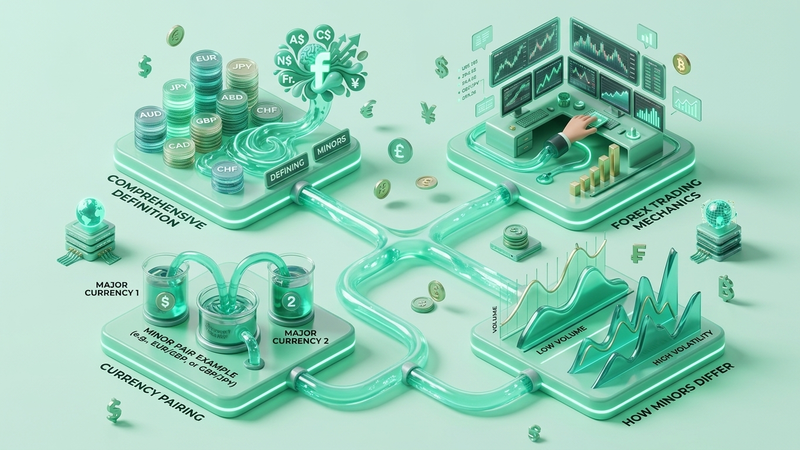
Minor forex pairs, also known as cross-currency pairs, are defined as currency pairs that do not feature the US Dollar (USD). Instead, they are composed of two other highly traded major currencies, such as the Euro (EUR), British Pound (GBP), or Japanese Yen (JPY), offering a way to trade based on the relative strength between two non-US economies.
A minor currency pair provides a direct exchange rate between two major global currencies, excluding the USD. They are frequently called “cross-currency pairs” or simply “crosses” because historically, to get a price for a non-USD pair like EUR/JPY, a bank would have to first cross the currencies through the US Dollar (EUR to USD, then USD to JPY). Today, direct pricing is available, but the name remains. A trader might ask, “Why are they called cross-currency pairs?” The term reflects this historical practice of bypassing, or “crossing,” the USD. Minor pairs represent a significant portion of the forex market, offering unique trading dynamics. The core attributes of minor pairs are as follows:
- Non-USD Composition: Their defining feature is the absence of the US Dollar.
- Major Currency Components: They are formed by combining currencies like the Euro, Pound Sterling, Japanese Yen, Swiss Franc, Canadian Dollar, Australian Dollar, and New Zealand Dollar.
- Moderate Trading Volume: They are traded less frequently than major pairs but far more often than exotic pairs.
- Distinct Economic Drivers: Their value is influenced by the economic relationship and interest rate differentials between the two respective countries.
The Key Characteristics of Minor Pairs
The primary characteristics of minor pairs include moderate liquidity, wider spreads, and price movements driven by the interplay between two non-USD economies. These features set them apart from both major and exotic pairs. A trader’s strategy must account for these specific traits, which present both opportunities and challenges. The main characteristics are:
-
- Moderate Liquidity: Minor pairs are less liquid than major pairs but are still considered highly liquid compared to exotics. This means there are typically enough buyers and sellers for efficient trading during main market hours.
- Wider Spreads: The bid-ask spread on minor pairs is wider than on majors. This is a direct result of their lower trading volume, which increases the transaction cost for entering and exiting a position.
*Distinct Volatility: Volatility in minor pairs can be strong, often exhibiting cleaner technical trends than majors that are frequently disrupted by US news. However, they can also experience periods of low movement when no specific economic news is driving either currency.
*Economic Interplay: Price action is a direct reflection of the economic health and monetary policy of two distinct economies, such as the Eurozone and Japan for the EUR/JPY pair.
Common Examples of Minor Currency Pairs Grouped by Base Currency
Common examples of minor currency pairs are logically grouped by their base currency, illustrating the various combinations available to trade. These groupings help traders identify opportunities based on specific economies they wish to follow. The most frequently traded minor pairs include the following crosses:
- Euro (EUR) Crosses: These pairs pit the Euro against other major currencies. Examples are EUR/GBP (nicknamed “The Chunnel”), EUR/JPY, EUR/CHF, EUR/AUD, and EUR/CAD.
- Pound (GBP) Crosses: These pairs feature the British Pound and are known for their volatility. Examples include GBP/JPY, GBP/CHF, GBP/AUD, and GBP/CAD.
- Yen (JPY) Crosses: Often used in carry trade strategies due to Japan’s historically low interest rates. Examples are AUD/JPY, CAD/JPY, CHF/JPY, and NZD/JPY.
Minor Pairs Vs. Major Pairs: A Detailed Comparison for 2026

The fundamental difference between minor and major pairs in 2026 is the exclusion of the US Dollar from minor pairs. This single distinction creates significant variations in liquidity, spreads, and the analytical focus required for trading. Majors are tied to US economic policy, while minors reflect the relationship between two other strong economies.
When traders ask, “What is the main difference between major and minor pairs?” the answer is always the US Dollar. The USD’s role as the world’s primary reserve currency gives major pairs the highest liquidity and tightest spreads, as confirmed by volume data from platforms like TradingView. Minor pairs, by contrast, force a trader to analyze the dynamic between two other countries, such as the United Kingdom and Japan for GBP/JPY, without the direct influence of a US jobs report or a Federal Reserve announcement. The following table provides a detailed comparison for traders in 2026.
| Feature | Major Pairs | Minor Pairs |
|---|---|---|
| Composition | Always includes the US Dollar (USD) paired with another major currency (e.g., EUR/USD, USD/JPY). | A cross of two major currencies, excluding the USD (e.g., EUR/GBP, AUD/JPY). |
| Liquidity | Highest. The market depth is immense, allowing for large orders with minimal price impact. | Moderate. High enough for most retail traders but lower than majors. |
| Spreads | Tightest. Transaction costs are very low due to high trading volume. | Wider. Costs to enter and exit trades are higher, impacting short-term strategies. |
| Volatility | High during major news releases, especially from the US. Can be predictable otherwise. | Can exhibit strong, sustained trends. Volatility is driven by news from two different economies. |
| Analysis Focus | Heavily influenced by the US economy and Federal Reserve policy. | Driven by the economic relationship between two non-USD economies and their central banks (e.g., ECB vs. BoJ). |
Distinguishing Minors from Exotic Pairs

Minor pairs are fundamentally different from exotic pairs due to the economic stability and liquidity of their constituent currencies. While both are less common than majors, minors pair two major currencies, whereas exotics pair one major currency with one from an emerging or smaller economy, resulting in much higher risk and cost.
A common point of confusion for new traders is whether minor pairs are the same as exotic pairs. They are not. Exotic pairs are composed of one major currency and one currency from a developing nation, such as the Turkish Lira (TRY), South African Rand (ZAR), or Mexican Peso (MXN). For example, USD/TRY and EUR/PLN (Polish Zloty) are exotic pairs. The primary distinction is risk. The economies behind exotic currencies often face greater political instability and economic uncertainty, leading to extremely low liquidity, very wide spreads, and unpredictable price swings. Minor pairs, composed of currencies from stable, developed economies, occupy a middle ground on the risk spectrum, offering more predictability and lower costs than exotics.
The Strategic Advantages of Trading Minor Pairs in 2026

The strategic advantages of trading minor pairs in 2026 center on diversification away from the US Dollar, the potential for cleaner technical trends, and unique opportunities to exploit interest rate differentials. These benefits provide traders with alternative ways to approach the market that are not directly tied to US economic performance.
For traders wondering why they would choose to trade minor pairs, the answer lies in the unique opportunities they present. Trading minors allows you to take a view on the relative strength of two economies, like the Eurozone versus Australia (EUR/AUD), without needing to factor in US data. These pairs can diversify a trading portfolio and reduce its overall correlation to USD-centric movements. Here are the main advantages:
- Diversification Away From the US Dollar: Trading minor pairs allows you to build a portfolio that is less sensitive to US economic news and Federal Reserve policy shifts. This is a powerful risk management tool, especially during periods of high uncertainty in the US.
- Stronger and Cleaner Technical Trends: Certain minor pairs, particularly Yen crosses like EUR/JPY and GBP/JPY, are known for developing strong, sustained trends. As shown on historical charts, these trends can be less “noisy” than those in major pairs, making them well-suited for trend-following strategies.
- Exploiting Interest Rate Differentials: Minor pairs are ideal for carry trade strategies. This involves buying a currency with a high interest rate and funding it with a currency that has a low interest rate, with the goal of collecting the “carry” or interest rate difference. The policy divergence between the European Central Bank and the Bank of Japan has historically made EUR/JPY a popular choice for this.
- Reduced Correlation: Because their movements are not tied to the USD, minor pairs do not always move in lockstep with majors. Adding them to a portfolio can help smooth out equity curves and reduce overall portfolio volatility.
Navigating the Risks and Challenges of Minor Pair Trading
The primary risks of trading minor pairs include wider spreads that increase transaction costs, lower liquidity that can lead to slippage, and the complex analysis required to monitor two separate economies. These challenges demand a disciplined approach to risk management and a deeper level of fundamental research from the trader.
While minor pairs offer benefits, they are not without their downsides. A balanced view is necessary for long-term success. The most direct drawback is that transaction costs are higher in minor pairs due to wider bid-ask spreads. This makes them less suitable for strategies that rely on small profits, such as scalping. A trader must understand and prepare for these challenges before allocating capital. The key risks include:
- Wider Spreads and Higher Transaction Costs: The bid-ask spread is the direct cost of a trade. In minor pairs, this spread is wider than in majors, meaning each trade starts with a larger initial loss that must be overcome to become profitable.
- Lower Liquidity and Risk of Slippage: Lower trading volume, especially outside of peak market hours, can lead to slippage. Slippage occurs when an order is filled at a different, often worse, price than requested, which can happen during fast-moving markets or with large orders.
- Increased Overnight Risk: Holding a position overnight or over a weekend is riskier with minor pairs. News from either of the two countries can cause the price to “gap” at the next market open, potentially jumping over a stop-loss order and leading to larger-than-expected losses.
- Complex Fundamental Drivers: To trade minors effectively, you must monitor the economic data, central bank announcements, and political events of two major economies simultaneously. This is more demanding than focusing on the US-centric analysis required for major pairs.
Essential Strategies for Trading Minor Forex Pairs
An effective strategy for trading minor pairs combines diligent fundamental analysis of two economies with a technical approach suited for trending markets. Success in this area requires a disciplined application of risk management principles, such as proper position sizing and the consistent use of stop-loss orders, to account for their unique characteristics.
Fundamental Analysis: Key Economic Drivers for Minors
Fundamental analysis for minor pairs involves comparing the relative economic strength and monetary policies of the two constituent countries. Your goal is to determine which economy is outperforming the other. This requires tracking key data points from both nations to forecast the currency pair’s direction. To do this effectively, focus on the following:
- Relative Economic Strength: Compare key economic indicators to see which economy is stronger. A trader should monitor Gross Domestic Product (GDP) growth, inflation rates via the Consumer Price Index (CPI), employment reports, and trade balance figures for both countries.
- Interest Rate Differentials: The direction of a currency pair is heavily influenced by the difference in interest rates set by their respective central banks. Pay close attention to the policy statements from institutions like the ECB and the Bank of England (BoE) when analyzing EUR/GBP.
- Economic Calendars: Use an economic calendar from a trusted source like Forex Factory to stay ahead of important data releases for both economies.
Technical Analysis: Adapting Indicators for Less Liquid Markets
Technical analysis for minor pairs should focus on identifying and following trends, as these pairs often exhibit strong directional moves. Adapting indicators to higher timeframes and prioritizing risk management is paramount due to their wider spreads and potential for volatility. Key technical approaches include:
- Trend-Following is Key: Since many minor pairs trend well, indicators that identify the direction and strength of a trend are very effective. Tools like Moving Averages (specifically the 50-day and 200-day MAs), the Moving Average Convergence Divergence (MACD), and the Average Directional Index (ADX) are popular choices.
- Respecting Support and Resistance: Key horizontal price levels on higher timeframes, such as the daily and weekly charts, are often very significant for minor pairs. Price action traders watch these levels for potential reversals or breakouts.
- Risk Management is Paramount: Given the wider spreads and risk of slippage, strict risk management is non-negotiable. Always use a stop-loss order to define your maximum acceptable loss on a trade. Use smaller position sizes than you would on a major pair to compensate for the higher volatility and cost.
Before we conclude, many aspiring traders have specific follow-up questions about the practicalities of trading minor pairs. The following section addresses the most common inquiries to provide further clarity and help you make an informed decision.
Frequently Asked Questions About Minor Forex Pairs
This section answers the most common questions traders have about minor forex pairs. It clarifies the terminology, suitability for beginners, which pairs are most liquid, and their profitability relative to major pairs. The goal is to provide quick, direct answers to help you build a solid foundational knowledge.
What Is a Cross-Currency Pair?
A cross-currency pair is another name for a minor forex pair. The term specifically refers to any currency pair that does not include the US Dollar. The name originated from the historical practice where converting between two non-USD currencies required two trades, first into USD and then from USD into the desired currency, effectively “crossing” through the dollar.
Is Trading Minor Pairs Suitable for Beginners?
Generally, it is not recommended for complete beginners. Beginners should start with major pairs because their high liquidity and tight spreads are more forgiving. Once a trader has a solid grasp of forex fundamentals and consistent risk management, exploring a highly liquid minor pair like EUR/JPY or EUR/GBP can be a logical next step to diversify their trading.
Which Minor Pairs Are Considered the Most Liquid?
The most liquid minor pairs are those that include the Euro, Pound, and Yen, as these are the most heavily traded currencies after the US Dollar. The list of the most liquid minor pairs includes:
- EUR/JPY
- EUR/GBP
- EUR/CHF
- GBP/JPY
- AUD/JPY
Are Minor Pairs More Profitable Than Major Pairs?
No, profitability is not an inherent quality of any pair type; it depends entirely on a trader’s skill, strategy, and risk management. While the strong trends in some minor pairs can offer significant profit potential, the wider spreads increase trading costs, which can reduce net profits. A successful strategy on a major pair will likely be more profitable than a poor strategy on a minor pair.
Weighing the Opportunity: Are Minor Pairs the Right Choice for Your Trading Portfolio in 2026?
The decision to add minor pairs to your trading portfolio in 2026 depends on your individual risk tolerance, trading style, and analytical capacity. Minor pairs offer valuable diversification and strong trending characteristics but demand higher transaction costs and more complex fundamental analysis. They are a logical step for intermediate traders, not for beginners.
Minor forex pairs occupy a unique space in the forex landscape. They provide a way to escape the constant noise of US economic data and trade on the pure economic relationship between two other global powers. For a trend-follower or a carry trader, pairs like GBP/JPY or AUD/JPY can be excellent vehicles for executing a strategy. However, these opportunities are balanced by the realities of lower liquidity and wider spreads, making them less suitable for high-frequency trading or scalping. The right choice depends on you. If you are willing to perform dual-economy analysis and can manage the associated costs, minor pairs can be a powerful addition to your toolkit. We recommend that you always begin by trading minor pairs on a demo account to gain experience without financial risk.