

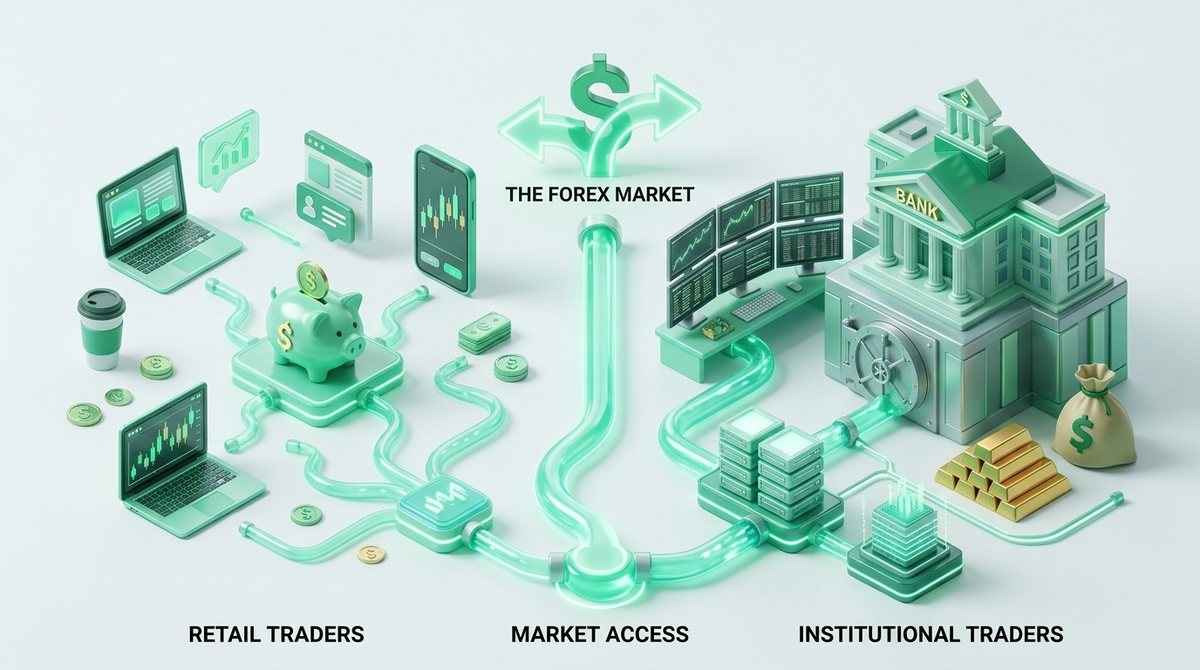
The foreign exchange market operates with two distinct classes of participants: retail traders and institutional traders. Their rules, tools, and objectives are fundamentally different. Understanding these distinctions is the first step for any individual trader aiming to operate effectively in this environment, which is projected to see continued technological and regulatory shifts through 2026.
Retail vs institutional forex traders differ primarily in capital scale, market access, technology, regulation, and trading objectives. Retail traders are individuals using personal funds through brokers, while institutional traders represent large entities like banks and hedge funds, managing billions and directly influencing market prices with superior access and infrastructure.
Who Is a Retail Trader and Who Is an Institutional Trader?

A retail trader is an individual, non-professional investor who trades with personal capital, while an institutional trader is a professional who trades on behalf of a large financial entity. The core difference lies in the source and scale of capital being managed and the professional capacity in which the trading occurs. This distinction determines their access, tools, and market role.
A retail trader is a person using their own money to speculate on currency price movements, typically through an online forex brokerage platform. An institutional trader works for a large financial organization, such as an investment bank, a hedge fund, a pension fund, or a corporation. They manage immense pools of capital for purposes including speculation, hedging international business risk, and fulfilling client orders.
The following table provides a summary of each trader’s core identity.
| Feature | Retail Trader | Institutional Trader |
|---|---|---|
| Identity | An individual, non-professional investor. | A professional employee of a financial firm. |
| Capital Source | Personal savings and funds. | Client funds, company capital, or pension assets. |
| Primary Goal | Speculative profit from price changes. | Varies: Speculation, hedging, market making, arbitrage. |
| Market Role | Price taker; reacts to market prices. | Price maker; influences market prices. |
Difference 1: Scale of Capital and Market Impact

The scale of capital is the most significant difference, directly influencing market impact and trading capabilities. Retail traders operate with small personal accounts, making them price takers with no ability to influence the market. Institutional traders manage vast sums, making them price makers whose actions can create price movements.
Retail trading capital typically ranges from a few hundred to several thousand dollars; a standard account often starts around $500. An individual retail trade has zero effect on the global forex market, which, according to the Bank for International Settlements (BIS) Triennial Survey, had a daily turnover of $7.5 trillion in 2022. In contrast, institutional traders deal in positions worth millions or billions of dollars. A single trade from a hedge fund could easily be $50 million. These large orders are the primary source of market “order flow,” and their execution can and does move prices. Why does an institutional trader’s order move the market? Because its size can absorb all available liquidity at a certain price level, forcing the price to a new level to find more buyers or sellers. Institutions are the primary source of market liquidity and order flow.
Because their orders are so large, institutions must actively manage their own market impact to avoid poor execution prices. They use sophisticated algorithms like VWAP (Volume-Weighted Average Price) or TWAP (Time-Weighted Average Price) to break a massive “parent” order into numerous smaller “child” orders. This technique executes the position over time to minimize price disruption.
Difference 2: Access to Markets and Liquidity

Access to the forex market is tiered, with institutions receiving direct access to the best prices and deepest liquidity, while retail traders have indirect access through brokers. This structural difference creates a disparity in the quality and cost of trade execution. The forex market is not a single, centralized exchange but a layered network of liquidity providers.
The forex market is structured in tiers, with the interbank market at the top. This is where major banks and financial institutions trade with one another, creating the core liquidity pool. Institutions sit at this top tier, while retail traders are at the bottom, accessing a filtered-down version of this liquidity. How do institutions get better access? They use prime brokerage services that give them direct lines to multiple top-tier liquidity providers simultaneously.
Institutional Access: Prime Brokerage and the Interbank Market
Institutions access top-tier liquidity through prime brokerage and the interbank market. A prime brokerage is a suite of services offered by large investment banks, like JPMorgan Chase or Goldman Sachs, to other institutional clients such as hedge funds. This service provides credit intermediation, allowing the hedge fund to trade with multiple liquidity providers using a single credit line from its prime broker. This gives them direct market access (DMA) to the interbank market, the exclusive network where major banks trade directly with each other on platforms like EBS and Refinitiv Matching. This is where the tightest spreads and deepest liquidity pools, known as Tier-1 liquidity, are found.
Retail Access: The Role of Forex Brokers
Retail traders access the forex market indirectly through a retail forex broker. These brokers act as intermediaries, sourcing liquidity from their own providers, which might be larger banks or liquidity aggregators. There are two main broker models. A Market Maker (or Dealing Desk) broker often takes the other side of a client’s trade, putting their positions on its “B-book.” An ECN/STP broker passes the client’s trades directly to its liquidity provider, operating an “A-book” model. In all cases, the liquidity and pricing available to a retail trader are a step removed from the core interbank market that institutions access directly.
Difference 3: Trading Technology and Infrastructure

Institutional trading technology is built for speed, advanced analytics, and high-volume execution, while retail technology prioritizes accessibility and user-friendliness. This technological gap, particularly in execution speed (latency), gives institutions a significant operational advantage. The difference in latency is measured in microseconds for institutions versus milliseconds for retail traders.
The technology stack used by each group is vastly different. Institutions invest millions in proprietary platforms, quantitative analysis teams, and physical infrastructure. A key institutional advantage is co-location, which involves placing their trading servers in the same data center as an exchange’s or liquidity provider’s servers. This physical proximity reduces data travel time, cutting execution latency to microseconds and enabling high-frequency trading (HFT) strategies. Retail traders use widely available platforms like MetaTrader 5 (MT5) or cTrader. While increasingly sophisticated with tools like Expert Advisors (EAs) for automation and Virtual Private Server (VPS) hosting to improve uptime, they cannot match the raw speed of institutional co-location.
| Feature | Institutional Trader | Retail Trader |
|---|---|---|
| Platform | Proprietary platforms, FXall, Currenex. | MetaTrader 4/5 (MT4/5), cTrader, TradingView. |
| Execution Speed | Microseconds (μs) via co-location. | Milliseconds (ms) via VPS or home connection. |
| Analytics | In-house quantitative teams, AI models, proprietary research. | Third-party indicators, broker analysis, public news. |
| Automation | Custom-built, high-frequency algorithms. | Expert Advisors (EAs), third-party scripts. |
Difference 4: Regulatory Environment and Protections

The regulatory environment for retail traders is designed for investor protection, while institutional regulation focuses on maintaining systemic market stability. This means retail traders are subject to rules like leverage caps and negative balance protection, which do not apply to institutions. By 2026, regulations are expected to further tighten marketing and disclosure rules for retail products.
Regulators like the European Securities and Markets Authority (ESMA) and the U.S. Commodity Futures Trading Commission (CFTC) create rules to shield non-professional investors from excessive risk. Institutional regulation, such as the Dodd-Frank Act in the U.S. and MiFID II in Europe, is concerned with preventing another financial crisis by increasing transparency and reducing systemic risk. Financial regulation for retail traders is focused on consumer safety. For example, ESMA mandates negative balance protection, ensuring a retail client cannot lose more money than they have in their account.
The following protections are common for retail traders in regulated jurisdictions:
- Leverage Caps: Strict limits on the amount of leverage a retail trader can use. For example, ESMA caps leverage on major forex pairs at 1:30 for retail clients.
- Negative Balance Protection: A guarantee from the broker that a trader’s account cannot go into a negative balance, protecting them from debt.
- Segregated Funds: A requirement for brokers regulated by bodies like the FCA in the UK or ASIC in Australia to keep client funds in accounts separate from the company’s operational funds.
- Marketing Restrictions: Increased scrutiny on how high-risk products like CFDs and forex are advertised to the general public.
Difference 5: Leverage and Risk Management
Retail and institutional traders use financial leverage in fundamentally different ways, which reflects their distinct approaches to risk management. Retail traders often use very high leverage as a necessity to trade meaningful position sizes with small capital, while institutions use much lower leverage as a strategic tool. High leverage is a double-edged sword that magnifies both profits and losses.
A retail broker in a less-regulated jurisdiction might offer leverage of 1:500, but this level of risk is a primary contributor to the high failure rate among new traders. In contrast, regulated regions impose strict leverage restrictions; the CFTC in the US limits leverage to 1:50 on major pairs. An institution, with its vast capital base, does not need high leverage to generate substantial absolute returns. Their risk management is a formal, team-based process. Professional risk officers use sophisticated models like Value at Risk (VaR) to quantify potential losses and ensure that position sizing adheres to the firm’s overall risk mandate.
Difference 6: Cost Structure: Spreads, Commissions, and Fees
Institutional traders benefit from a significantly lower transaction cost structure compared to retail traders. This is due to their direct access to raw interbank pricing and the massive volume they trade. A retail trader’s all-in cost is higher because it includes a broker’s markup on the spread.
The all-in cost for an institutional trader is extremely low, making strategies that rely on small margins viable. A retail trader’s costs are higher and more varied. What is the difference between an institutional and retail spread? An institution sees the raw price feed from the interbank market, while a retail trader sees a price that includes the broker’s profit. Slippage, the difference between the expected price of a trade and the price at which the trade is actually executed, affects both trader types. However, institutions can mitigate it more effectively with their superior technology and direct access to deep liquidity pools.
The following points outline the cost differences:
- Institutional Costs: They trade on raw interbank spreads, which can be near-zero (e.g., 0.1 pips on EUR/USD), and pay a small, volume-based commission, such as $2 per million dollars traded.
- Retail Costs: They trade on wider spreads that include a broker markup (e.g., a 0.8 pip spread on EUR/USD), may also pay a commission on ECN-style accounts, and can incur other charges like swap fees for holding positions overnight.
Difference 7: Trading Objectives and Strategies
The trading objectives of institutions are diverse and often non-speculative, whereas retail trading is almost entirely for speculative profit. This fundamental difference in purpose dictates the strategies each group employs. Institutions may trade to hedge risk or make markets, while retail traders aim to profit from price fluctuations.
The “why” behind a trade is a critical distinction. An institution like a multinational corporation isn’t trying to predict where the Euro will go next week; it’s trying to lock in an exchange rate to protect the value of its international revenue. A retail trader, on the other hand, is almost always speculating on future price direction. This difference in objective leads to very different strategic approaches.
Institutional Objectives: Hedging, Arbitrage, and Market Making
Institutional trading serves a variety of purposes beyond pure speculation. For example, a European car manufacturer like BMW that sells cars in the United States must convert its dollar revenue back to euros. To protect against a decline in the USD/EUR exchange rate, its corporate treasury will trade forex to hedge this currency risk. Other institutional objectives include market making, where large banks provide liquidity to the market and profit from the bid-ask spread on enormous volumes, and arbitrage, which involves exploiting tiny, fleeting price differences for the same asset across different markets. When institutions do speculate, as hedge funds and proprietary trading desks do, their strategies are often based on complex macroeconomic analysis or quantitative models.
Retail Objectives: Pure Speculation
The primary objective for the vast majority of retail traders is pure speculation. The goal is to profit from changes in a currency pair’s price, typically over short to medium timeframes. This leads to a focus on strategies like scalping (holding trades for seconds to minutes), day trading (closing all positions within the day), and swing trading (holding trades for several days or weeks). Consequently, retail traders often rely heavily on technical analysis. They use tools like chart patterns, price action, and indicators such as moving averages or the Relative Strength Index (RSI) to generate trading signals, a practice less central to many institutional strategies.
Difference 8: Information and Research Asymmetry
A significant information and research asymmetry exists, giving institutions a clear advantage over retail traders. Institutions have access to expensive, real-time data and proprietary research that is unavailable to the average individual. This information gap means retail traders often react to news that institutions have already priced into the market.
The difference in research resources is stark. An institutional trading floor is equipped with tools like the Bloomberg Terminal or Reuters Eikon, which cost upwards of $25,000 per user annually. These provide instantaneous news, in-depth data, and analytics. Institutions also employ teams of analysts who conduct proprietary research and may have direct contact with policymakers. Retail traders rely on free news websites, broker-provided commentary, and social media forums. By the time information trickles down to the retail level, its market-moving potential has often been exhausted. However, looking to 2026, the rise of AI-powered sentiment analysis tools and more affordable data feeds is beginning to narrow this gap, though the core advantage remains with institutions.
Difference 9: Psychological and Professional Environment
The psychological environment of a retail trader is solitary and emotional, while an institutional trader operates within a professional, team-based structure. This distinction profoundly affects decision-making, discipline, and accountability. Retail traders battle fear and greed with their own “scared money,” a concept central to trading psychology.
Trading is often a solitary activity for a retail investor, making them highly susceptible to emotional decisions driven by fear, greed, or the fear of missing out (FOMO). The pressure is intensely personal because their own financial well-being is on the line. For an institutional trader, trading is a job. While stressful, decisions are often guided by a team, a trading mandate, or a pre-defined algorithm. The trader is using “other people’s money” (OPM), and their performance is judged against objective metrics and benchmarks in a formal performance review. The pressure is professional (related to job security and bonuses) rather than a threat of personal financial ruin, and a support system of risk managers provides crucial oversight.
Difference 10: The Blurring Lines in 2026: Rise of Prop Firms and the “Pro-tail” Trader
The lines between retail and institutional trading are blurring due to the rise of proprietary trading firms that fund retail traders and the emergence of the sophisticated “pro-tail” trader. While core differences in market access and regulation persist, this evolution creates a new professional path for dedicated individuals. This trend offers retail traders access to institutional-grade capital.
A proprietary trading firm, or prop firm, is a company that provides capital to traders who can pass a trading challenge or evaluation. By passing, a trader gains access to a funded account, often with hundreds of thousands of dollars, and keeps a share of the profits. This model gives talented retail traders access to significant capital without risking their own. This has given rise to the “pro-tail” trader: a sophisticated retail trader who uses advanced tools like a VPS for low latency, develops custom Expert Advisors, trades with true ECN brokers, and often operates with capital from a prop firm like FTMO or The Funded Trader. They adopt institutional-like methods for risk management and strategy, creating a hybrid class of market participant.
Can a Retail Trader Succeed Against Institutions? The Final Verdict
A retail trader can succeed, but not by playing the same game as institutions. Success depends on understanding the institutional advantages in scale, cost, and information and leveraging the retail trader’s unique edge: flexibility. The market is not rigged, but the playing field is asymmetrical.
While institutions are powerful, their size is also a constraint. They cannot enter or exit massive positions instantly without causing adverse price movement. A retail trader, however, is nimble. You can enter and exit the market instantly with zero market impact, taking advantage of short-term volatility that an institution is too large to capture. You do not have to answer to a board or meet quarterly performance benchmarks. Success for a retail trader requires acknowledging the differences, employing impeccable risk management, developing a robust trading plan, and exploiting your flexibility—your key competitive edge.
Frequently Asked Questions About Retail and Institutional Trading
This section answers common questions that arise when comparing the two types of forex traders, providing clear definitions and direct comparisons for key concepts within the market structure.
What Is a Prime of Prime Broker?
A Prime of Prime (PoP) is a firm that bridges the gap between top-tier institutional liquidity and smaller market participants. A PoP holds a prime brokerage account with a Tier-1 bank (like Barclays or Deutsche Bank) and then offers these institutional-grade liquidity solutions and credit relationships downstream. Their clients include smaller retail brokers, new hedge funds, and high-volume individual traders who do not meet the stringent capital requirements for a direct Tier-1 prime brokerage relationship.
Is Institutional Trading More Profitable Than Retail Trading?
In absolute dollar terms, yes, institutional trading is vastly more profitable due to the immense capital they manage. A small percentage gain on billions of dollars results in millions in profit. However, in terms of percentage return on investment (ROI), a skilled retail trader can potentially achieve a much higher percentage gain on their small account. Institutions are often limited by their own size and market impact, which makes achieving extremely high percentage returns on their large assets under management (AUM) very difficult.
Do Institutional Traders Use Technical Analysis?
Yes, but they use it differently than most retail traders. While a retail trader might use an indicator like a moving average crossover to generate a direct buy or sell signal, institutions are more likely to use technical analysis to identify key price levels. They look at major support and resistance zones, pivot points, and psychologically important round numbers as areas where significant liquidity might be resting. They combine this with fundamental analysis and order flow data rather than using technicals in isolation for signal generation.
What Are the Main Types of Institutional Forex Traders?
The main types of institutional forex traders are large organizations that participate in the currency market for various reasons. These institutional players collectively account for the overwhelming majority of daily trading volume.
- Commercial and Investment Banks: The largest players, such as Citibank and JPMorgan Chase, who act as market makers, execute trades for clients, and trade for their own accounts.
- Hedge Funds: These are speculative firms that use aggressive and complex strategies, including leverage, to generate high returns.
- Central Banks: Entities like the U.S. Federal Reserve or the European Central Bank that intervene in forex markets to manage their country’s currency value and implement monetary policy.
- Asset Management Firms and Pension Funds: These firms, like BlackRock, manage international investment portfolios and trade currencies to facilitate the purchase of foreign assets or hedge currency exposure.
- Multinational Corporations: Companies like Apple or Toyota use the forex market primarily to hedge against currency risk arising from their international sales and supply chain operations.