


This guide explains the Straight Through Processing (STP) model in forex trading for 2026. It details how STP brokers operate, their execution process, and their core differences from ECN and Market Maker brokers. You will learn the advantages and disadvantages of this model to determine if it aligns with your trading strategy.
What Is an STP (Straight Through Processing) Broker?

An STP (Straight Through Processing) broker is a financial intermediary that routes client orders directly to one or more of its liquidity providers. As a type of No Dealing Desk (NDD) broker, it acts as a bridge, connecting your trades to the interbank market without any dealer intervention. This model contrasts with Dealing Desk brokers who take the other side of client trades.
An STP broker is a type of No Dealing Desk (NDD) forex brokerage. Its primary function is to serve as a direct bridge, passing a client’s trade orders straight to a liquidity provider without manual intervention. These liquidity providers can be banks, hedge funds, or other financial institutions. This automated process is the opposite of the Dealing Desk model, where the broker may act as the counterparty to a trader’s position. An STP broker acts as a financial intermediary, not a counterparty to trades.
The Core Principle: No Dealing Desk Intervention
The core principle of the STP model is the complete absence of a dealing desk for trade execution. This means your broker does not become the counterparty to your trade, which eliminates the primary conflict of interest found in Market Maker models. This execution method is known as the “A-Book” model, where 100% of client orders are passed directly to the external market for execution at the best available price. In contrast, a “B-Book” model involves the broker internalizing the trade, profiting when the client loses. Both the Financial Conduct Authority (FCA) and Australian Securities and Investments Commission (ASIC) promote transparency in broker execution models.
The Role of Liquidity Providers in the STP Model
The role of liquidity providers is fundamental to the STP model’s function and transparency. Liquidity providers (LPs) are large financial institutions that provide the bid and ask prices, effectively creating the market where trades are executed. STP brokers aggregate price quotes from a diverse pool of these LPs to find the best available bid and ask prices for their clients. A deeper liquidity pool typically results in more competitive pricing and tighter spreads. The following are examples of Tier-1 LPs:
- Barclays
- Deutsche Bank
- Goldman Sachs
- J.P. Morgan
- Citigroup
How Does an STP Broker Execute Your Trades?

An STP broker executes your trades through a fully automated process designed for speed and efficiency. The broker’s technology, often called an “STP bridge,” instantly connects your trading platform to its pool of liquidity providers. STP brokers utilize the Financial Information eXchange (FIX) protocol for standardized communication, which ensures rapid and reliable order routing from the trader to the execution venue.
The entire trade execution process is automated to minimize latency. When you place an order, the broker’s system does not manually intervene. Instead, its STP bridge technology, which often uses the Financial Information eXchange (FIX) protocol, instantly transmits your order to the liquidity pool. The system then finds the best price and executes the trade in milliseconds. For traders wondering how fast an STP broker can execute a trade, speeds are often measured in milliseconds, thanks to this advanced infrastructure.
A Step-by-Step Look at the Order Flow
The order flow within an STP environment follows a precise and automated sequence. Here is a step-by-step description of how your order is processed:
- Order Placement: You place a buy or sell order for a currency pair, such as EUR/USD, on your trading platform, like MetaTrader 5 or cTrader.
- Instant Transmission: Your order is immediately transmitted from your platform to the broker’s STP execution system or bridge.
- Price Aggregation: The STP system instantly scans the live price feeds from all connected liquidity providers in its liquidity pool.
- Best Price Selection: The system identifies the best available bid price (if you are selling) or the best available ask price (if you are buying) from the aggregated quotes.
- Order Execution: The order is executed automatically with the liquidity provider offering that best price. The broker simultaneously opens an identical offset order with the LP to hedge its position.
- Confirmation: The details of the executed trade, including the final fill price and execution time, are sent back and confirmed on your trading platform, typically within 100 milliseconds or less.
Understanding Spreads and Markups in STP
The revenue model for an STP broker is based on adding a small markup to the spreads received from its liquidity providers. The broker takes the “raw spread” from its LPs and widens it by a specific amount, which constitutes its profit on the trade. This spread is typically variable, meaning it fluctuates based on market conditions and the prices provided by the LPs. For example, if a liquidity provider offers a raw spread of 0.1 pips on EUR/USD, the STP broker might display a spread of 1.1 pips to you. The broker’s profit is the 1.0 pip difference. Some hybrid STP/ECN models may offer raw spreads directly but will instead charge a fixed commission per lot traded.
The Primary Advantages of Trading with an STP Broker

The primary advantages of trading with an STP broker center on transparency, execution speed, and the alignment of broker-client interests. These benefits directly address common trader concerns like re-quotes, slow execution, and the conflict of interest inherent in other models. The main advantage of an STP broker is the alignment of interests with the trader, as profit comes from volume, not client losses.
Benefit 1: Minimized Conflict of Interest
The conflict of interest is minimized because the broker’s revenue is tied to your trading volume, not your losses. Since the broker earns a profit from the spread markup or a commission on every trade you make, it is in their interest for you to be a successful and active trader. A profitable trader is a long-term, high-volume client for the STP broker. This A-Book model stands in direct contrast to the B-Book model, where a broker profits directly from a client’s trading losses.
Benefit 2: Faster Execution Speeds and No Re-quotes
Faster execution is a direct result of the fully automated, straight-through nature of the order processing. With no dealing desk to delay or analyze the order, trades are sent directly to the market and executed at the prevailing rate. This process virtually eliminates re-quotes, which occur when a dealer cannot fill an order at the requested price and instead offers a new, often worse, price. In a true STP environment, an order is filled at the next best available price from the liquidity pool, a process known as market execution.
Benefit 3: Enhanced Price Transparency and Access to Interbank Rates
You gain enhanced price transparency because you are seeing prices aggregated from multiple top-tier liquidity providers. This competition between LPs leads to more competitive pricing and tighter spreads than what a single market maker might offer. Traders get access to price feeds that are a close reflection of the true interbank market rates. Some platforms even offer Depth of Market (DOM) data, allowing you to see the available liquidity at different price levels.
Potential Disadvantages and Risks to Consider

The potential disadvantages of an STP broker involve variable spreads and the possibility of slippage during volatile market conditions. While the STP model offers many benefits, you must understand these characteristics to manage your trading risks effectively. The main risks with STP brokers are variable spreads widening during volatility and the possibility of slippage.
The Reality of Variable Spreads
Variable spreads are a direct consequence of receiving prices from the live interbank market. While spreads on major pairs like EUR/USD can be extremely tight, often under 1 pip, during periods of normal liquidity, they can widen significantly. This widening occurs during major economic news releases, such as the Non-Farm Payroll (NFP) report, or during times of low liquidity, like market open or close. A sudden increase in the spread can raise your trading costs or trigger stop-loss orders unexpectedly. This is a key downside for traders who prefer the predictability of fixed spreads.
Understanding Slippage During High Volatility
Slippage is the difference between the price you expect when you click to trade and the price at which your order is actually filled. In a fast-moving, highly volatile market, the price from the liquidity provider can change in the milliseconds between order placement and execution. This can result in negative slippage (a worse fill price) or positive slippage (a better fill price). It is important to know that slippage is a natural feature of market execution in a true NDD environment and not necessarily a broker’s fault. Reputable brokers have clear policies on how they handle slippage.
STP vs. ECN vs. Market Maker: A Comparative Analysis for 2026
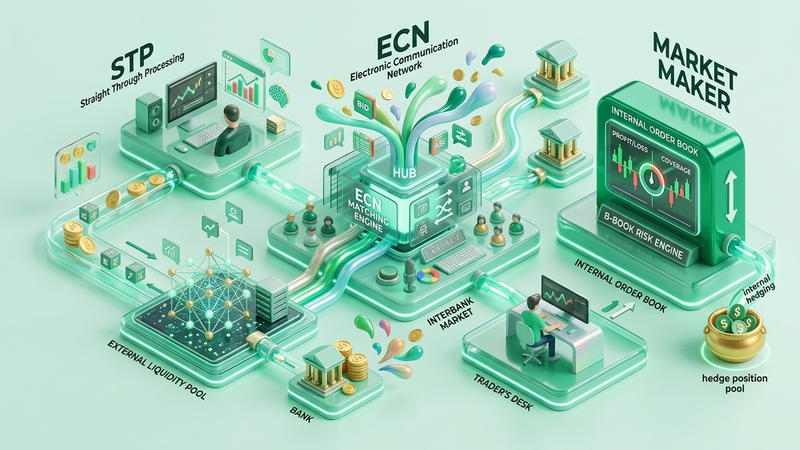
The STP, ECN, and Market Maker models differ primarily in trade execution, cost structure, and potential for conflict of interest. Understanding these differences is key to selecting a broker that fits your trading style. A 2026 report from Finance Magnates notes that traders are increasingly demanding transparency, driving growth in NDD models.
The main difference between STP and ECN brokers is how orders are routed; STP sends orders to a broker’s specific LPs, while ECN creates a central network for all participants. Both are NDD models, which contrast with the Market Maker model where the broker is the counterparty. The table below provides a clear comparison across key criteria.
| Feature | STP (Straight Through Processing) | ECN (Electronic Communication Network) | Market Maker (Dealing Desk) |
|---|---|---|---|
| Execution Model | No Dealing Desk (NDD). Routes orders to liquidity providers. | No Dealing Desk (NDD). Orders interact in a central anonymous order book. | Dealing Desk (DD). Broker is the counterparty to the trade. |
| Spreads | Variable, with a broker markup. | Variable, often raw interbank rates. | Typically fixed, but can be variable. |
| Commissions | Usually none (built into spread). Some hybrids may charge them. | Yes, a fixed commission per lot is standard. | Usually none (built into the wider spread). |
| Conflict of Interest | Low. Broker profits from trading volume. | Lowest. Broker profits only from commissions. | High. Broker can profit from client losses (B-Book). |
| Anonymity | Partial. LPs see the broker, not the client. | High. All participants are anonymous in the network. | None. The broker knows all client positions. |
| Best For | All traders, especially scalpers and news traders, who want speed and transparency. | Advanced and institutional traders who need market depth and tightest spreads. | Beginners who prefer fixed spreads and simpler cost structures. |
STP vs. ECN: The Nuances of Execution
The nuance between STP and ECN execution lies in the order routing and interaction. Both are NDD models that promote transparency. However, an ECN (Electronic Communication Network) broker creates a hub where orders from all participants—traders, banks, and other brokers—interact directly within a central order book, often providing visible Depth of Market (DOM). An STP broker, by contrast, routes your order to its specific, pre-selected pool of liquidity providers. ECN is often seen as a purer form of Direct Market Access (DMA), but the lines have blurred as many brokers offer hybrid STP/ECN solutions.
STP vs. Market Maker (Dealing Desk): The Fundamental Difference
The fundamental difference between STP and Market Maker models is the counterparty to your trade. A Market Maker, or Dealing Desk (DD) broker, creates its own internal market and takes the opposite side of its clients’ trades, a practice known as B-Booking. This creates a direct conflict of interest, as the broker profits when the client loses. An STP broker A-Books trades by passing them to an external market. The trade-off is that Market Makers can offer benefits like guaranteed fills with no slippage and fixed spreads, but at the cost of potential re-quotes and the inherent conflict.
Hybrid Models: The Blurring Lines Between Broker Types in 2026
The lines between broker types are blurring in 2026, with many firms operating a hybrid model to manage risk. A broker may use a sophisticated system to segment clients. For example, consistently profitable or high-volume traders might have their orders processed via the A-Book (STP) model, as the broker profits from their volume. Conversely, the trades of smaller, less experienced retail clients might be internalized via the B-Book (Market Maker) model, where the broker assumes the risk. This risk management strategy allows brokers to offer different account types and pricing structures, making it important for you to ask a potential broker about their specific execution policy.
How to Identify and Choose a Reputable STP Broker in 2026
Choosing a reputable STP broker in 2026 requires verifying Tier-1 regulation and analyzing their execution model transparency. Your due diligence should focus on the broker’s regulatory status, cost structure, and the quality of their trading technology. This process protects your capital and ensures a fair trading environment. It’s important to ask how you can check if a broker is legitimate before depositing any funds.
To identify and select a trustworthy STP broker, you must conduct thorough due diligence. The most important factor is regulation from a top-tier authority. After confirming a broker’s license, you should analyze their trading conditions, including average spreads, commissions, and execution policies. Use a detailed checklist to compare potential brokers systematically, ensuring they meet your specific needs for platform, support, and cost-effectiveness.
Key Regulatory Bodies to Look For (FCA, CySEC, ASIC)
Regulation is the most important factor in choosing a broker and is non-negotiable for protecting your funds. Reputable brokers are licensed and supervised by top-tier regulatory agencies. These bodies enforce strict rules, including the segregation of client funds from company funds and participation in investor compensation schemes. Here are the key regulatory bodies to look for:
- FCA (UK): The Financial Conduct Authority is one of the world’s most respected regulators.
- ASIC (Australia): The Australian Securities and Investments Commission offers strong investor protection.
- CySEC (Cyprus/EU): The Cyprus Securities and Exchange Commission provides a regulatory gateway to the European Union.
- BaFin (Germany): The Federal Financial Supervisory Authority.
- CFTC/NFA (USA): The Commodity Futures Trading Commission and National Futures Association regulate the U.S. markets.
- FINMA (Switzerland): The Swiss Financial Market Supervisory Authority.
A Checklist for Vetting Potential STP Brokers
Using a comprehensive checklist helps you to systematically evaluate and compare brokers. This due diligence ensures you select a broker that is not only reputable but also a good fit for your trading strategy. The following checklist covers the essential areas to investigate:
- Regulation and Trust: Is the broker licensed by a Tier-1 regulator? Are client funds segregated? Is negative balance protection offered? How many years has the broker been in operation? Is the parent company publicly traded?
- Execution Model and Transparency: Does the broker clearly state they use an STP/NDD model? Do they disclose their liquidity providers? Do they publish execution speed statistics? What is their official policy on slippage and re-quotes? Do they operate a pure A-Book or a hybrid model? Are order fill quality reports available?
- Trading Costs: What are the average spreads on major pairs like EUR/USD and GBP/USD during peak and off-peak hours? Is there a commission per lot? What are the overnight swap fees (rollover)? Are there inactivity fees? What are the deposit and withdrawal fees?
- Trading Platform and Tools: Do they offer platforms like MT4, MT5, and cTrader? Is the mobile trading app functional and stable? Are advanced charting tools and indicators included? Is there an integrated news feed? Is VPS hosting available for automated strategies? Is FIX API access offered for advanced traders?
- Account and Support: What is the minimum deposit required? What is the range of available account types? What are the leverage options and margin requirements? Is customer support available 24/5 and responsive? How simple is the deposit and withdrawal process? What educational resources are provided?
The Future of STP and Forex Brokerage Technology
The future of STP and forex brokerage technology points towards greater speed, transparency, and intelligence. Future STP brokerage technology focuses on AI for order routing and co-located servers to achieve sub-millisecond execution. Competition and regulatory pressure will drive brokers to adopt innovations that provide traders with better pricing and more detailed execution data.
By 2026 and beyond, several trends will shape the brokerage landscape. The use of AI and machine learning will become standard for optimizing order routing, dynamically selecting the LP most likely to provide the best fill with the lowest slippage for a given market condition. Continued investment in infrastructure, such as co-locating servers in major financial data centers like Equinix LD4 (London) and NY4 (New York), will further reduce latency. Additionally, while still nascent, the principles of Decentralized Finance (DeFi) could eventually introduce new models for decentralized liquidity that challenge the traditional broker/LP relationship.
Now that we have explored the intricate details of STP brokers, from their core mechanics to choosing the right one for your 2026 trading strategy, let’s address some common questions to solidify your understanding.
Frequently Asked Questions About STP Brokers
This section addresses common questions about STP brokers. It clarifies comparisons with other models, defines key terms, and explains the main classifications of brokers. The answers provide direct information to help you make informed decisions when navigating the forex market and selecting a brokerage partner.
Is an STP Broker Always Better Than a Market Maker?
Not necessarily, as the better choice depends on your specific trading needs and preferences. An STP broker is generally better for experienced traders, scalpers, and news traders who prioritize fast execution, transparency, and minimal conflict of interest. A well-regulated Market Maker might be suitable for beginners who value the simplicity of fixed spreads and a predictable cost structure, as long as they understand the inherent counterparty relationship.
What Is a True STP Broker?
A “true” STP broker is a brokerage that operates a pure A-Book model. This means 100% of its clients’ orders are passed directly to external liquidity providers for execution, with no intervention from a dealing desk and no internalization of trades (B-Booking). Many brokers use the “STP” label, so it is important for you to seek brokers who offer clear transparency and disclosure about their exact execution model.
Can STP Brokers Offer Fixed Spreads?
No, a true STP broker cannot offer fixed spreads. The spreads offered by an STP broker are inherently variable because they are a direct reflection of the bid/ask prices coming from the dynamic interbank market. Prices from liquidity providers fluctuate constantly based on supply, demand, and volatility. Any broker offering genuinely fixed spreads is, by definition, acting as a Market Maker for those trades, as they must absorb the price risk themselves.
What Are the Main Types of No Dealing Desk (NDD) Brokers?
The two main types of No Dealing Desk (NDD) brokers are STP and ECN. These classifications describe how the broker handles your order without operating an internal dealing desk. The primary NDD models are:
- Straight Through Processing (STP): This model routes your trades to a broker’s specific pool of liquidity providers.
- Electronic Communication Network (ECN): This model creates a central network where the orders of all market participants (traders, institutions, banks) can interact in a single, anonymous order book.
Final Verdict: Is an STP Broker the Right Choice for Your Trading Strategy?
An STP broker is the right choice if your trading strategy prioritizes execution speed, price transparency, and an environment with minimal conflict of interest. This model is particularly well-suited for scalpers, day traders, and news traders who require direct market access to capitalize on small price movements without the interference of re-quotes.
An STP broker represents an excellent choice for intermediate to advanced traders who understand and can manage the dynamics of variable spreads and potential slippage. While beginners can also benefit from the transparency of the STP model, they must first educate themselves on how the cost structure works, especially during volatile market periods. Ultimately, the best course of action is to use the detailed checklist provided to assess your personal trading needs against the features and regulatory standing of a potential STP broker to make an informed decision.