

A Forex liquidity provider is a financial institution that quotes both a buy and sell price on a currency pair, creating a market for brokers. In 2026, they operate using advanced technology to aggregate prices from multiple sources, fulfilling orders in milliseconds and providing the deep liquidity that stabilizes the foreign exchange market. This guide offers a definitive look at what liquidity providers are, their operational mechanics, and the market landscape of 2026.
Liquidity is the lifeblood of the foreign exchange market, a system with a daily turnover of $7.5 trillion, according to the 2022 Bank for International Settlements (BIS) Triennial Central Bank Survey. A liquidity provider (LP) acts as a market maker, typically a large financial institution, that supplies bid and ask pricing for various currency pairs. They are the wholesale source of pricing that retail brokers offer to you, the trader. This article explains their function, the technology they use, and how to evaluate them.
The Fundamental Role of Liquidity in the Forex Market
Liquidity’s fundamental role in the Forex market is to ensure that assets can be bought or sold quickly without causing a significant change in price. High liquidity results in tighter spreads, greater price stability, and efficient order execution for traders, forming the foundation of a fair and functional market environment. A liquid market is defined by a high volume of active buyers and sellers, which minimizes price volatility and slippage.
The primary reason liquidity is paramount is that it enables smooth price action and fair order execution. A market with many active buyers and sellers for a currency pair, like EUR/USD, is considered highly liquid. In contrast, an illiquid market has few participants, leading to high volatility, sudden price gaps, and significant slippage, where an order is filled at a price different from the one requested. A trader benefits from a liquid market because it ensures orders are filled at or very near the expected price, reducing unexpected costs.
The core benefits of high liquidity in the Forex market are:
- Tighter Spreads: With more participants quoting prices, competition increases, which narrows the gap between the bid (buy) and ask (sell) price. This directly lowers transaction costs for traders.
- Price Stability: A deep pool of orders helps absorb large trades without causing drastic price fluctuations, leading to a more stable and predictable market environment.
- Efficient Order Execution: High liquidity means there is almost always a counterparty available for any trade, allowing orders to be filled instantly at the best available market price.
Defining a Forex Liquidity Provider (LP)
A Forex liquidity provider (LP) is an entity that creates a market by quoting both a buy (bid) and a sell (ask) price for a financial instrument. These entities are typically large financial institutions, including banks, hedge funds, and major investment firms. The core function of an LP is to act as the ultimate “wholesaler” of currency positions for brokers.
These providers are market makers that stand ready to absorb large volumes of orders from their clients, who are primarily Forex brokers. By providing a constant stream of buy and sell quotes, they ensure that a broker can execute its clients’ trades without causing extreme price movements. This function is what underpins the entire structure of the retail Forex market, connecting it to the broader institutional interbank system.
The Mechanics: How Liquidity Providers Fulfill Orders
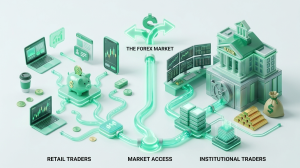
Liquidity providers fulfill orders using a combination of advanced technology, price aggregation, and a tiered market structure. This process is designed to find the best possible price for a broker’s client order from a deep pool of quotes and execute it in milliseconds. The system operates as a high-speed “black box” that connects retail traders to the global foreign exchange market.
The entire mechanism is built to be fast, efficient, and reliable. It starts the moment a trader places an order and ends when the confirmation appears on their trading platform, with the entire journey often taking less than 100 milliseconds. This speed and efficiency are made possible by a sophisticated technology stack that links brokers directly to the liquidity pool.
The Order Flow Process: From Broker to Liquidity Pool
The order flow process is the step-by-step journey a trader’s order takes from their platform to the liquidity pool for execution. This chain of events relies on the broker’s business model and its connection to liquidity providers. For brokers operating an A-Book model, the process is automated for direct market access.
The journey of a trader’s order to the liquidity pool follows these steps:
- A trader places an order, for instance, to buy 1 lot of EUR/USD, through their retail broker’s trading platform.
- The broker’s server, if operating on an A-Book model, instantly routes this order via a FIX API to its connected liquidity provider or aggregation engine.
- The aggregation engine, which is software that combines multiple price feeds, receives the order from the broker.
- The order is then filled from the aggregated liquidity pool, which contains the best available bid and ask prices sourced from numerous LPs.
- A confirmation of the filled order is sent back through the same technological chain to the trader’s platform, typically within milliseconds.
This entire process is facilitated by technology from firms like oneZero or PrimeXM, which specialize in building the aggregation engines and bridge technology that connect brokers to liquidity pools.
Price Aggregation and the Best Bid-Ask Spread
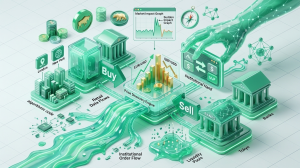
Price aggregation is the process of combining price quotes from multiple liquidity providers to create a single, deeper liquidity pool. An aggregator is the software that performs this function, constantly scanning the order books of all connected LPs to find the best available prices. This technology is central to how modern Electronic Communication Network (ECN) and Straight Through Processing (STP) brokers operate.
The aggregator works by cherry-picking the highest bid price from one LP and the lowest ask price from another to construct a new, tighter spread for the broker. This combined price feed is known as the Best Bid and Offer (BBO). For example, if LP1 offers EUR/USD at a bid/ask of 1.0850/1.0852 and LP2 offers it at 1.0851/1.0853, the aggregator will display a combined best price of 1.0851 (the best bid from LP2) and 1.0852 (the best ask from LP1). This gives the broker’s clients access to a spread that is tighter than what any single provider could offer.
Tiered Liquidity Structure Explained
The tiered liquidity structure is the hierarchy of liquidity provision that organizes the Forex market. This structure is not flat; different providers have different sizes and roles, creating a flow of liquidity from the largest institutions down to individual retail traders. This system ensures that market access is available at all levels.
There are two main tiers in this hierarchy. Tier 1 liquidity providers are the largest global banks that constitute the interbank market, where currencies are traded in massive volumes. Tier 2 liquidity providers include smaller banks, hedge funds, and specialized aggregators that access liquidity from Tier 1 providers and then pass it down to smaller market participants. This structure forms a chain that allows liquidity to flow efficiently throughout the global financial system.
The Two Primary Tiers of Forex Liquidity Providers
The two primary tiers of Forex liquidity providers are distinguished by their size, their role in the market, and the clients they serve. Tier 1 providers form the core of the market, while Tier 2 providers act as intermediaries. This distinction is fundamental to understanding how different market participants, from large institutions to retail brokers, gain access to currency pricing.
Tier 1 consists of the largest institutional players who create the market, while Tier 2 includes a wider range of firms that distribute this liquidity. The relationship between these tiers is facilitated by prime brokerage services, which allow smaller firms to access the trading facilities of the top-tier banks.
Tier 1 Liquidity Providers: The Core of the Market
Tier 1 liquidity providers are the largest global banks that form the foundation of the interbank market. These bulge-bracket banks handle immense trading volumes, often dealing directly with one another and with other large institutional clients. They are the primary source of currency pricing and market depth in the global Forex market.
These institutions create the primary market through their own dealing desks, trading for their own accounts and fulfilling orders for major clients like corporations and central banks. The Euromoney FX Survey consistently ranks these banks by market share, with top players including J.P. Morgan, UBS, Deutsche Bank, Citi, and Goldman Sachs. A key point is that Tier 1 LPs do not deal directly with retail brokers. Instead, they offer their services through prime brokerage relationships, which have very high capital and volume requirements.
Tier 2 Liquidity Providers and Prime of Primes (PoP)
Tier 2 liquidity providers are firms that obtain their liquidity from one or more Tier 1 providers and then offer it to other market participants. This group includes smaller banks, hedge funds, and specialized financial technology companies that act as aggregators. They are the crucial bridge connecting the retail Forex world to the institutional interbank market.
Within this tier is the “Prime of Prime” (PoP) provider. A PoP is a firm that holds an active prime brokerage relationship with a Tier 1 bank. This credit relationship allows the PoP to access top-tier institutional liquidity, which it then repackages and offers to smaller clients. These clients, such as retail Forex brokers, smaller hedge funds, and high-volume traders, typically cannot meet the stringent capital requirements to establish a direct relationship with a Tier 1 bank. Therefore, PoPs provide essential market access for a large portion of the Forex industry.
The Critical Connection: How Brokers Access Liquidity
A broker’s business model dictates how it accesses liquidity and processes client trades. The three primary models are A-Book, B-Book, and a Hybrid approach, each with different implications for order execution and potential conflicts of interest. Understanding these models helps you know whether your trades are passed to an external liquidity provider or handled internally by your broker.
The choice of model is a strategic decision for the broker. An A-Book model prioritizes passing risk to the market, while a B-Book model involves taking on that risk. Why do brokers use different models? A broker might use a B-Book for smaller, less experienced traders and an A-Book for larger, professional clients to manage its overall risk exposure effectively. Both the Financial Conduct Authority (FCA) and the Australian Securities and Investments Commission (ASIC) provide materials explaining these business models to promote transparency.
The following table compares the main brokerage models:
| Model | How It Works | Profit Source | Conflict of Interest |
|---|---|---|---|
| A-Book | The broker passes 100% of client trades directly to a liquidity provider using a Straight Through Processing (STP) system. | The broker earns profit from a small markup on the spread or by charging a commission per trade. | Low. The broker profits from trading volume, not from client losses. |
| B-Book | The broker acts as the market maker and the direct counterparty to its clients’ trades. The trades are not passed to an external LP. | The broker profits when its clients lose trades. The client’s loss is the broker’s gain. | High. The broker’s financial interests are in direct opposition to its clients’ success. |
| Hybrid | The broker combines both models. It may send larger or more successful traders to the A-Book while keeping smaller or unprofitable traders on its B-Book. | A combination of spreads/commissions (A-Book) and client losses (B-Book). | Variable. The conflict of interest depends on which book a specific client’s trades are placed on. |
Key Criteria for Evaluating a Forex Liquidity Provider in 2026
Evaluating a Forex liquidity provider in 2026 requires checking key criteria to ensure reliability and performance. The most important factors include regulatory compliance with a top-tier authority, the depth of the liquidity pool, execution speed measured in milliseconds, and the stability of its technological infrastructure, such as its FIX API. A thorough evaluation is a necessary step for any institution choosing a liquidity partner.
The following checklist details the most important criteria for a broker or institution when selecting an LP partner for 2026 and beyond.
- Regulatory Compliance and Licensing: The provider must be licensed by a top-tier financial authority like the FCA (UK), CySEC (Cyprus), or ASIC (Australia). This is the primary safeguard for the safety of deposited funds and ensures the provider operates under strict standards.
- Depth of the Liquidity Pool: A deep liquidity pool signifies the ability to absorb large orders without causing significant price slippage. A provider should be able to supply data on its average daily trading volumes and depth of market for major pairs.
- Spreads and Commission Structures: Spreads must be consistently tight, not just during quiet market hours but also during high-impact news events. Commission structures should be transparent, competitive, and without hidden fees.
- Execution Speed and Low Latency: In 2026, a liquidity provider’s execution speed is measured in milliseconds (ms), with top performance achieved through co-located servers in data centers like Equinix NY4 and LD4. Low latency is a direct result of superior technology and infrastructure.
- Technological Infrastructure and API Connectivity: A stable and robust Financial Information eXchange (FIX) API is the industry standard for connectivity. The FIX Trading Community sets these protocols. The provider’s technology must be reliable to prevent downtime and connection issues.
- Range of Tradable Instruments: A modern LP should offer a wide range of financial instruments. This includes not only major, minor, and exotic Forex pairs but also Contracts for Difference (CFDs) on global indices, commodities like gold and oil, and major cryptocurrencies.
- Reporting and Transparency: The provider must offer detailed post-trade execution reports. This is a requirement for transparency and for conducting best execution analysis under regulations like MiFID II in Europe.
The Future of Forex Liquidity: Trends Shaping 2026 and Beyond
The future of Forex liquidity is being shaped by the rise of non-bank providers, evolving regulations demanding greater transparency, and the growing need for multi-asset offerings. For 2026 and beyond, technology, especially AI, will continue to redefine pricing and execution, while regulatory frameworks will push for more detailed reporting and analysis. These trends indicate a more competitive and transparent market.
Market participants must adapt to these shifts to remain competitive. Brokers will need partners who are technologically advanced and compliant, while traders will benefit from better pricing and a wider range of products.
The Rise of Non-Bank and AI-Driven Liquidity
Non-bank liquidity providers are increasingly dominating market share by using superior technology. Firms like XTX Markets and Citadel Securities leverage machine learning and AI algorithms to predict market flows and price currency pairs more competitively than many traditional banks. According to the 2023 Euromoney survey, XTX Markets became the top FX provider, a first for a non-bank firm. This trend is expected to accelerate into 2026, with AI-driven pricing becoming a standard for top-tier liquidity.
Evolving Regulatory Landscapes
Regulatory bodies worldwide will continue to push for greater market transparency. Regulations like MiFID II have already set a precedent for detailed post-trade reporting and a focus on “best execution.” In 2026, we can anticipate that regulatory technology (RegTech) will become more integrated, forcing LPs to enhance their compliance and reporting frameworks to provide clients with auditable proof of execution quality.
Multi-Asset Liquidity
Brokers in 2026 will increasingly demand a single liquidity relationship that provides access to a diverse range of asset classes. The demand is no longer just for Forex. A comprehensive LP must offer deep liquidity for CFDs on indices, commodities, and a broad spectrum of digital assets, including major cryptocurrencies. This consolidation simplifies a broker’s operations and provides a more unified trading experience for the end client.
Answering Your Core Questions About Liquidity Provision
This section provides direct answers to some of the most common questions about Forex liquidity providers. These targeted responses clarify specific points for both new and experienced market participants, serving as a quick-reference guide.
What Is a Liquidity Pool in Forex?
A liquidity pool in Forex is a collective concentration of buy and sell orders for a financial asset, sourced from multiple liquidity providers. A price aggregator creates a single, virtual liquidity pool that is deeper and offers better pricing than any single provider can offer alone. This virtual order book allows for tighter spreads and the capacity to absorb large orders with minimal price impact.
Can a Retail Trader Connect Directly to a Tier 1 Liquidity Provider?
No, a retail trader cannot connect directly to a Tier 1 liquidity provider. The reason is that Tier 1 banks have extremely high capital requirements, often demanding tens of millions of dollars in collateral, and enforce minimum trade sizes that are far beyond the scope of a retail trader. Access for retail traders is facilitated indirectly through their broker, which connects to a PoP or another Tier 2 LP.
What Are the Main Types of Financial Instruments Offered by LPs?
The main types of financial instruments offered by modern liquidity providers cover multiple asset classes to meet broker demand. These typically include:
- Forex: Major, Minor, and Exotic currency pairs.
- Commodities: Precious metals like Gold and Silver, and Energies such as Crude Oil.
- Indices: CFDs on major global stock indices, including the S&P 500, FTSE 100, and DAX.
- Cryptocurrencies: CFDs on popular digital assets like Bitcoin (BTC) and Ethereum (ETH).
What Is the Difference Between a Liquidity Provider and a Market Maker?
The difference is that “liquidity provider” is a broad term, while “market maker” describes a specific function. All Tier 1 liquidity providers are institutional market makers, but not all market makers are liquidity providers in the institutional sense. A Liquidity Provider is any entity that provides bid/ask quotes to the market. A Market Maker is a specific type of LP that actively takes the other side of client trades to create a market, profiting from the bid-ask spread. For example, a B-Book broker is a retail market maker for its own clients, whereas a bank like J.P. Morgan is an institutional market maker for the entire financial system.
The Ultimate Impact: Why Choosing the Right LP Is Crucial for Broker and Trader Success
Choosing the right liquidity provider is a foundational decision that directly impacts the success of both brokers and traders. For a broker, a high-quality LP ensures a stable, profitable, and reputable business. A partnership with a poor LP, in contrast, leads to frequent technical problems, uncompetitive wide spreads, and ultimately, the loss of clients and reputation.
For a trader, the quality of their broker’s LP is felt on every single trade. It directly affects trading outcomes through the tightness of spreads, the speed of execution, and the amount of slippage experienced, especially during volatile market conditions. A superior LP is the hidden engine that powers a fair and efficient trading environment. This connection reinforces the fundamental role of liquidity in creating a functional market for everyone involved.